Polymarket-Kalshi Arbitrage: How Traders Are Extracting Millions from Cross-Platform Prediction Market Gaps
A trader generated $5.3M in a single month using an HFT bot on Polymarket sports markets, executing 2,127 bets at $178K daily profit. Meanwhile, cross-platform arbitrage between Polymarket and Kalshi is creating risk-free returns of up to 22% on identical events. The prediction market ecosystem is spawning a new class of quantitative traders — and LATAM retail traders are paying attention.
Polymarket-Kalshi Arbitrage: The New Frontier for Quantitative Prediction Market Traders
Cross-platform arbitrage between Polymarket and Kalshi is generating outsized returns for a new class of quantitative traders. One trader earned $5.3 million in a single month using a high-frequency bot on Polymarket sports markets, while others are locking in risk-free profits by exploiting pricing gaps on identical events across platforms.
For LATAM crypto-native traders, this represents a rapidly maturing opportunity. Prediction markets now aggregate over $3 billion in weekly volume across Polymarket and Kalshi alone, and the pricing inefficiencies between platforms are creating actionable edges — if you know where to look and how to execute.
What happened and why it matters
In early 2026, a single trader generated $5.3 million in profit over one month by deploying a high-frequency trading (HFT) bot on Polymarket's sports betting markets. The bot executed 2,127 bets, averaging approximately $178,000 in daily profit. The strategy relied on speed, volume, and systematic edge extraction — not luck.
Simultaneously, traders began publicly documenting cross-platform arbitrage opportunities. The most cited example: buying a "Yes" contract on Polymarket at $0.64 and a "No" contract on the same event on Kalshi at $0.18. Total cost: $0.82 for a guaranteed $1.00 payout regardless of the outcome — an 18-cent risk-free profit per contract, translating to roughly a 22% return.
A separate developer reported converting $100 into $5,214 within 24 hours using a cross-platform arbitrage bot that scanned for pricing discrepancies between Polymarket, Kalshi, and other platforms in real time.
These are not isolated incidents. The ecosystem is producing infrastructure to support this activity at scale: aggregation terminals that consolidate order books from multiple prediction markets into a single interface, autonomous trading funds that operate across Polymarket, Kalshi, Hyperliquid, and DeFi protocols, and cross-platform intelligence tools that tracked 12 connected markets and $35 million in volume during a single geopolitical event where platforms disagreed on probabilities for days.
What prediction markets are saying
There are no direct prediction markets on arbitrage profitability itself, but the structural data tells the story. Cross-platform pricing discrepancies of 5–15% on identical events are being reported regularly. On high-liquidity political and sports markets, the gap typically narrows within hours. On lower-liquidity markets (weather, niche geopolitics, regulatory outcomes), gaps can persist for days.
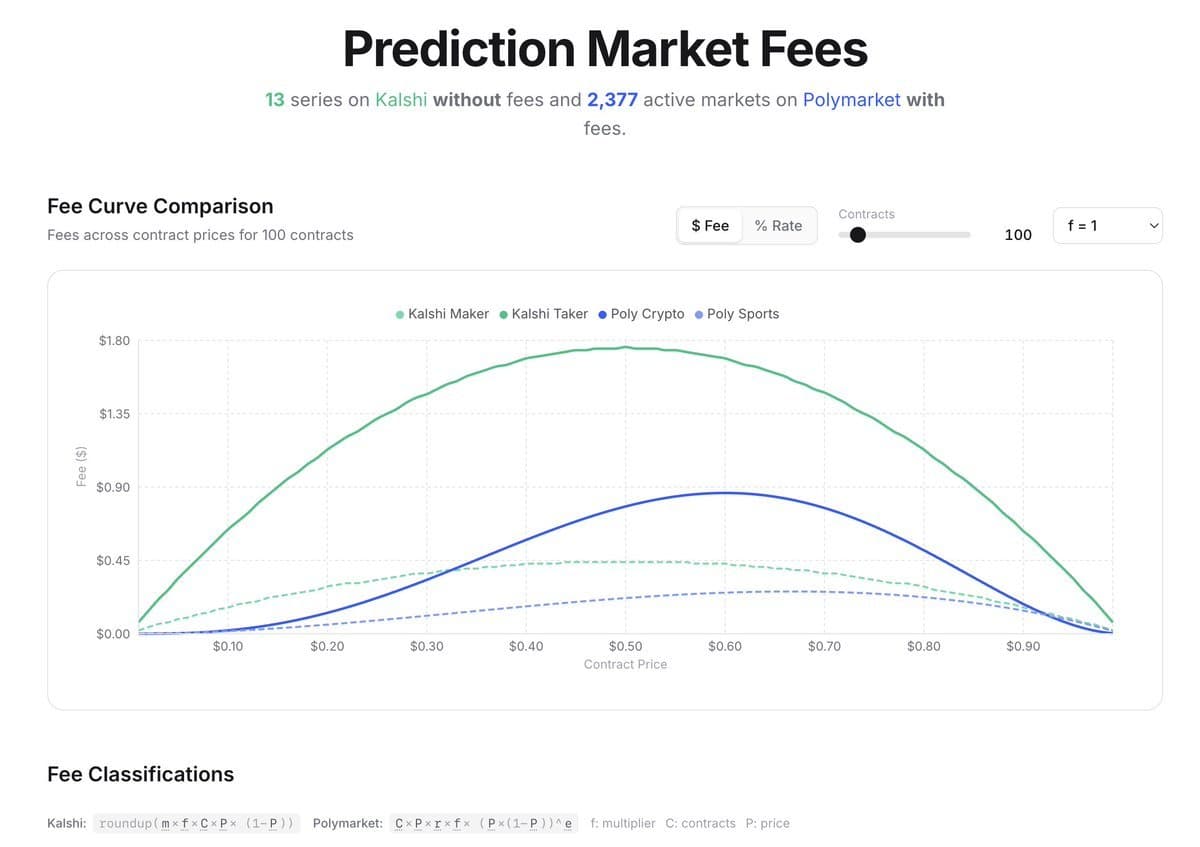
Estimated probability of sustained arbitrage opportunities persisting through Q2 2026: approximately 70%, driven by growing platform fragmentation and uneven liquidity distribution. However, fee structure changes are compressing margins. Polymarket ended its six-year zero-fee policy in January 2026, while Kalshi maintains 13 zero-fee categories with varying fee structures across others. Traders who ignore fee differentials risk turning profitable spreads into losses.
Scenarios and probabilities
- Base scenario (55% probability): Arbitrage opportunities continue but margins compress to 3–8% as more bots enter the market and platforms adjust pricing engines. Profitable execution increasingly depends on speed, capital efficiency, and fee optimization. The $5.3M-per-month returns become outliers rather than the norm.
- Bull scenario (25% probability): New prediction market platforms launch in 2026 (several are in development), fragmenting liquidity further and creating fresh arbitrage windows. Cross-platform aggregation tools mature, enabling retail traders to compete with institutional bots. Monthly arbitrage returns for sophisticated traders stabilize at 15–30%.
- Bear scenario (20% probability): Platforms implement cross-platform API restrictions or shared order books that eliminate pricing gaps. Regulatory action (particularly from the CFTC regarding Polymarket's U.S. access) reduces volume and liquidity. Fee increases across platforms make small-spread arbitrage unviable for most traders.
Impact on prediction markets
The rise of cross-platform arbitrage is fundamentally reshaping prediction market dynamics. Arbitrageurs are de facto market makers — their activity forces prices to converge across platforms, which improves overall market efficiency. But this comes at a cost: retail traders who don't understand fee structures or execution speed are increasingly at a disadvantage.
For LATAM traders specifically, the key insight is that prediction market arbitrage operates differently from crypto exchange arbitrage. Prediction market contracts have binary outcomes and fixed expiration dates, meaning position sizing and timing matter as much as the spread itself. A 22% risk-free return sounds compelling, but it requires capital to be locked until the event resolves — which could be days, weeks, or months.
The emergence of autonomous trading systems — like the bot funds operating simultaneously across Polymarket, Kalshi, Hyperliquid, PumpFun, Meteora, and PancakeSwap — suggests that the next evolution is not just cross-platform arbitrage within prediction markets, but cross-asset-class strategies that combine prediction market positions with crypto derivatives and DeFi protocols.
Risks and what would invalidate this thesis
- Fee erosion: Polymarket's January 2026 fee introduction already compressed margins. Further fee increases or the elimination of Kalshi's zero-fee categories would significantly reduce arbitrage viability. Traders must actively monitor fee structures — tools are now available specifically for comparing costs across platforms.
- Regulatory intervention: The CFTC has increased scrutiny of prediction markets. Restrictions on U.S. access to Polymarket or new regulations on cross-platform trading could reduce volume and close arbitrage windows overnight.
- Market efficiency convergence: As more bots and aggregation platforms enter the space, pricing discrepancies may narrow to the point where only institutional-scale capital can extract meaningful returns. The window for retail arbitrageurs may be measured in months, not years.
- Smart contract and platform risk: Polymarket operates on-chain, while Kalshi is a regulated exchange. Bridging capital between these ecosystems introduces settlement risk, withdrawal delays, and potential smart contract vulnerabilities that are not present in single-platform trading.
- Liquidity traps: Apparent arbitrage opportunities on low-liquidity markets may be mirages — the spread looks attractive, but insufficient order book depth means you cannot execute at the quoted price, or your position moves the market against you.
FAQ
How does Polymarket-Kalshi arbitrage work? You buy complementary contracts on the same event across both platforms so that you profit regardless of the outcome. For example, buying "Yes" at $0.64 on Polymarket and "No" at $0.18 on Kalshi costs $0.82 total. Since one contract always pays $1.00, you lock in $0.18 profit per pair, minus fees.
Can retail traders realistically profit from prediction market arbitrage? Yes, but margins are compressing. The key factors are capital size (you need enough to make small percentage returns worthwhile), fee awareness (Polymarket now charges fees; Kalshi varies by category), and speed (manual execution works on slow-moving markets, but HFT bots dominate fast-moving ones).
Is prediction market arbitrage legal for LATAM traders? Polymarket is accessible globally (it operates on Polygon blockchain), and Kalshi is a CFTC-regulated U.S. exchange with certain access restrictions. LATAM traders should verify local regulations regarding event contracts and online trading platforms. The legal landscape varies significantly by country.
Sources
Track markets like this in real time on Predik.