Ecuador-Colombia Trade War: Noboa's Tariffs Hit 50% as Bilateral Commerce Unravels in 2026
Ecuador escalated its trade war with Colombia in February 2026, raising tariffs from 30% to 50% on Colombian imports. President Daniel Noboa justified the move on security grounds, but the impact is hammering exporters, truckers, and border communities in both countries. With over a dozen sectors affected and 600-meter truck queues at the border, this is a live case for prediction markets: will the conflict escalate further or will diplomatic pressure force a deal?
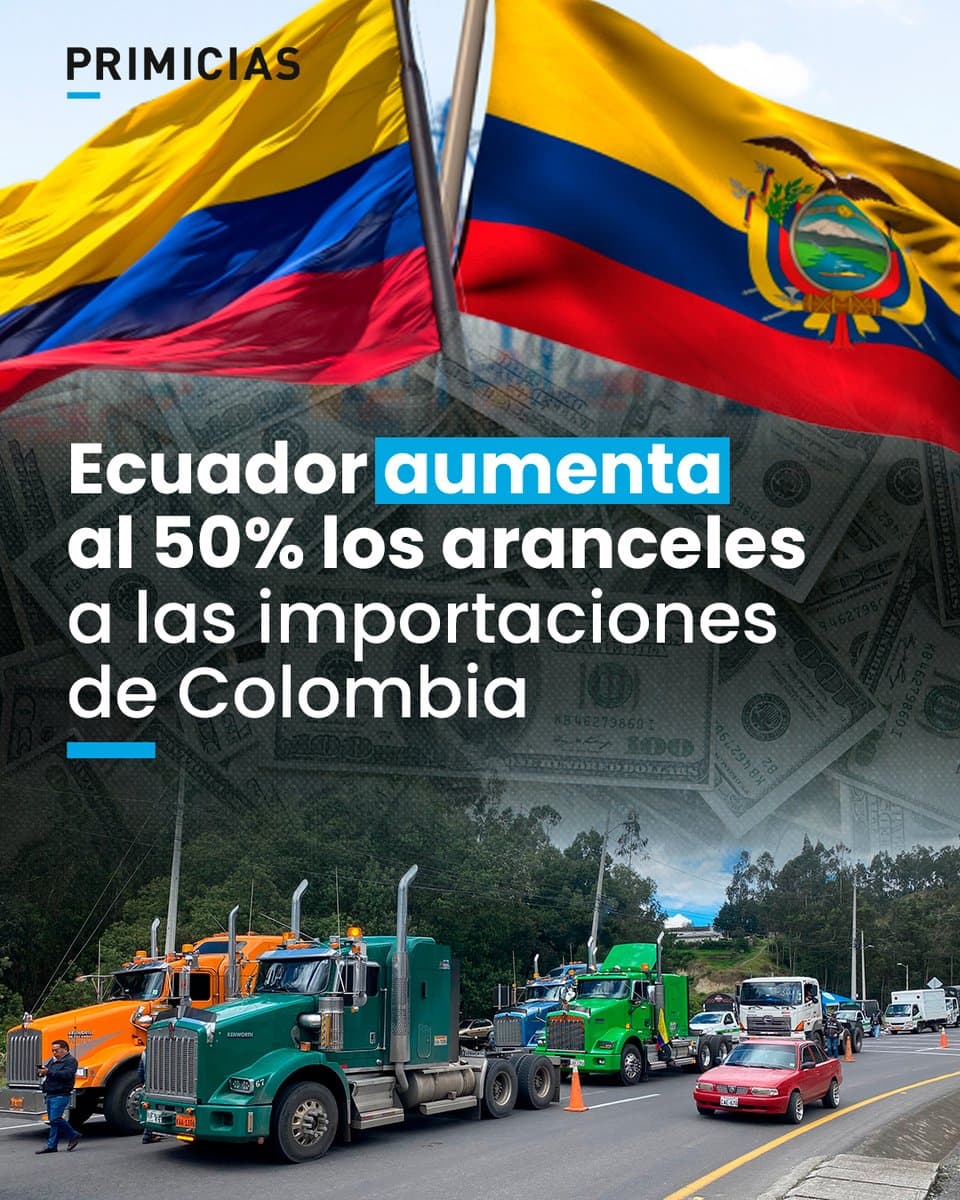
Ecuador-Colombia Trade War: Noboa Raises Tariffs to 50% and Shakes Bilateral Commerce
Ecuador's President Daniel Noboa escalated the trade war with Colombia in February 2026, hiking tariffs on Colombian imports from 30% to 50%. The move, officially tied to security concerns, has disrupted bilateral trade worth billions of dollars, impacted over a dozen economic sectors, and sparked protests from Ecuadorian border communities demanding the tariffs be repealed.
For LATAM prediction market traders, this is a textbook geopolitical scenario with measurable outcomes: will the tariffs hold, escalate, or be negotiated down? The timeline is compressed, the stakes are high for both economies, and the political incentives on each side are diverging fast.
What happened and why it matters
The Ecuador-Colombia trade war began in late January 2026 when Ecuador imposed a 30% tariff on Colombian imports, citing Colombia's failure to implement "concrete and effective security measures." By January 31, trucks were already piling up at the border in lines stretching 600 meters as the deadline approached.
On February 26, 2026, the Ecuadorian government announced a dramatic escalation: tariffs would jump from 30% to 50%. The justification remained security-focused, but the real-world impact landed squarely on commerce. More than a dozen sectors were hit, from agriculture to industrial goods, raising costs for Ecuadorian businesses that depend on Colombian inputs.
Colombia responded with its own retaliatory tariffs, making this a mutual trade war — an unusual and damaging scenario between two countries that had long been major trading partners. Colombian President Gustavo Petro pushed back, arguing that "cocaine exports are increasingly Ecuadorian" and offering to help Ecuador control its own ports. Meanwhile, the U.S. and Ecuador launched a joint military operation near the Colombian border on March 7, bombing a drug trafficker camp — adding a hard security dimension to the economic conflict.
On the ground, the impact is visceral. Transporters in Ecuador's Carchi province — the border region most affected — marched in early March demanding the government repeal the tariffs and associated security fees that are choking cross-border commerce. Ecuadorian business owners have publicly pleaded: "Don't apply the 50% levy, we are suffering."
What prediction markets are saying
As of early March 2026, no major prediction market platform has a dedicated contract specifically on the Ecuador-Colombia tariff dispute. However, broader LATAM geopolitical risk contracts on platforms like Polymarket and Kalshi have seen increased activity. Based on the current trajectory — escalation without active negotiation channels — estimated implied probabilities for key outcomes are as follows (estimated, not from a live contract):
- Tariffs remain at or above 50% through Q2 2026: ~55%
- Formal bilateral trade negotiation launched before June 2026: ~35%
- Tariffs reduced below 30% before June 2026: ~15%
These estimates reflect the political incentives at play: Noboa faces elections and is leaning into a security-hawk posture, making a quick reversal politically costly.
Scenarios and probabilities
- Base scenario (55% estimated): Tariffs remain elevated at 40-50% through mid-2026. Both countries absorb economic damage but neither side blinks. Border trade slows significantly, and affected sectors adapt by seeking alternative suppliers. Diplomatic channels remain cold but neither side escalates to a full trade embargo.
- Bull scenario (20% estimated): International pressure — possibly from the U.S., the Andean Community, or direct business lobbying — forces both sides to the negotiating table before Q2 2026. Tariffs are reduced to 10-15%, and a joint security framework is announced to give Noboa political cover. Cross-border commerce recovers rapidly.
- Bear scenario (25% estimated): The conflict escalates beyond tariffs. Colombia retaliates with additional trade restrictions, diplomatic relations deteriorate further, and the military dimension (joint U.S.-Ecuador operations near the border) strains the relationship to a breaking point. Colombia's absence from the Shield of the Americas Summit in Doral (March 7) alongside Brazil and Mexico signals deeper regional fractures. Trade between the two countries drops by 50%+ from 2025 levels.
Impact on prediction markets
This dispute is a strong candidate for new prediction market contracts on platforms like Predik. The key tradeable questions include: Will Ecuador reduce tariffs below 30% before a specific date? Will Colombia impose additional retaliatory measures? Will bilateral trade volume recover to 2025 levels by year-end?
For traders, the critical signal to watch is whether formal negotiations are announced. Any credible diplomatic engagement would likely cause a sharp repricing of resolution probability upward. Conversely, if Noboa continues to mirror Trump-style trade brinkmanship — as critics have noted, he has adopted a pattern of mimicking U.S. policy moves — the conflict could become entrenched, making "no resolution" the dominant bet.
The U.S.-Ecuador joint military action near the Colombian border adds a wildcard: it could either pressure Colombia to cooperate on security (de-escalating the trade rationale) or further inflame tensions. Traders should price in this ambiguity.
Risks and what would invalidate this thesis
- Sudden diplomatic breakthrough: A back-channel deal or third-party mediation (e.g., from the U.S. or Andean Community) could rapidly de-escalate the situation, invalidating the base-case stalemate scenario.
- Ecuadorian domestic political shift: If the economic pain — particularly from border province protests and business sector pressure — becomes politically untenable for Noboa ahead of elections, he may reverse course faster than expected.
- Escalation beyond trade: If the dispute spills into diplomatic expulsions, border closures, or military incidents, it would move outside the scope of a trade war analysis and into a broader geopolitical crisis with different probability distributions.
- External shock: A broader global trade disruption (e.g., further U.S. tariff escalation affecting LATAM supply chains) could either overshadow or compound the bilateral dispute in unpredictable ways.
FAQ
What tariffs has Ecuador imposed on Colombian imports? Ecuador initially imposed a 30% tariff in late January 2026, then raised it to 50% on February 26, 2026, citing Colombia's failure to take adequate security measures against drug trafficking.
How is the Ecuador-Colombia trade war affecting border communities? Trucks have backed up in 600-meter queues at the border. Transporters in Carchi province have marched demanding the government repeal tariffs and security fees. Ecuadorian businesses in affected sectors are publicly calling for relief from the 50% levy.
Is this trade war related to drug trafficking? Officially, yes — Ecuador framed the tariffs as a response to Colombia's insufficient security measures. However, critics argue the move is more of a political distraction, noting that Noboa's approach mirrors Trump-style tariff tactics rather than addressing narcotrafficking through targeted security cooperation.
Sources
- Mónica Palacios Z. — Political analysis on X
- Primicias — Ecuador tariff escalation report
- EFE Noticias — Colombia-Ecuador trade war coverage
- AP Noticias — Ecuadorian business impact report
- Detroit News — U.S.-Ecuador joint military operation
Track markets like this in real time on Predik.