Insider Trading on Polymarket: How One Account Made $515,000 Betting on the U.S. Strike Against Iran
A Polymarket account called 'Magamyman' earned $515,000 in a single day by betting on the U.S. military strike against Iran, placing the first trade 71 minutes before the news went public. The market showed only a 17% probability at the time of purchase. Additionally, six anonymous wallets collectively profited $1.2 million from the same event. This case reignites the debate over insider trading in prediction markets and whether regulators like the CFTC will step in to oversee these platforms.
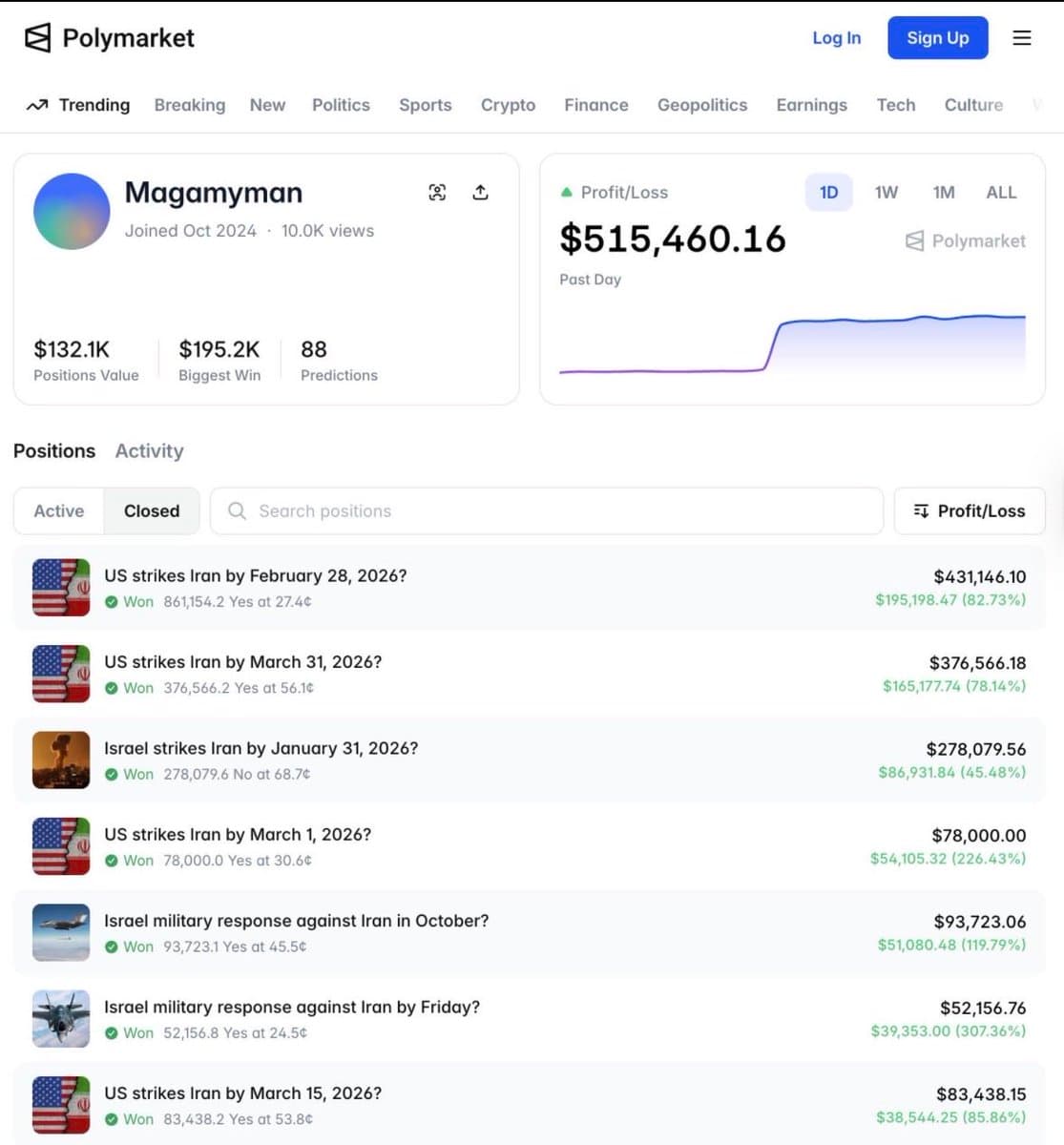
Insider Trading on Polymarket: The $515,000 Bet Placed Before the Iran Strike
A Polymarket user operating under the handle 'Magamyman' made $515,000 in a single day by betting on the U.S. military strike against Iran, with the first trade executed 71 minutes before the news became public. The market priced the event at just 17% probability when the position was opened.
This case has sent shockwaves through the prediction market ecosystem, particularly among LATAM and crypto-native traders who rely on these platforms for transparent, decentralized forecasting. Beyond Magamyman, six recently created anonymous wallets collectively earned $1.2 million betting on the same event hours before it happened — raising serious questions about information asymmetry and market integrity on blockchain-based prediction platforms.
What happened and why it matters
On February 28, 2026, the United States launched military strikes against Iran in what was dubbed Operation Epic Fury. On Polymarket, the leading crypto prediction market, the probability of a U.S. strike on Iran sat at roughly 17% when the account 'Magamyman' began aggressively buying YES shares. The first trade was placed at approximately 71 minutes before any mainstream media outlet reported the strikes.
Magamyman's single-day profit: $515,000. But the account's track record extends further. Prior to this event, Magamyman had already accumulated roughly $278,000 in profits by correctly predicting Israel's strikes on Iran, and had an active $64,000 position on a possible U.S. action against Iran — placed weeks in advance when the payout odds were extremely favorable.
The pattern is striking: Magamyman has specialized in Middle Eastern geopolitical events, previously nailing the exact ceasefire date between Israel and other parties. The account has been active on Polymarket since 2024, but its most profitable trades cluster around highly sensitive military events.
Separately, six anonymous wallets — all recently created — placed large bets on the same outcome hours before the strike and collectively walked away with $1.2 million. The combination of new accounts, precise timing, and outsized profits has triggered widespread suspicion of insider trading.
U.S. Representative Mike Levin has publicly raised questions about the case, asking who had advance knowledge and whether existing regulatory frameworks can address this type of activity on decentralized platforms.
What prediction markets are saying
Before the strike, Polymarket's "Will the U.S. strike Iran?" contract traded at approximately 17% probability. Within hours it surged to 100% as the event was confirmed. The speed of the move — and the concentration of buying just before it — is what distinguishes this from normal market activity.
On broader regulatory markets, the estimated probability that the CFTC will open a formal investigation into insider trading on prediction platforms by Q3 2026 is around 35-40% (estimated based on current political momentum and congressional attention). The probability that Polymarket specifically faces regulatory action or enforcement in 2026 is estimated at 25-30%.
On Predik and similar platforms, traders are now pricing in increased regulatory risk for the entire prediction market sector, which could affect liquidity and market structure going forward.
Scenarios and probabilities
- Base scenario (50-55%): The CFTC and congressional committees investigate the incident, issue statements, and possibly subpoena Polymarket for wallet data and KYC records. Polymarket implements stricter monitoring for unusual trading patterns but continues operating. The prediction market sector faces heightened scrutiny but no existential regulatory threat in 2026.
- Bull scenario (20-25%): Investigations reveal the trades were based on sophisticated open-source intelligence (OSINT) analysis rather than privileged information. Magamyman's track record is explained by genuine geopolitical expertise. The incident actually validates prediction markets as effective information aggregation tools, boosting adoption and legitimacy.
- Bear scenario (20-25%): Evidence links the trading accounts to individuals with direct access to classified military planning. Congress uses the case to push for aggressive regulation of crypto-based prediction markets, potentially forcing platforms to implement pre-trade surveillance, position limits, or even restricting certain geopolitical contracts entirely. This could significantly limit the scope and appeal of prediction markets.
Impact on insider trading in prediction markets
This incident exposes a fundamental tension in prediction markets: their value comes from aggregating all available information — including information that some participants may have before others. In traditional financial markets, insider trading laws clearly prohibit trading on material non-public information. But prediction markets, especially decentralized ones built on blockchain, operate in a regulatory gray zone.
For traders, the key risk is interpretation: a market moving sharply before an event might signal insider activity, or it might reflect skilled analysis of public signals (troop movements, diplomatic communications, satellite imagery). Distinguishing between the two is extremely difficult, and this ambiguity creates both opportunity and danger for retail participants.
The fact that Magamyman had been building positions in Iran-related markets for weeks — not just minutes — complicates the pure insider trading narrative. Some of the profits came from positions established well in advance at favorable odds, suggesting at least some degree of analytical conviction rather than last-minute tips.
For LATAM traders on platforms like Predik, the takeaway is clear: always consider the possibility that sharp pre-event moves reflect information asymmetry, not just market sentiment. Position sizing and risk management matter more than ever in geopolitical contracts.
Risks and what would invalidate this thesis
- If blockchain forensics reveal that the wallets are linked to known political figures or government insiders, the regulatory response could be far more severe and faster than the base scenario suggests.
- Speculation linking the account to members of the Trump family (based on the 'Magamyman' username and alleged wallet connections) remains unverified. If confirmed, it would escalate the situation into a major political scandal beyond just market regulation.
- If the CFTC determines it lacks jurisdiction over blockchain-based prediction markets, enforcement could stall entirely, leaving the status quo intact but eroding public trust in market fairness.
- A broader geopolitical escalation in the Middle East could overshadow the insider trading debate entirely, shifting regulatory attention to national security concerns instead.
FAQ
How much did Magamyman make from the Iran strike bet? Approximately $515,000 in a single day, with the first trade placed 71 minutes before the news broke publicly. The market was at 17% probability at the time of entry.
Were other accounts involved in suspicious pre-strike trading? Yes. Six recently created anonymous wallets collectively earned $1.2 million by betting on the U.S. strike against Iran hours before it was publicly announced.
Can the CFTC regulate prediction markets like Polymarket? The CFTC has existing authority over event contracts and has previously taken action against prediction market platforms. However, enforcing insider trading rules on decentralized, blockchain-based platforms operating with pseudonymous accounts presents significant jurisdictional and technical challenges.
Sources
Track markets like this in real time on Predik.