Meta Shuts Down the Metaverse After $80 Billion: How Prediction Markets Called the Collapse
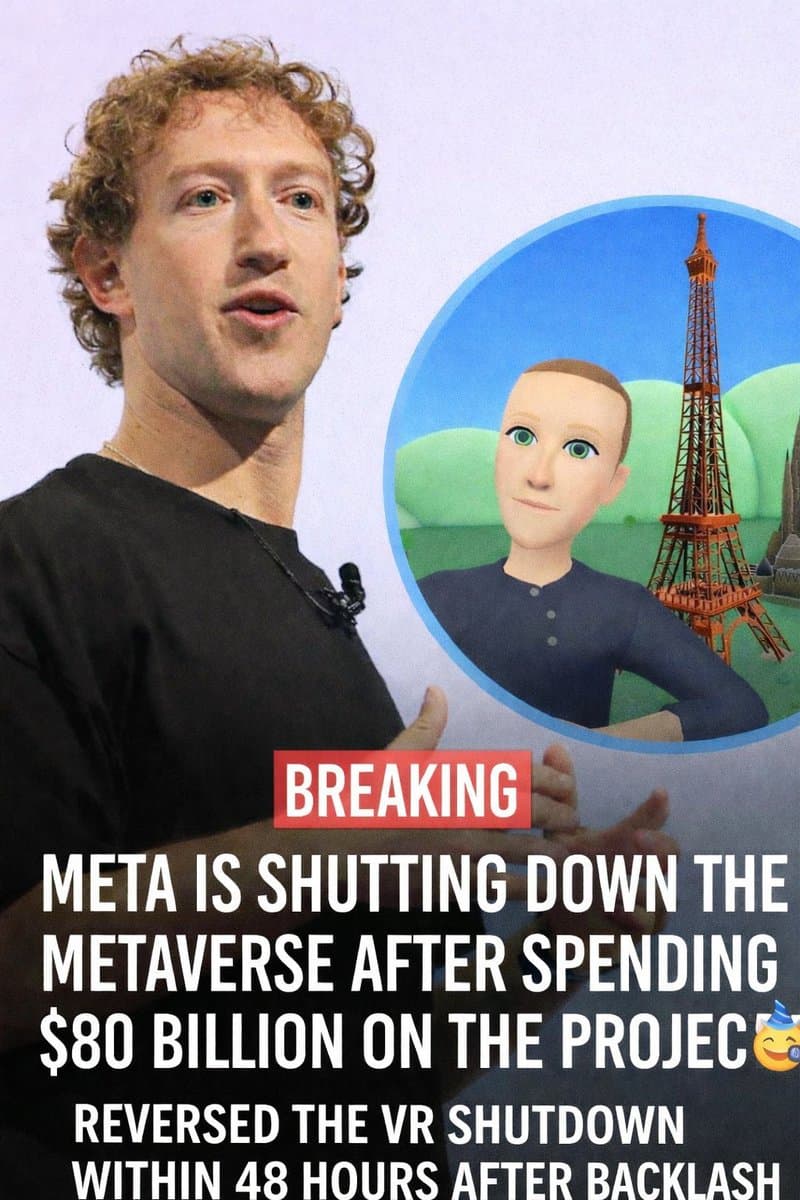
Meta is pulling the plug on its flagship metaverse project after burning nearly $80 billion through Reality Labs since 2020. Horizon Worlds will lose VR access on Quest headsets by June 2026 as the company pivots hard toward AI and wearables. Prediction markets had been pricing in this outcome for months — here is what traders saw, what it means for big tech bets, and what new markets are opening around Meta's future.
Meta Shuts Down the Metaverse After $80 Billion: What Prediction Markets Are Saying
Meta is effectively ending its metaverse experiment after investing approximately $80 billion through Reality Labs since 2020, making it one of the largest destructions of corporate capital in tech history. Horizon Worlds, Meta's flagship virtual world, will lose VR access on Quest headsets by June 15, 2026, with removal from the Quest Store beginning March 31. The company is now pivoting aggressively toward AI and wearables.
For LATAM traders and prediction market participants, this represents a landmark case study in how speculative markets can price in corporate failure before official announcements. Platforms like Polymarket saw viral engagement around the Meta metaverse collapse — one post alone garnered over 12,900 likes — and traders who positioned early against the metaverse thesis have been vindicated. The question now is what new markets emerge around Meta's AI pivot and whether the company can recover the lost decade.
What happened and why it matters
In March 2026, reports emerged that Meta would end VR access to Horizon Worlds on Quest headsets, effectively gutting the core of its metaverse vision. The timeline: removal from the Quest Store by March 31, 2026, and full shutdown of VR access by June 15, 2026. The app is shifting to a mobile-only model — a far cry from the immersive virtual world Zuckerberg pitched when he renamed Facebook to Meta in October 2021.
The financial toll is staggering. Reality Labs has accumulated roughly $80 billion in operating losses since 2020: approximately $6.6 billion in 2020, $10.2 billion in 2021, $13.7 billion in 2022, $16.1 billion in 2023, and continued multi-billion-dollar quarterly burns through 2024 and 2025. For context, that $80 billion could have purchased over 1.1 million Bitcoin at current prices — an investment that would have delivered dramatically better returns.
Horizon Worlds peaked at just 200,000 monthly active users. Compare that to Roblox, which consistently hits 100 million daily active users. The product-market fit was never there. Even Meta's internal culture reflected the problem: the company recently shut down an internal AI token leaderboard called "Claudeonomics" after employees were gaming the system for badges, burning millions in the process.
It is important to note that Meta has framed this as a strategic pivot rather than a full shutdown. Some analysts and fact-checkers have pushed back on the "shutdown" narrative, arguing that Meta is restructuring Reality Labs around mixed reality hardware, AI-powered wearables like Ray-Ban Meta smart glasses, and mobile experiences rather than abandoning the space entirely. At one point, Meta appeared to reverse its shutdown decision within 48 hours before settling on the current VR wind-down plan. Regardless of the framing, the original vision of an immersive, VR-first metaverse is effectively dead.
What prediction markets are saying about Meta's metaverse shutdown
Polymarket became a focal point for the Meta metaverse narrative. The platform's posts about the $80 billion shutdown went viral, and community sentiment overwhelmingly priced in failure well before the formal VR wind-down was announced. Crypto-native traders on the platform — many of whom had been skeptical of the metaverse thesis since 2022 — found vindication as Meta shifted its messaging from virtual worlds to artificial intelligence.
The crypto community itself has tracked the metaverse's decline through a now-famous timeline of hype cycles: NFTs dominated 2021, the metaverse was the narrative in 2022, GameFi in 2023, memecoins in 2024, InfoFi in 2025, and "shutdown" became the darkly humorous meta-narrative for 2026. Prediction market traders who followed these shifting narratives were better positioned to anticipate Meta's retreat.
Community members are now actively calling for new prediction markets on Polymarket around Meta's next strategic moves — including whether the company will fully exit Reality Labs, how its AI pivot will impact the stock price (which was already trading under pressure after the ticker changed from $FB to $META), and whether decentralized metaverse alternatives like Otherside and Upland will capture the users Meta could not.
Scenarios and probabilities
- Base scenario (estimated 55% probability): Meta completes the VR wind-down by June 2026 and restructures Reality Labs around AI wearables and mixed reality hardware. Losses from Reality Labs decrease but remain in the $8-12 billion annual range as the company searches for product-market fit in AI-powered devices. META stock stabilizes but underperforms the Nasdaq for 12-18 months.
- Bull scenario (estimated 20% probability): Meta's AI pivot accelerates faster than expected. Ray-Ban Meta smart glasses and a new AI wearable device gain mainstream adoption, and Reality Labs becomes a viable business unit by 2028. The metaverse losses are reframed as R&D investment in spatial computing infrastructure that feeds into successful AI products. META stock recovers to new highs.
- Bear scenario (estimated 25% probability): The AI pivot fails to differentiate Meta from competitors like Apple, Google, and OpenAI. Reality Labs continues burning $15+ billion annually with no clear path to profitability. Shareholder pressure mounts, and there are calls to spin off or fully shut down Reality Labs. The metaverse shutdown becomes a broader narrative about Zuckerberg's strategic misjudgment that weighs on the company's valuation for years.
Impact on prediction markets
The Meta metaverse collapse is one of the highest-profile events to be actively tracked and debated on prediction markets in 2026. For platforms like Predik and Polymarket, it demonstrates the power of crowd-sourced probability estimation: traders were pricing in metaverse failure long before corporate announcements caught up. This creates a feedback loop where prediction market signals themselves become leading indicators for traditional financial analysts.
For LATAM traders specifically, this event highlights the growing importance of prediction markets as an information tool — not just a speculative vehicle. When legacy media was still debating whether the metaverse would succeed, prediction market odds were already shifting decisively toward failure. The lesson: watching how probabilities move on platforms like Predik can provide an informational edge over traditional news cycles.
New prediction markets are likely to emerge around Meta's AI timeline, Reality Labs restructuring milestones, and whether competing metaverse projects (decentralized alternatives built on Web3 infrastructure) can succeed where Meta failed. These markets represent fresh opportunities for traders who understand both the technology and the corporate dynamics at play.
Risks and what would invalidate this thesis
- The "pivot" is genuine and succeeds: If Meta's shift to mobile-based metaverse experiences and AI wearables gains unexpected traction, the VR shutdown could be reframed as smart capital reallocation rather than failure. This would invalidate bearish prediction market positions.
- Narrative vs. reality divergence: Some fact-checkers have flagged that the "full shutdown" narrative may be overstated. If Meta announces reinvestment in VR or a new metaverse product, traders who assumed a permanent exit could be caught off guard.
- Regulatory or antitrust actions: Government intervention — either forcing Meta to divest Reality Labs or blocking its AI expansion — could change the trajectory in ways not captured by current prediction market probabilities.
- Competing metaverse breakthroughs: If Apple Vision Pro or a decentralized alternative achieves the user adoption that Horizon Worlds never could, it might reignite Meta's interest in the space and lead to a reversal of the wind-down.
FAQ
Did Meta officially shut down the Metaverse? Meta is ending VR access to Horizon Worlds on Quest headsets by June 15, 2026, and shifting to a mobile-only model. While the company frames this as a pivot rather than a full shutdown, the original VR-first metaverse vision has been effectively abandoned after nearly $80 billion in Reality Labs losses since 2020.
How much did Meta spend on the Metaverse? Reality Labs accumulated approximately $80 billion in operating losses from 2020 through early 2026. This includes spending on VR hardware (Quest headsets), Horizon Worlds software development, and metaverse-related research. At current Bitcoin prices, that amount could have purchased over 1.1 million BTC.
Can you bet on Meta's Metaverse shutdown on prediction markets? Polymarket has featured active discussion and community engagement around the Meta metaverse collapse. Traders and community members are calling for formal prediction markets on Meta's next moves, including Reality Labs restructuring and the company's AI pivot timeline. Platforms like Predik offer real-time tracking of technology and big tech prediction markets relevant to this story.
Sources
- Polymarket — Prediction Markets Platform
- Polymarket on X (Twitter)
- Meta Platforms — Investor Relations (Reality Labs Financials)
Track markets like this in real time on Predik.