Polymarket Sports Betting Whales: How Systematic Traders Are Extracting Millions from Prediction Markets in 2026
A Polymarket sports betting whale generated $5.3 million in profit during a single month in early 2026, placing 2,127 systematic bets across five sports with an average daily profit of $178,850. Meanwhile, a Chinese student quietly accumulated $2.85 million while his parents thought he was studying finance. These stories reveal how prediction markets are becoming industrial-scale profit machines for data-driven traders—and what LATAM bettors can learn from their strategies.
Polymarket Sports Betting Whales: How Systematic Traders Are Making Millions in 2026
A single Polymarket sports betting whale generated $5.3 million in profit during one month in early 2026, placing 2,127 bets across five different sports with an average daily profit of $178,850. This is not an outlier—it is part of a growing wave of professional traders turning prediction markets into industrial-scale profit machines.
For LATAM traders and prediction market users on platforms like Predik, these stories are more than headlines. They reveal the structure of opportunity—and risk—in a rapidly maturing market where data-driven strategies are separating professionals from casual bettors at an accelerating pace.
What happened and why it matters
In early March 2026, on-chain data surfaced showing that a top Polymarket trader executed a systematic sports betting operation of unprecedented scale. The trader placed 2,127 individual bets across soccer, NBA basketball, and three other major sports, generating $5.3 million in net profit over roughly 30 days. The average position size exceeded $1 million, with heavy concentration in European football clubs and select NBA matchups including teams like the Thunder, Warriors, and Spurs.
Simultaneously, the story of a Chinese university student who accumulated $2.85 million on Polymarket went viral across Spanish-speaking social media, garnering over 7,000 likes. The student reportedly built his fortune while his parents believed he was studying finance—a detail that resonated deeply with the LATAM crypto community.
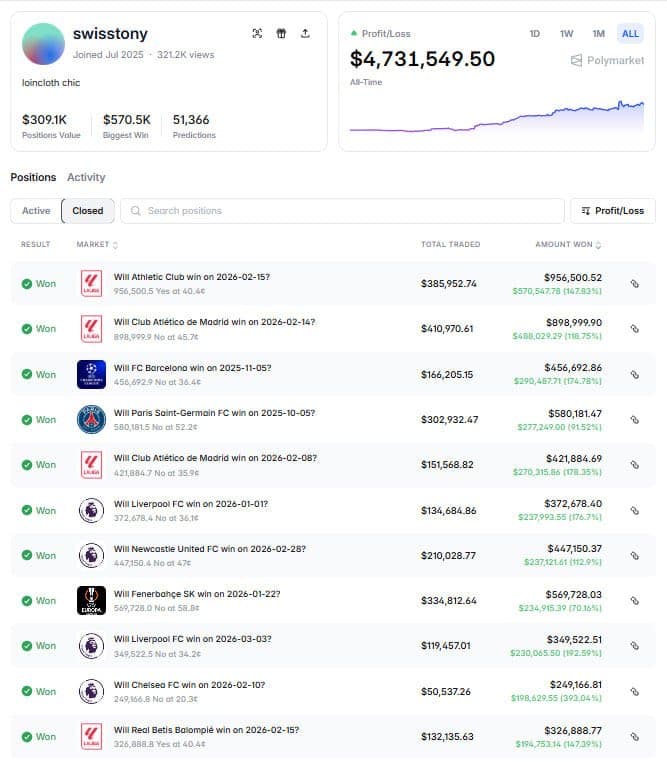
These are not isolated anecdotes. Another trader on Polymarket leaderboards started with just $5 and grew his account to $4.7 million in profit over approximately five months, making 50,807 predictions with $22.6 million in total volume—ranking among the platform's top-10 all-time earners. A separate trader accumulated $47 million in volume with $1.9 million in profit. Even a college student who built a sports betting bot reported earning $65,621 by exploiting inefficiencies after migrating from traditional sportsbooks to Polymarket's limitless structure.
What prediction markets are saying
Polymarket's sports markets have exploded in volume throughout early 2026. The platform's partnership with Palantir and TWG AI, announced in March 2026, signals institutional-level commitment to market integrity using AI-powered tools (Palantir's Vergence AI) to detect manipulation and insider activity in real time.
On-chain data shows that the top 20 Polymarket sports bettors now control a disproportionate share of volume. The trader ranked #20 on the leaderboard has generated $109,874 in all-time profit from $785,000 in volume—a 14% return that dwarfs traditional sports betting margins. The trader ranked #31 shows $26,159 in profit. The concentration of whale activity in soccer and basketball markets suggests these are the most liquid and exploitable categories.
Estimated probability that professional whale activity in Polymarket sports markets continues growing through 2026: approximately 85%, based on platform growth trends and the absence of position limits.
Scenarios and probabilities
- Base scenario (60% probability): Polymarket sports betting volume doubles by year-end 2026 as more sophisticated traders enter. Whale dominance creates a two-tier market where casual bettors face increasingly efficient odds, compressing margins for retail participants. Platforms like Predik that provide analytical tools gain adoption among LATAM users seeking an edge.
- Bull scenario (25% probability): Regulatory clarity in key LATAM markets (Brazil, Mexico, Argentina) accelerates on-chain sports betting adoption. Retail traders who adopt systematic strategies early capture outsized returns before market efficiency increases. Polymarket or similar platforms launch localized products for the region.
- Bear scenario (15% probability): Regulatory crackdowns in major jurisdictions force Polymarket to restrict sports markets or implement position limits. Whale profits attract scrutiny from gaming regulators. Liquidity fragments across competing platforms, making large systematic strategies harder to execute.
How Polymarket sports betting whales reshape the market
The emergence of whale-scale traders fundamentally changes prediction market dynamics. When a single trader places $1 million-plus positions on European football matches, they move odds in ways that create both risk and opportunity for smaller participants. These whales are effectively price-setters—their bets encode information that the market absorbs almost instantly.
For LATAM traders on Predik, the key insight is structural: Polymarket's lack of position limits and KYC-light environment creates a playing field where scale advantages compound. Unlike traditional sportsbooks, which limit or ban winning accounts, prediction markets reward consistent edge. This explains why multiple bot-builders and systematic traders have migrated from sportsbooks to Polymarket—on traditional platforms, winners get restricted. On prediction markets, they scale up without limits.
The Palantir partnership adds another dimension: AI-driven integrity monitoring suggests the platform is preparing for institutional-level volumes. The contrarian approach—buying "No" shares when the crowd piles into favorites—has also emerged as a viable retail strategy, as some analysts have observed.
Meanwhile, competing platforms are introducing features like parlay betting across 12+ events spanning politics, crypto, and sports, settling on Arbitrum without KYC. This fragmentation of the prediction market ecosystem could either dilute whale power or create new arbitrage opportunities across platforms.
Risks and what would invalidate this thesis
- Regulatory intervention: If U.S. or international regulators classify prediction market sports betting as gambling, platforms may face licensing requirements, position limits, or outright bans that would eliminate whale strategies. Polymarket's own founder has warned that growing visibility brings "more money, more problems," particularly around sensitive market categories.
- Liquidity traps: Whale-dominated markets can become illiquid when big players exit simultaneously. Retail traders who copy whale strategies without understanding position sizing could face significant losses during liquidity crunches.
- Edge decay: As more sophisticated traders and AI bots enter the market, the inefficiencies that current whales exploit will shrink. The $178,850 daily profit figure is likely unsustainable as competition intensifies—early movers capture disproportionate returns.
- Counterparty and smart contract risk: On-chain betting platforms carry inherent technical risks. Oracle failures, smart contract bugs, or market manipulation could result in unfair resolutions that disproportionately impact large positions.
FAQ
How much did the top Polymarket sports betting whale make? The top trader generated approximately $5.3 million in profit in a single month from 2,127 bets across five sports, with an average daily profit of $178,850 and position sizes exceeding $1 million.
Can retail traders replicate whale strategies on prediction markets? Not at the same scale, but the principles apply: focus on specific sports where you have informational edge, use systematic approaches rather than gut feeling, and manage bankroll rigorously. Platforms like Predik help by providing analytical tools and real-time market data to identify value.
What sports are Polymarket whales betting on most? European football (soccer) dominates whale activity, followed by NBA basketball. Large positions frequently target top European league clubs and NBA franchises like the Thunder, Warriors, and Spurs. Some whales also exploit time-based edges related to live sports broadcasts.
Sources
- Polymarket whale trading data analysis
- Chinese student Polymarket success story
- Polymarket – Prediction Market Platform
Track markets like this in real time on Predik.