Iran-Hormuz Deal: What Prediction Markets Say About an Open Strait and Falling Oil
The White House says the Iran-Hormuz deal is signed on June 14, 2026, reopening the Strait of Hormuz "for everyone" and pressuring oil. Here is what prediction markets price for the signing, what it means for LATAM exporters, and why de-escalation could reignite crypto risk appetite.
Iran-Hormuz deal and the open-strait oil prediction traders are watching
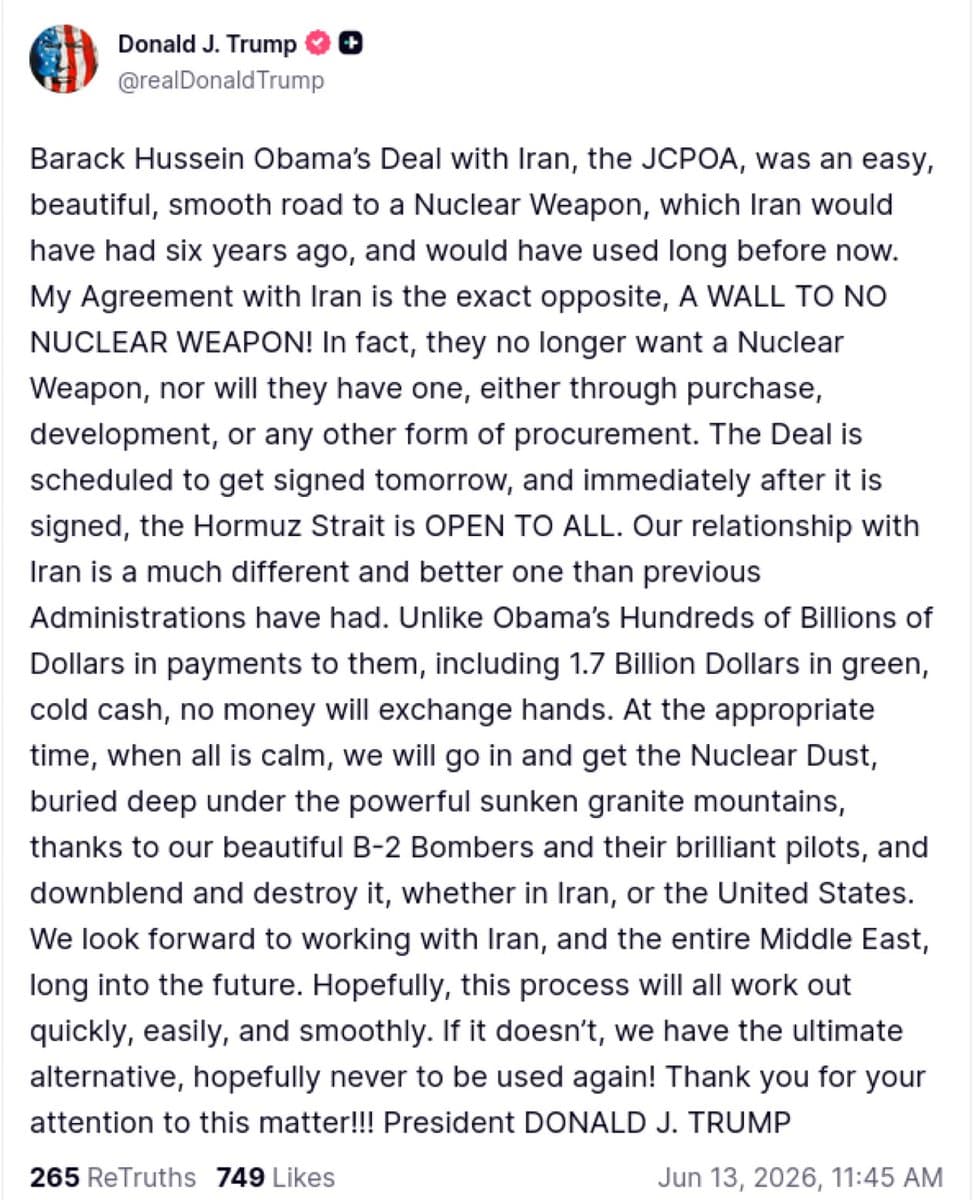
On June 13-14, 2026, the White House announced via Truth Social that a U.S.-Iran deal would be signed on June 14 and that "immediately after signing, the Strait of Hormuz will be OPEN TO ALL." If verified, the Iran-Hormuz deal removes months of war premium from oil — Brent already slid toward $87.5 as the news broke.
For LATAM traders, this matters on two fronts: it directly hits oil-exporting economies (Mexico, Ecuador, Colombia, Venezuela), and a clean de-escalation tends to revive global risk appetite — historically supportive for Bitcoin and the broader crypto complex. The catch: Trump has announced imminent Iran deals before that failed to materialize, so the market's real question is execution risk, not the headline.
What happened and why it matters
President Donald Trump stated the U.S.-Iran agreement was scheduled to be signed on June 14, 2026, and that the Strait of Hormuz would be "open to all" immediately afterward, with a promise to permanently prevent Iran from obtaining a nuclear weapon. Reported terms circulating in regional and pro-government Iranian media include: nuclear material destroyed and removed, the nuclear program dismantled, no funds released until terms are met, the Strait reopened, and Iran barred from financing armed proxy groups. Some accounts also described a broad ceasefire across fronts, including Lebanon.
Context is critical: before late February 2026, the Strait of Hormuz was open and free-transit. One widely shared interpretation warns that a post-deal Strait could be "open" but not free — with vessels potentially paying a transit fee to Iran, which some framed as a partial Iranian win. Meanwhile, CENTCOM reportedly reinforced its naval presence around Hormuz to keep traffic flowing ahead of signing, and there were claims of Iranian one-way attack drones in the area — a reminder that the situation remained fluid up to the deadline. Notably, at least one report cited Iran downplaying or dismissing a Sunday signing, underscoring the gap between announcement and verification.
The price reaction was immediate: Brent crude was reported around $87.5 as the reopening narrative spread, unwinding part of the geopolitical risk premium built up over prior months.
What prediction markets are saying
On the Iran-Hormuz deal, prediction markets like Polymarket and Kalshi are the cleanest gauge of whether the signing actually happens on schedule versus slipping again. As of June 14, 2026, exact contract prices were moving fast, but based on the pattern of prior failed announcements and Iran's reported pushback, an estimated 45%-60% implied probability for a verified signing "this week" is a reasonable read — well below the certainty the headline suggests (all figures estimated, not official market quotes). Crude-price markets, by contrast, were pricing the bearish case more confidently as Brent fell toward the high $80s.
Scenarios and probabilities
- Base scenario: Deal is signed on or near June 14 but with caveats (fees, phased verification); Hormuz reopens with conditions, oil stabilizes in the mid-to-high $80s after the initial drop. Estimated probability: ~50%.
- Bull scenario (for risk assets): Clean, verified de-escalation with free transit restored; war premium fully unwinds, Brent slides toward the low $80s or below, and crypto risk appetite rebounds sharply. Estimated probability: ~25%.
- Bear scenario: Signing slips or collapses (Iran walks, drone incidents escalate, U.S. invokes its "last option"); war premium snaps back, oil spikes, and risk assets sell off. Estimated probability: ~25%.
Impact on prediction markets
Binary "will the deal be signed by [date]" contracts are sensitive to headline whiplash: a single Truth Social post or an Iranian denial can swing implied odds 10-20 points within hours. The interpretation risk is treating an announcement as a settlement — these markets settle on verifiable events, not promises. For crude and crypto-linked markets, watch for over-extrapolation: an open Strait lowers tail risk on oil, but a conditional reopening (transit fees, partial verification) is a softer bearish catalyst than a full free-transit restoration. Separate the headline (signed tomorrow) from the verifiable fact (signed, ratified, and Strait demonstrably open).
Risks and what would invalidate this thesis
- Signing is postponed or canceled — Iran publicly dismissed a Sunday signing, and Trump's prior "imminent" deals have failed before.
- A "conditional" reopening with transit fees or incomplete verification keeps a residual war premium in oil, muting the bearish move.
- Military escalation (drone strikes near Hormuz, a U.S. "last option") reverses de-escalation and spikes oil, hitting risk assets including crypto.
FAQ
Is the Iran-Hormuz deal actually signed? As of June 14, 2026, the White House announced a signing for that date, but verification was pending and Iran had publicly downplayed a Sunday signing. Treat it as announced, not confirmed.
Why is oil falling on the news? A reopened Strait of Hormuz removes months of geopolitical war premium; Brent was reported near $87.5 as the reopening narrative spread.
How could this affect Bitcoin and crypto? A clean de-escalation typically lifts global risk appetite, which has historically supported Bitcoin — though a conditional or failed deal would blunt or reverse that effect.
Sources
Track markets like this in real time on Predik.