The Venezuela-Trump Oil Deal and Prediction Markets: How 65 Billion Barrels Reprice LATAM Political Risk
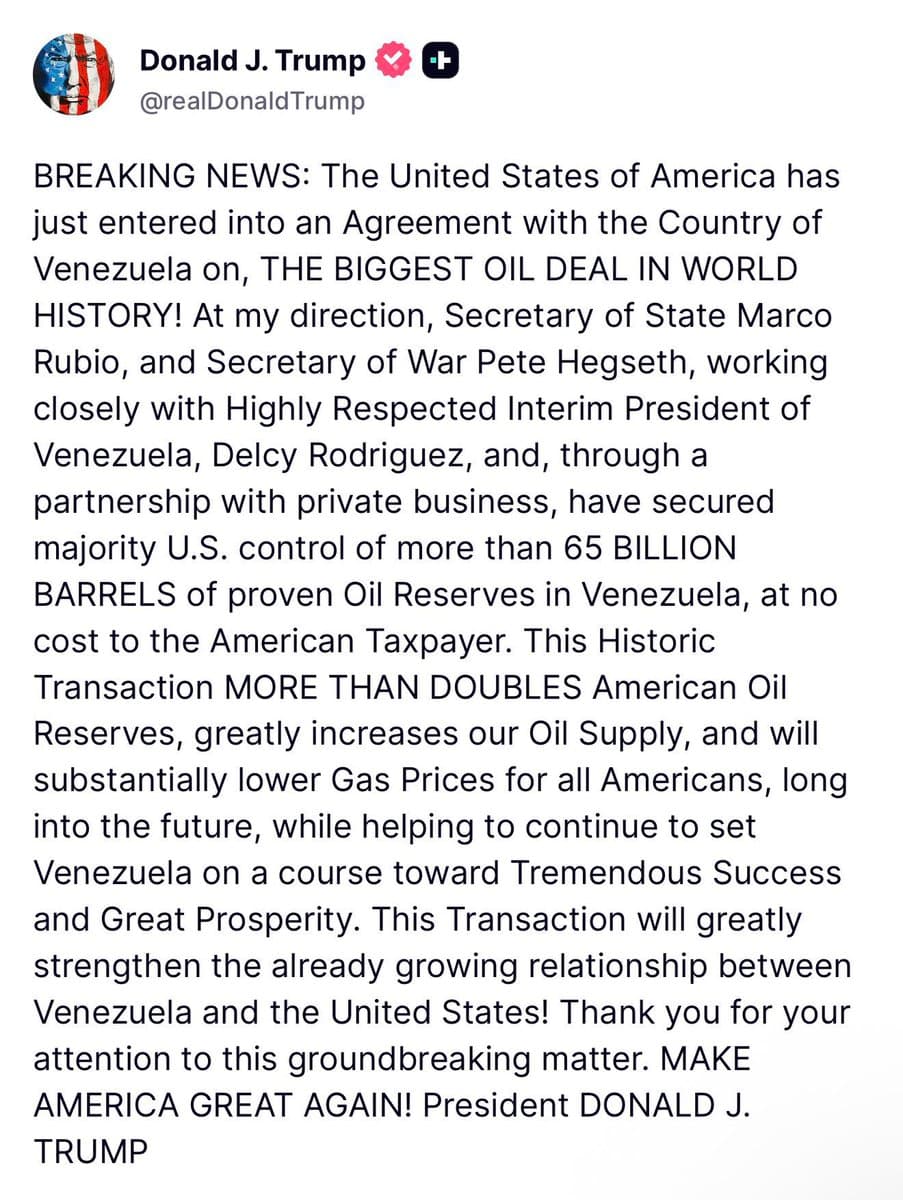
Washington and Caracas announced a deal giving the United States majority control over more than 65 billion barrels of Venezuelan crude — roughly a fifth of the world's largest proven reserves. The headline is oil, but the real trade is geopolitical leverage. Here is how the Venezuela-Trump oil deal is moving prediction markets on regime continuity, sanctions relief and Brent, what the current odds imply, and which contracts reprice first when a producer country's sanctions status changes.
The Venezuela-Trump oil deal and prediction markets: what 65 billion barrels actually buy
On Friday, August 28, 2026, Donald Trump announced what he called "the largest oil deal in world history": U.S. majority control over more than 65 billion barrels of Venezuelan crude, confirmed the same day by Venezuela's acting president Delcy Rodríguez. That volume is roughly 20% of Venezuela's proven reserves — the largest on the planet at around 300 billion barrels. For traders, the Venezuela-Trump oil deal and prediction markets are now the same story: this is not a barrel trade, it is a leverage trade, and it reprices political-risk contracts before it reprices crude.
Why it matters for LATAM: the deal does two things at once. It redirects heavy-crude flows toward U.S. Gulf Coast refineries — the exact configuration Mexican Maya, Colombian Castilla and Ecuadorian Napo currently supply — and it reopens the entire Polymarket and Kalshi complex on Venezuelan regime continuity, sanctions relief and the oil price. When the sanctions status of a producer country changes, the first instruments to move are not futures. They are binary political contracts.
What happened and why it matters
The concrete facts, separated from interpretation:
- August 28, 2026: Trump announces the agreement publicly, framing it as U.S. "majority control" over 65 billion barrels. Secretary of State Marco Rubio is named as the closer, working alongside the U.S. embassy channel in Caracas.
- Same day: Delcy Rodríguez, acting president of Venezuela, confirms the "historic agreement" and publicly thanks Trump — a de facto recognition of the interim arrangement by both sides.
- The reserve math: Venezuela sits on roughly 300 billion barrels of proven reserves but has produced only about 23.5 billion barrels over the past 30 years. The gap between reserves and output is the entire investment case; figures circulating around the deal point to a build-out target near 90 billion barrels of producible crude requiring $100–200 billion in capital.
- The China displacement angle: For years Chinese buyers absorbed discounted Venezuelan barrels under sanctions. U.S. legislators supporting the deal frame it explicitly as recapturing that flow — which is the geopolitical core, not the margin.
- The political fault line: Critics inside and outside Venezuela, including former energy officials, call the arrangement unconstitutional and a transfer of sovereign resources. One U.S. congresswoman who backs the deal has also warned publicly that any agreement with the interim government "has an expiration date: the day Trump leaves the White House." That single sentence is the most tradable statement in the entire news cycle.
Interpretation, flagged as such: a deal signed with an interim executive rather than ratified through Venezuelan institutions carries reversal risk that no barrel count offsets. Markets should price the counterparty, not the reserve.
What prediction markets are saying about the Venezuela-Trump oil deal
Treat every number in this section as an estimate derived from the news flow and typical repricing behavior after a sanctions-status shock — verify live before sizing anything.
- Nicolás Maduro out of power through year-end 2026: estimated 80–90%. The framing has already shifted; markets are no longer trading "will he go" but "what replaces the interim arrangement." The residual probability is not restoration — it is disorder.
- Formal, broad U.S. sanctions relief on Venezuelan oil codified by December 31, 2026: estimated 55–65%. An announced deal and a published general license are different events, and the gap between them is where contracts stay mispriced longest.
- Venezuelan crude output above 1.5 million barrels per day by end-2027: estimated 20–30%. Capital commitments of $100–200 billion are multi-year; drilling does not respond to press conferences.
- Brent settling below $60 at any point in Q4 2026: estimated 25–35%. Venezuelan barrels are heavy and sour, and Gulf Coast refining capacity for that grade is finite — the bearish crude impulse is real but bounded.
- Deal materially unwound or renegotiated within 24 months: estimated 35–45%, driven almost entirely by the U.S. electoral calendar and Venezuelan constitutional challenges.
The structural read: political contracts on Polymarket and Kalshi repriced within hours of the announcement, while physical-flow and production contracts barely moved. That divergence is the signal. Announcement risk is priced instantly; execution risk is priced slowly.
Scenarios and probabilities
- Base scenario (≈55%): Managed transition, slow barrels. The agreement holds on paper through 2026. Licenses are issued selectively, a handful of U.S. majors and service companies re-enter, and Venezuelan output rises modestly — call it 200,000–400,000 barrels per day of incremental supply within 18 months. Regime-continuity contracts stay pinned near their post-announcement levels; sanctions-relief contracts grind upward as licenses publish. Brent impact: minimal, under $3.
- Bull scenario (≈20%): Full normalization. Broad sanctions relief is codified, capital commitments in the $100–200 billion range get concrete anchor investors, and Venezuela credibly targets recovery toward historical output. Heavy-crude discounts to Maya narrow the arbitrage window for Mexican and Colombian exporters, U.S. Gulf refiners lock in multi-year offtake, and "sanctions lifted by 2027" contracts settle YES well before deadline. Risk premium in LATAM sovereign spreads compresses beyond Venezuela.
- Bear scenario (≈25%): Constitutional reversal or political expiry. Venezuelan legal challenges, an internal power fracture, or a change in U.S. administration voids the arrangement. Prediction markets whipsaw hardest here because the announcement premium has to be fully unwound — political contracts can retrace 30–50 points in days. Crude gets a modest bid on lost supply expectations, and LATAM geopolitical-risk contracts broaden to neighboring jurisdictions.
Impact on prediction markets
Sanctions-status changes create a specific, repeatable pattern worth internalizing:
First hours: binary regime and sanctions contracts gap. Liquidity is thin, spreads widen, and headline-driven fills happen at prices that do not survive the week. This is where retail gets run over.
First week: the market separates "announced" from "implemented." Contracts referencing an official document — a general license number, a Federal Register publication, a signed decree — decouple from contracts referencing a press statement. Read resolution criteria obsessively; two markets with near-identical titles can settle on opposite facts.
First quarter: physical reality asserts itself. Production data, tanker tracking and refinery run rates either confirm the thesis or quietly kill it, and the slow drift in output-linked contracts is where the actual edge sits for anyone willing to do the unglamorous work.
The main interpretation risk: conflating a political headline with a supply event. Venezuelan reserves are enormous, but reserves are not production, production is not exports, and exports of heavy sour crude are not fungible with the light sweet barrels that set the Brent benchmark. A market pricing "U.S. controls 65 billion barrels" as a bearish oil shock is pricing a geology fact as a logistics fact.
Risks and what would invalidate this thesis
- Political expiration risk. An agreement signed with an interim executive and tied to one U.S. administration can be reversed by either side. If Venezuelan courts or a successor U.S. government void it, every probability above shifts materially toward the bear case.
- Reserves-to-barrels gap. Producing 90 billion barrels requires $100–200 billion of capital, functioning infrastructure and decades. Venezuela produced only ~23.5 billion barrels in 30 years with a national oil company that has since deteriorated. Any thesis assuming fast output recovery is assuming away the hardest part.
- Resolution-criteria risk. "Sanctions lifted" can mean a specific license, a full policy reversal, or an executive statement. Prediction market losses in geopolitical events come more often from misread resolution language than from misread politics.
- Displacement backlash in LATAM. If Venezuelan heavy crude re-enters Gulf Coast refineries at scale, Mexico, Colombia and Ecuador lose share. Policy responses from those producers are a second-order variable most models ignore entirely.
- Liquidity risk. Venezuela-linked contracts are thin. A position that looks right can still be unexitable during the exact volatility window you were trading.
FAQ
What exactly did the United States and Venezuela agree to? Announced August 28, 2026, the agreement gives the U.S. what Trump described as majority control over more than 65 billion barrels of Venezuelan crude — around 20% of Venezuela's proven reserves. Acting president Delcy Rodríguez confirmed it the same day. Full implementing documents and licensing terms had not been published as of writing.
Does this deal lower oil prices? Not quickly. Venezuela holds roughly 300 billion barrels in proven reserves but produced only about 23.5 billion over the past 30 years. Converting reserves into flowing barrels needs an estimated $100–200 billion and years of work, so the near-term Brent effect is a sentiment effect, not a supply effect.
Which prediction market contracts move most on news like this? Binary political contracts — regime continuity, sanctions relief by a set date, and leadership-exit markets — reprice within hours on Polymarket and Kalshi. Production and price-level contracts move far more slowly because they depend on verifiable physical data rather than announcements.
How does this affect Mexico, Colombia and Ecuador? All three export heavy or medium-sour crude into U.S. Gulf Coast refineries. Returning Venezuelan barrels compete directly for that same refining slate, which pressures differentials before it pressures headline benchmarks.
Sources
Track markets like this in real time on Predik.