Claude-Built Quant Bot Nets a Polymarket Trader $218,425 in 64 Days
A viral Spanish-language thread spotlighted a trader who used Claude to build a quant bot that booked +$218,425 on Polymarket — roughly $3,413 a day across 48,018 predictions at a 52% win rate. We break down why a 52% win rate can still be profitable, the real risks of copying these wallets, and how replicable this actually is for LATAM retail traders.
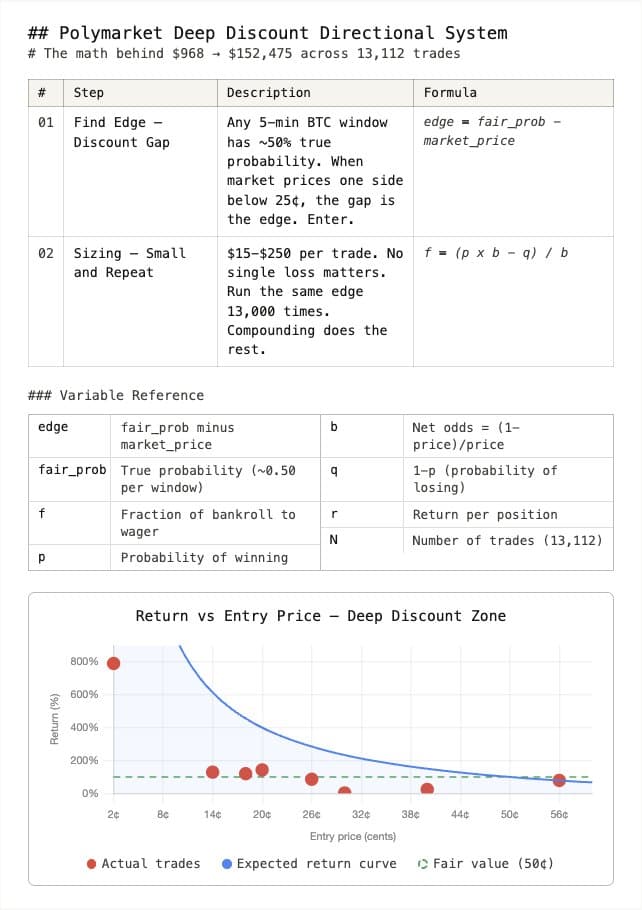
The Claude Bot That Made a Polymarket Trader $218,425: What's Real and What's Hype
A trader reportedly used Claude to build a quant bot that booked roughly +$218,425 on Polymarket since April 5, 2026 — averaging about $3,413 in profit per day across 48,018 predictions at a 52% win rate over 64 days, firing nearly 31 trades per hour. The math works because of high volume and tight risk per trade, not because the bot is rarely wrong.
For LATAM retail and crypto-native traders, this is the headline case in a wider 2026 wave of people automating prediction markets with AI. It matters because the numbers are seductive, the wallets are public, and "copytrade" links are everywhere — but the gap between watching a wallet and reproducing its edge is far larger than the threads suggest.
What happened and why it matters
The story went viral through a Spanish-language thread (later echoed in English) describing a public Polymarket wallet that, starting April 5, 2026, generated about +$218,425 in profit. The reported stats: 48,018 predictions, a 52% win rate, ~31 trades per hour, ~$3,413 average daily profit over 64 days. One version of the thread noted a first deposit of roughly $304,800 — meaning this was not a $100 bankroll turned into a fortune, but a well-capitalized operation compounding a thin edge at scale.
It did not appear in isolation. Other widely shared wallets in the same window claimed +$288,872 in 42 days (56% win rate, ~$6,878/day), +$78,118 in 40 days (64% win rate), and over $589,000 in 77 days (63% win rate). Separately, a much-shared "security guard" story claimed a $900 stake grew to $187,000. Most of these bots reportedly trade crypto "Up/Down" microstructure markets — short-duration BTC price windows — with tiny median trade sizes (one wallet's median was cited at $2.12) and very high frequency (one at ~113 trades per hour). The common thread: exploiting small, repeatable market inefficiencies, not predicting Bitcoin's direction.
What prediction markets are saying
These aren't event-market "odds" — they're trading wallets, and the signal is the performance data itself. The pattern across the cited wallets is consistent: win rates clustered between 47% and 64%, trade frequency of roughly 28–113 per hour, and median position sizes from a couple of dollars to low double digits. On Polymarket's short crypto markets, the dominant tactic described is buying outcomes at 98–99.9¢ when resolution is nearly certain, collecting the small remaining spread thousands of times. The implied edge per trade is tiny; the returns come from turnover and disciplined sizing. (These figures are self-reported via public wallets and viral threads and should be treated as estimated until independently verified on-chain.)
Scenarios and probabilities
- Base scenario: The wallet stats are broadly accurate but reflect a well-funded, latency-sensitive arbitrage strategy that decays as more bots crowd in. Replicable in concept, hard to reproduce profitably for typical retail. Estimated ~60%.
- Bull scenario: The strategy stays profitable for early movers with capital and infrastructure, and tooling matures so a competent retail trader can capture a smaller but real edge. Estimated ~25%.
- Bear scenario: Headline numbers are cherry-picked survivors (or partly inflated), fees, slippage and resolution risk erase the edge for copytraders, and most who chase it lose money. Estimated ~15%.
Impact on prediction markets
A 52% win rate is profitable here only because the average win and average loss are managed and the volume is enormous — at ~31 trades/hour, even a sub-1¢ expected edge compounds. That's the key interpretation risk for anyone reading these threads: win rate alone tells you almost nothing without position sizing, fees, and the price you entered at. Buying at 98–99.9¢ means a single wrong resolution can wipe out dozens of small wins, so survival depends on the bot being right about which markets are "nearly certain." Crowding is the other force: as retail piles into the same crypto Up/Down markets, the inefficiencies that fund these returns get thinner, and the edge that looks like $3,413/day today can compress quickly.
Risks and what would invalidate this thesis
- Copytrading ≠ replication: mirroring a wallet means you enter later, at worse prices, with different size — the very latency and fill quality that create the edge are what you lack.
- Capital and survivorship bias: several cases started with large deposits (one ~$304.8K), and viral threads only surface winners; the wallets that blew up don't trend.
- Tail and resolution risk: buying near-certain outcomes at 98–99.9¢ offers small upside and large downside per trade; a few mis-resolved or manipulated markets can erase weeks of gains.
- Fees, slippage, and platform risk: high-frequency strategies are sensitive to costs and to rule, liquidity, or access changes on the venue.
- Unverified data: if on-chain analysis shows the reported P&L is inaccurate or netted against hidden losses, the thesis weakens materially.
FAQ
How can a 52% win rate be profitable? Because profitability depends on the size of wins versus losses and on volume, not just how often you're right. With ~31 trades per hour and tight risk control, a small positive expected value per trade compounds into thousands of dollars a day.
Can a LATAM retail trader just copy these wallets? In practice, no edge transfers cleanly. Copytraders enter later and at worse prices, lack the capital and execution speed, and inherit the tail risk without the infrastructure that makes the strategy work.
What do these bots actually trade? Mostly short-duration crypto "Up/Down" markets on Polymarket — buying outcomes that are nearly certain to resolve a given way and collecting a small spread thousands of times, rather than forecasting Bitcoin's price.
Sources
Track markets like this in real time on Predik.