Burford Capital Takes the YPF Lawsuit to ICSID: What a $16 Billion Judgment Means for Argentina and Prediction Markets
Burford Capital has confirmed it will escalate Argentina's $16 billion YPF expropriation case to ICSID, the World Bank's international arbitration tribunal. This move threatens Argentina's fiscal stability under Milei and creates new sovereign-risk trading opportunities on prediction markets. We break down the scenarios, probabilities, and what traders should watch.
Burford YPF Argentina Lawsuit: What Prediction Markets Signal About a $16 Billion Judgment
Burford Capital has confirmed it will take Argentina's $16 billion YPF expropriation case to ICSID, the World Bank's international arbitration tribunal. This escalation threatens Argentina's fiscal stability and opens significant trading opportunities on sovereign risk prediction markets.
The YPF expropriation lawsuit — rooted in Argentina's 2012 nationalization of the oil giant from Repsol and the Eskenazi family — is entering a critical new phase. With a judgment exceeding $16 billion (more than half of Argentina's central bank reserves), the outcome could reshape the country's fiscal trajectory under President Milei and ripple across sovereign debt and prediction markets throughout 2026.
What happened and why it matters
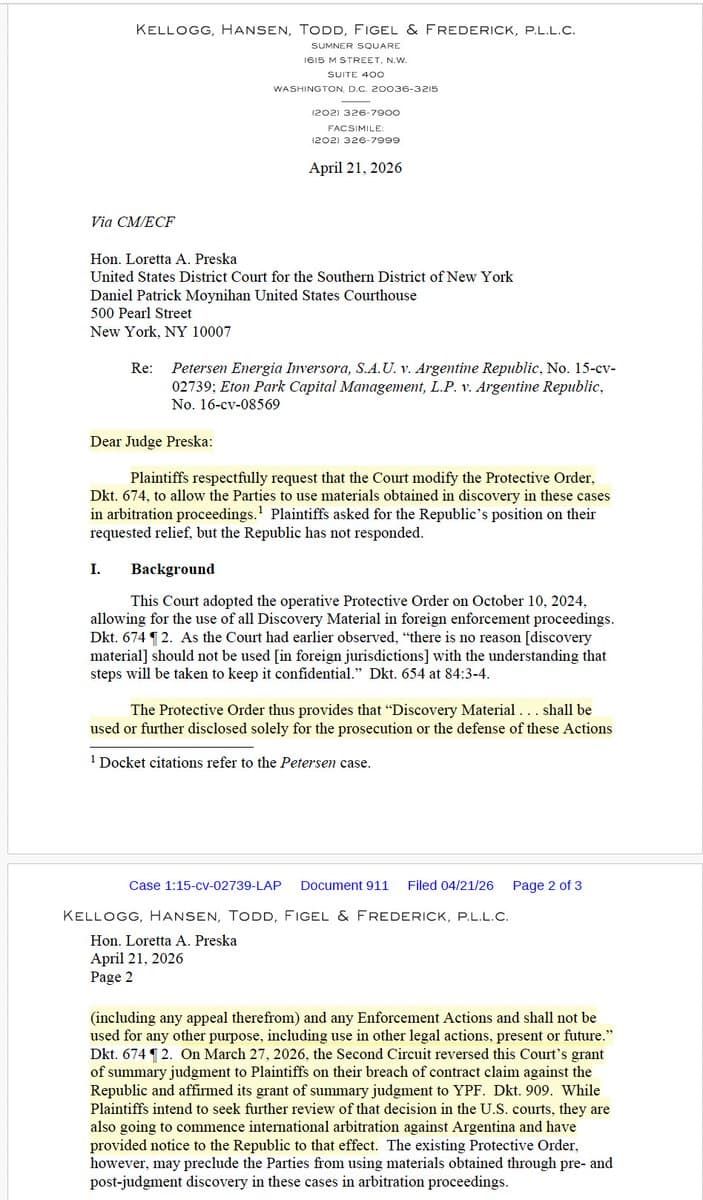
On April 22, 2026, Burford Capital confirmed it will pursue arbitration against Argentina at the International Centre for Settlement of Investment Disputes (ICSID), a World Bank tribunal. Burford's legal team asked U.S. Judge Loretta Preska to modify her standing order — which currently limits the use of discovery materials to the New York proceedings — so that the same evidence can be deployed in the new ICSID arbitration.
The plaintiffs also notified Judge Preska that Argentina has been formally informed of the upcoming ICSID proceedings and indicated they will seek to review the U.S. Court of Appeals ruling before May 8, 2026. This dual-track legal strategy — pursuing both U.S. courts and international arbitration simultaneously — significantly increases pressure on the Argentine government.
The underlying dispute dates back to 2012, when then-President Cristina Fernández de Kirchner nationalized YPF, expropriating shares from Spanish energy firm Repsol and the Eskenazi family. Burford Capital later acquired litigation claims from the Eskenazi family and has since pursued Argentina for damages. The current judgment exceeds $16 billion — a figure that represents more than half of Argentina's central bank (BCRA) gross reserves.
What prediction markets are saying
While no single market currently prices the exact Burford-YPF outcome, several proxy indicators on platforms like Polymarket and Predik provide signals. Argentine sovereign default probability contracts have been trading with elevated implied risk since the ICSID announcement. Estimated probabilities suggest markets assign roughly a 25–35% chance that Argentina reaches a negotiated settlement below $5 billion, and approximately a 15–20% probability of a forced payment or asset seizure scenario within the next 12 months (estimated based on sovereign CDS spreads and bond pricing).
Prediction markets tracking Milei's fiscal targets and IMF program compliance have also seen increased activity, as a multi-billion-dollar judgment payout would fundamentally alter Argentina's debt sustainability math.
Scenarios and probabilities
- Base scenario (45–50%): Argentina and Burford enter protracted negotiations while ICSID proceedings advance slowly. A settlement in the $4–7 billion range is reached over 12–24 months, partially structured through sovereign bonds. Argentine spreads remain elevated but a crisis is avoided.
- Bull scenario (20–25%): The Milei administration leverages diplomatic channels — potentially including U.S. government support — to secure a significantly reduced settlement under $3 billion. This would be sharply positive for Argentine bonds and compress sovereign risk premiums.
- Bear scenario (25–30%): ICSID rules fully in Burford's favor and Argentina faces asset seizures or attachment orders on sovereign assets abroad. This could trigger a technical default event, spike country risk above 2,000 basis points, and destabilize the peso.
Impact on prediction markets
The Burford-YPF case is becoming a key input for anyone trading Argentine sovereign risk. Prediction market contracts on Argentine default, IMF program compliance, and peso stability all carry implicit exposure to the lawsuit's resolution. Key indicators to watch:
- Burford Capital's stock price (LON: BUR) as a real-time sentiment gauge on expected recovery
- Argentine sovereign CDS spreads, which directly reflect default probability
- Statements from the Milei administration regarding willingness to negotiate
- The May 8, 2026 deadline for the Appeals Court review request
For crypto-native traders, Argentine stablecoin premiums (USDT/ARS spreads) and the blue-market dollar gap serve as additional real-time gauges of domestic financial stress tied to this litigation risk. A widening FX gap would signal that local markets are pricing in fiscal deterioration.
Risks and what would invalidate this thesis
- U.S. political intervention: Some analysts speculate the Trump administration could intervene diplomatically in Argentina's favor, which would dramatically alter the negotiating dynamics and potentially reduce the final settlement amount well below current estimates.
- ICSID jurisdictional challenge: Argentina could contest ICSID jurisdiction on procedural grounds, potentially delaying proceedings by years and reducing near-term payment pressure — but also extending uncertainty.
- Surprise settlement: If both sides are closer to a deal than public posturing suggests, current risk premiums may be significantly overstated. Any leak of settlement talks could rapidly compress spreads.
- Legislative or constitutional maneuvers: Argentina's Congress could attempt legislation affecting the legal framework around the expropriation, though this would likely face its own international legal challenges and could worsen investor confidence.
FAQ
What is the Burford-YPF lawsuit about? Burford Capital acquired litigation claims from the Eskenazi family after Argentina expropriated YPF shares from Repsol and the Eskenazis in 2012. A U.S. court issued a judgment against Argentina exceeding $16 billion.
What is ICSID and why does it matter? ICSID (International Centre for Settlement of Investment Disputes) is a World Bank arbitration tribunal. Taking the case to ICSID gives Burford an additional international enforcement mechanism beyond U.S. courts, making it harder for Argentina to avoid payment.
How could this affect Argentine prediction markets? A forced payment of $16 billion or more would consume a massive share of Argentina's reserves, potentially triggering default. Prediction markets on sovereign risk, Milei's fiscal program, and peso stability are all sensitive to the lawsuit's trajectory.
Sources
- Reuters — Burford Capital and YPF Arbitration Coverage
- Polymarket — Sovereign Risk and Argentina Contracts
- Infobae — Burford ICSID Filing Reports (April 22, 2026)
- Clarín — Burford Confirms International Tribunal Pursuit
Track markets like this in real time on Predik.