CLARITY Act in 2026: Bessent Pushes Congress on Crypto Market Structure as Senate Votes Line Up
Treasury Secretary Scott Bessent is urging Congress to pass the CLARITY Act crypto market structure bill 'before it's too late.' With House approval at 294-134, $56M in lobbying, and SEC-CFTC alignment, Senate sources say votes are locked. Prediction markets price a roughly 58.5% probability of passage in 2026, with Senator Hagerty expecting Banking Committee action in April. We break down what's at stake for LATAM traders.
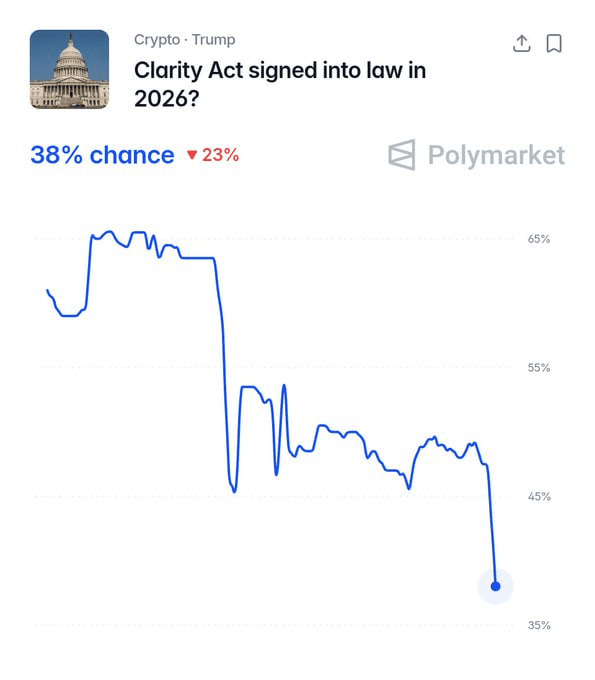
CLARITY Act crypto legislation: why April 2026 is the make-or-break window
Treasury Secretary Scott Bessent has publicly pressured Congress to pass the CLARITY Act crypto market structure legislation 'before it's too late,' and Senate sources say the votes are locked. Prediction markets currently estimate a 58.5% probability that the bill becomes law in 2026, after the House passed it 294-134 on July 17, 2025.
For LATAM retail and crypto-native traders, this matters because U.S. market structure rules will shape what tokens U.S. brokers can list, how stablecoins are treated cross-border, and whether traditional finance giants like Charles Schwab finally step into crypto — a shift that historically pulls liquidity and price discovery toward U.S. venues and away from offshore platforms many LATAM users rely on.
What happened and why it matters
The Clarity for Payment Stablecoins and Digital Asset Market Structure (CLARITY) Act cleared the U.S. House on July 17, 2025 by a 294-134 vote — a rare bipartisan margin. Since then, the bill has been working through the Senate, with the industry deploying roughly $56 million in lobbying spend to keep it moving. Treasury Secretary Scott Bessent recently said Congress must act 'before it's too late,' framing the legislation as urgent for U.S. competitiveness. Senator Bill Hagerty has stated the Senate Banking Committee will advance the bill 'in April' 2026, and Senator Cynthia Lummis has warned that if the window closes now, the next realistic shot at comprehensive crypto regulation could slip to 2030. Critically, the SEC and CFTC — historically split on jurisdiction over digital assets — appear aligned on the framework for the first time, removing one of the longest-standing political blockers.
What prediction markets are saying
On Polymarket, the implied probability that the CLARITY Act becomes law in 2026 sits around 58.5% as of late May 2026 (estimated, based on observed market movement). That number has been volatile: it dropped sharply in late April when calendar pressure from competing Senate priorities pushed the bill's 2026 projection lower, then partially recovered as committee progress was confirmed. Prediction markets are effectively pricing a coin-flip-plus scenario — meaningful conviction, but far from certainty.
Scenarios and probabilities
- Base scenario: Senate Banking Committee advances the bill in Q2 2026, floor vote in summer or early fall, signed into law before year-end. Estimated probability: ~55-60%.
- Bull scenario: Banking Committee moves in April as Hagerty signaled, fast-tracked Senate floor vote, signed by mid-summer 2026. SEC-CFTC joint rulemaking begins immediately, unlocking Schwab and other TradFi entrants. Estimated probability: ~15-20%.
- Bear scenario: Senate calendar slips, the bill gets bundled into a broader package that stalls, and the next realistic window pushes into 2027 or — as Lummis warned — as late as 2030. Estimated probability: ~20-25%.
Impact on prediction markets
Markets tied to U.S. crypto regulation tend to react sharply to two kinds of catalysts: scheduled procedural events (committee markups, floor votes) and unscheduled political signals (statements from Treasury, party leadership shifts). Bessent's 'before it's too late' framing is the latter — it nudges probabilities up but can fade if no concrete calendar follows. Traders should separate the legislative signal from the price signal: a bill passing committee is not the same as a bill becoming law, and prediction market odds frequently overshoot on intermediate procedural wins. Interpretation risk is high here because 'passage' definitions on different platforms vary — some markets resolve on enactment, others on Senate floor vote — so always check resolution criteria before sizing positions.
Risks and what would invalidate this thesis
- Senate calendar gets consumed by appropriations, foreign policy, or election-year politics, pushing CLARITY off the floor entirely.
- A late-stage amendment fight — particularly around stablecoin reserve rules or DeFi carve-outs — fractures the bipartisan coalition that delivered 294-134 in the House.
- SEC-CFTC alignment breaks down during rulemaking, even if the bill passes, delaying practical market structure clarity by 12-24 months.
- A major industry incident (exchange failure, large-scale fraud) shifts political appetite back toward enforcement-first posture.
FAQ
What is the CLARITY Act? It is U.S. legislation that defines how digital assets are classified between the SEC and CFTC and sets market structure rules for crypto trading, custody, and stablecoins.
When could it become law? Senate sources point to committee action in April 2026 and a possible enactment before year-end. Prediction markets price roughly 58.5% probability of passage in 2026.
Why does this matter for LATAM traders? U.S. market structure rules influence which assets global brokers list, how stablecoins move across borders, and where liquidity concentrates — all of which affect LATAM access, spreads, and onboarding paths.
Sources
- Polymarket — CLARITY Act passage market
- Levi Rietveld on X
- Bitcoin Pulse on X
- The Bitcoin Conference on X
Track markets like this in real time on Predik.