Data Center Memory Shortage: Micron Can't Cover Half of Demand — What Prediction Markets Are Pricing
Micron ($MU) reportedly cannot cover even half of data center memory demand, while Nebius ($NBIS) trends globally after a Q2 print of $582.3M revenue and $3B ARR. HBM and DRAM scarcity has become the real bottleneck of the AI capex cycle. Here's what prediction markets on Kalshi and Polymarket are pricing on earnings, hyperscaler capex and the "AI bubble" question — and why LATAM traders in Mexico, Argentina and Colombia should care about RAM, notebook and imported hardware prices in 2026.
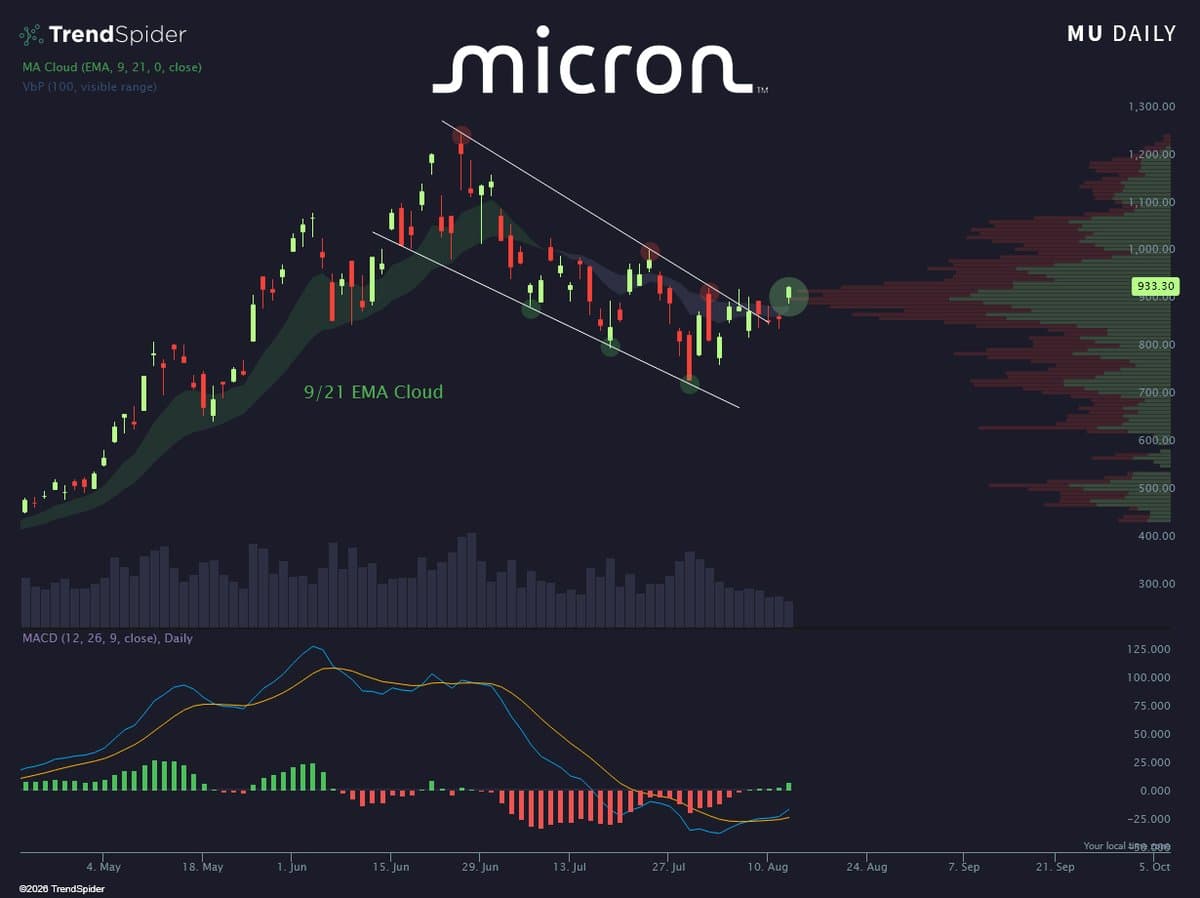
Data Center Memory Shortage: Micron, and What Prediction Markets Are Pricing
Micron ($MU) reportedly cannot cover even half of current data center memory demand, and that supply gap — not GPU logic — is now the binding constraint on the AI capex cycle. The data center memory shortage is tradable on prediction markets through Kalshi contracts on earnings, guidance and hyperscaler capex, and through Polymarket's "AI bubble" markets.
For LATAM traders this is not an abstract US semiconductor story. Memory is the single most price-elastic component in consumer hardware, and it is priced in dollars. When HBM (high-bandwidth memory) capacity gets absorbed by AI data centers, conventional DRAM supply tightens as a second-order effect — and that lands directly on RAM modules, notebooks and imported hardware in Mexico, Argentina and Colombia, on top of local currency and import-tax dynamics.
What happened and why it matters
The signal that moved the conversation on August 13, 2026: Kalshi's finance desk reported that Micron cannot supply even half of the memory demand coming from data center customers. Micron is one of only three at-scale DRAM/HBM producers globally, alongside Samsung and SK Hynix — so a shortfall at Micron is not a share-shift story, it is an industry-capacity story.
The demand side is documented in hard numbers. Nebius ($NBIS) reported Q2 2026 revenue of $582.3M against a $573.9M estimate, adjusted EBITDA of $236.2M versus $172.6M expected, and annualized run-rate revenue of $3.0B at the end of June — up 58% quarter over quarter and roughly +454% year over year. The company reaffirmed a year-end 2026 ARR target of ~$7–9B, raised contracted power from more than 4GW to 5GW, and said it intends to deploy 1GW per year starting in 2027. It also disclosed four customer agreements above $1B in total contract value during the quarter, with average annual contract value above $20M per megawatt.
Read those two facts together and the picture is straightforward: neo-cloud operators are signing multi-year, multi-gigawatt commitments, and every one of those gigawatts requires memory that does not currently exist in sufficient volume. Capital commitment is running ahead of the physical supply chain.
The positioning side is equally loud. Michael Burry disclosed on August 12, 2026 that he added to shorts on Nebius at $247, Micron at $924, Oracle at $152, and added to puts on the $SOXX semiconductor ETF — while adding to longs on Mercado Libre at $1,850 and Zoetis. He characterized Nebius as "what the top of a boom looks like." The market disagreed in the short term: $NBIS rose roughly 21% intraday on the earnings print and was up close to 30% over two days. Separately, Goldman Sachs disclosed a 10.5% stake in Nebius on August 7, 2026. Note that $NBIS was still down roughly 35% from its June all-time high before this move — this is a violent, two-sided tape, not a one-way trend.
Facts and interpretation, kept separate: the revenue, ARR, power contracts and disclosed positions above are reported figures. The claim that memory scarcity persists through 2027 is an inference, not a fact.
What prediction markets are saying about the data center memory shortage
Prediction market pricing on this theme clusters into three families. All figures below are estimated from context and market structure, not quoted live prices — verify current odds on the platforms before sizing anything.
- Earnings and guidance contracts (Kalshi): markets on whether Micron beats consensus revenue and whether it raises forward guidance. Estimated ~70–78% implied probability of a revenue beat, reflecting a supply-constrained pricing environment where the constraint is units shipped, not demand.
- Hyperscaler capex contracts (Kalshi): markets on aggregate 2026 capital expenditure thresholds for the largest cloud operators. Estimated ~65–75% implied probability that combined capex guidance is revised upward again before year-end.
- "AI bubble" markets (Polymarket): contracts on drawdown thresholds in AI-linked equities or on sentiment-defined bubble-burst resolutions within a defined window. Estimated ~25–35% implied probability of a bubble-defined resolution in the next six months.
The tension is worth naming explicitly. Bubble markets pricing 25–35% and capex-upgrade markets pricing 65–75% are not contradictory — they describe different horizons. Physical shortage supports near-term revenue and pricing power; valuation risk is a 12–24 month question. A trader can be long the shortage and skeptical of the multiple at the same time.
Scenarios and probabilities
- Base scenario (≈55%, estimated): Memory scarcity persists through the rest of 2026. Contract DRAM and HBM prices stay elevated, Micron and its peers keep running near full allocation, and hyperscaler plus neo-cloud capex guidance is revised up at least once more. Consumer RAM and notebook prices in LATAM rise on a lag of roughly one to two quarters. Equity tape stays volatile in both directions.
- Bull scenario (≈25%, estimated): The shortage deepens into a full allocation regime. Memory suppliers price like a cartel of three, margins expand faster than consensus, Nebius hits the upper end of its $7–9B ARR guide, and short positioning in $NBIS, $MU and $SOXX gets forced to cover — the squeeze dynamic several traders are explicitly positioning for. Capex-upgrade contracts resolve yes; bubble contracts get cheaper.
- Bear scenario (≈20%, estimated): Capacity additions and a demand air-pocket arrive together. One large AI contract is delayed or cancelled, financing costs for gigawatt-scale buildouts bite, and memory pricing rolls over the way it has in every prior semiconductor cycle. Burry's thesis ages well, $SOXX puts pay, and bubble-resolution markets reprice sharply higher.
Impact on prediction markets
Three mechanics matter when you translate this into positions.
First, supply-constrained industries make earnings contracts easier to model than price contracts. When a producer is sold out, revenue becomes a function of capacity and contract pricing, both of which are visible in advance. That is why earnings-beat markets on memory names tend to trade at higher implied probabilities than equity direction markets — the beat can be near-certain while the stock still falls on guidance tone or valuation.
Second, bubble markets are definition risk, not thesis risk. A "burst" contract resolves on the written criteria — a specific index drawdown, a date window, a named source. You can be directionally right about AI valuations and still lose the contract because the threshold was never touched inside the window. Read resolution language before you read the chart.
Third, and most relevant for LATAM: a prediction market position on memory-linked outcomes is one of the few dollar-denominated hedges against a hardware price shock available to a retail trader in the region who cannot easily buy US semiconductor equities. If RAM and notebook prices in Mexico City, Buenos Aires or Bogotá rise because global memory is scarce, a position that pays out on that same scarcity offsets part of the real-world cost. The correlation is imperfect and lagged — local prices also move on FX, freight and import duties — but the direction is genuine.
One structural caution: liquidity on niche semiconductor contracts is thin. Wide spreads mean the quoted probability may reflect a small resting order rather than genuine consensus. Size accordingly.
Risks and what would invalidate this thesis
- Capacity comes online faster than expected. Samsung and SK Hynix have both signaled aggressive HBM expansion. Semiconductor shortages have historically resolved into gluts, and the lag between "sold out" and "oversupplied" has repeatedly been shorter than the market assumed.
- Demand is contracted, not delivered. Nebius reports backlog and total contract value — including a multi-year pipeline extending toward 2031. Contracted revenue is not recognized revenue. A single large counterparty renegotiating or delaying would change the arithmetic materially.
- Financing conditions tighten. Gigawatt-scale buildouts are capital-intensive and rate-sensitive. Higher funding costs or tighter credit would slow deployment schedules and relieve memory demand faster than any supply response.
- Positioning-driven moves mislead. A 30% two-day move in $NBIS with a well-publicized short book is partly a mechanical squeeze, not a clean fundamental signal. Do not read short-covering as confirmation of a thesis.
- Local LATAM prices decouple. Retail hardware prices in the region are driven by FX, tariffs and inventory as much as by global memory costs. A stronger local currency or an inventory glut at distributors can fully offset a global price increase.
FAQ
Why is memory the bottleneck instead of GPUs? AI accelerators require large stacks of high-bandwidth memory to feed compute. HBM production is concentrated in three suppliers, uses more wafer capacity per unit than standard DRAM, and has yield constraints — so memory capacity, not chip logic, sets the practical ceiling on how fast data centers can be built.
Will RAM and notebook prices rise in Mexico, Argentina and Colombia in 2026? Directionally likely if global memory scarcity persists, with a typical lag of one to two quarters between contract price increases and retail shelf prices. The size of the move depends on local currency, import duties and distributor inventory, so the global signal sets the direction, not the magnitude.
How do I trade a memory shortage on a prediction market? Through the contract families that reference it: earnings and guidance markets on memory producers, aggregate hyperscaler capex threshold markets, and AI-valuation or bubble-resolution markets. Read the resolution criteria first — most losses on these contracts come from definition mismatch, not from being wrong about the underlying industry.
Does a famous investor's short position mean the trade is crowded? A disclosed short is one datapoint, not a signal. In this case the disclosed positions in $NBIS, $MU and $ORCL were followed by sharp rallies in those names — visible short interest can itself become fuel for upside when a catalyst lands.
Sources
Track markets like this in real time on Predik.