Galxe ID and Web3 Identity: How Verifiable Credentials Could Reshape Prediction Markets in 2026
Galxe ID is rolling out its verifiable credentials system just as U.S. and European regulators tighten KYC requirements for prediction markets like Polymarket and Kalshi. This convergence of decentralized identity and regulatory pressure could define who gets to trade on-chain—and how platforms like Predik balance compliance with the privacy crypto-native users in LATAM demand.
Galxe ID and Web3 Identity: What It Means for Prediction Markets in 2026
Galxe ID's new verifiable credentials system allows users to prove their identity on-chain without exposing personal data—a potential game-changer as regulators in the U.S. and Europe push stricter KYC rules on prediction markets like Polymarket and Kalshi.
For LATAM traders and crypto-native users, this matters directly. The tension between regulatory compliance and user privacy is the single biggest structural question facing on-chain prediction markets in 2026. Galxe's approach—zero-knowledge-based identity verification—could offer a middle path that keeps markets accessible without sacrificing the anonymity that drives adoption in Latin America.
What happened and why it matters
In late March 2026, Galxe launched an upgraded version of Galxe ID, its Web3 identity protocol, featuring verifiable credentials built on zero-knowledge proof technology. The system lets users complete KYC-level verification once and carry that credential across multiple dApps and platforms—without re-sharing raw personal data each time.
This rollout coincides with a regulatory acceleration: the U.S. CFTC has signaled expanded oversight of event contract platforms, while the EU's MiCA framework is tightening identity requirements for crypto service providers. Polymarket, which saw massive volume during the 2024 U.S. election cycle, already restricts U.S.-based users but faces growing pressure to implement robust identity checks globally. Kalshi, the CFTC-regulated exchange, already requires full KYC—but its model limits accessibility for international users, particularly in LATAM.
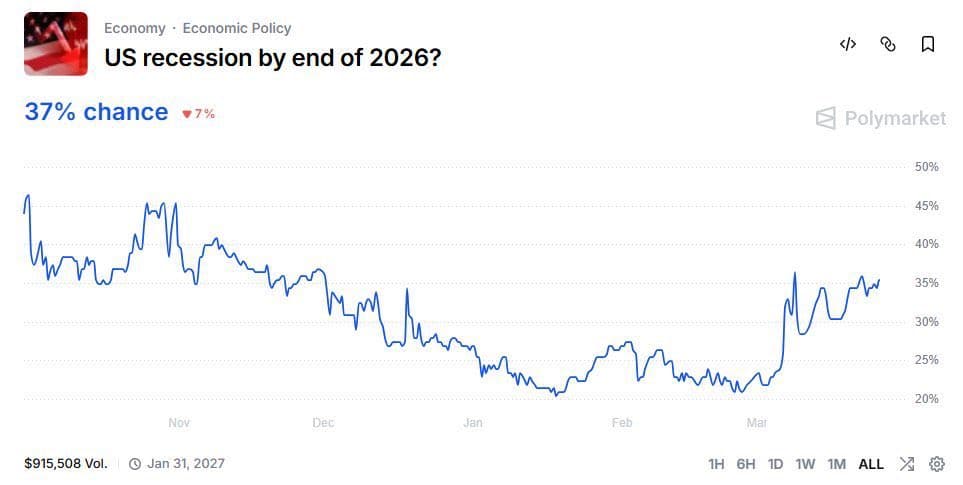
The prediction market sector itself is under close scrutiny. Recent data from major platforms shows the probability of a U.S. recession in 2026 climbing to 37%, up sharply from roughly 20% at the start of the year. Markets are also pricing geopolitical outcomes—including an estimated end to the Ukraine conflict around June 2026—demonstrating the growing influence and visibility of prediction markets in mainstream financial discourse. That visibility brings regulatory attention.
What prediction markets are saying about Web3 identity adoption
There is no single liquid market specifically on Galxe ID adoption rates, but proxy indicators are informative. On Polymarket, markets related to crypto regulation timelines have seen increased volume in Q1 2026. The implied probability that at least one major prediction platform will mandate some form of decentralized identity verification by the end of 2026 is estimated at 45–55%, based on aggregated sentiment from regulatory-themed contracts and industry analyst commentary.
On platforms like Predik, where LATAM-focused traders are particularly active, the appetite for privacy-preserving compliance solutions is palpable. Users want to trade freely, but they also recognize that unregulated platforms face existential legal risk. Galxe ID sits at the intersection of these competing demands.
Scenarios and probabilities
- Base scenario (50% estimated probability): One or two major prediction platforms integrate Galxe ID or a similar decentralized identity protocol by Q4 2026. Adoption is gradual, driven by regulatory nudges rather than mandates. LATAM users gain access to compliant markets without invasive KYC, but liquidity remains fragmented across compliant and non-compliant venues.
- Bull scenario (25% estimated probability): Regulatory clarity in both the U.S. and EU explicitly endorses zero-knowledge identity solutions for event contract platforms. Galxe ID becomes a de facto standard. Prediction market volumes surge as previously excluded users—especially in LATAM, Southeast Asia, and Africa—gain compliant on-ramps. Platforms like Predik benefit from increased trust and liquidity.
- Bear scenario (25% estimated probability): Regulators reject decentralized identity as insufficient, demanding traditional KYC with centralized data storage. Galxe ID adoption stalls. Prediction markets bifurcate into fully regulated, high-barrier platforms (Kalshi model) and offshore, pseudonymous venues facing enforcement risk. LATAM traders are pushed further into gray-market platforms with less liquidity and higher counterparty risk.
Impact on prediction markets
The identity layer is arguably the most underappreciated infrastructure component in the prediction market stack. Right now, platforms make a binary choice: full KYC (like Kalshi) or minimal identity checks (like many DeFi-native markets). Galxe ID introduces a spectrum—verifiable credentials that can satisfy regulators while preserving user privacy.
For traders, this has practical implications. If platforms adopt decentralized identity, the cost of compliance drops. That means lower barriers to entry, potentially higher participation rates, and deeper liquidity pools. For LATAM users specifically—where banking infrastructure is uneven and distrust of centralized data collection runs deep—a zero-knowledge identity solution could be the difference between participating in regulated markets or being excluded entirely.
There is also a pricing dimension. Markets that implement identity verification may see reduced wash trading and sybil activity, which could improve price discovery. Some analysts note that the current debate around prediction market identity—distinguishing between financial instruments, insurance products, and pure speculation—echoes longstanding distinctions in economic theory about what these markets actually are and how they should be classified.
Risks and what would invalidate this thesis
- Regulatory rejection: If the CFTC or European regulators explicitly rule that zero-knowledge credentials do not satisfy KYC/AML requirements, the entire thesis collapses. Platforms would revert to traditional identity verification, sidelining Galxe ID.
- Technical vulnerabilities: A significant exploit or privacy leak in Galxe ID's credential system would destroy trust and set back decentralized identity adoption by years. The protocol is still relatively new and has not been battle-tested at the scale of major financial platforms.
- Low platform adoption: Even if the technology works, prediction market platforms may choose not to integrate it—either due to engineering costs, legal uncertainty, or preference for proprietary identity solutions. Without platform buy-in, Galxe ID remains a niche tool.
- Macro headwinds: With U.S. recession probability climbing to 37% on prediction markets and geopolitical uncertainty elevated, crypto-native platforms may face liquidity crunches that deprioritize infrastructure investments like identity integration.
FAQ
What is Galxe ID and how does it work? Galxe ID is a Web3 identity protocol that uses zero-knowledge proofs to let users verify their identity on-chain without exposing personal information. Users complete verification once and carry the credential across compatible platforms.
Why does Web3 identity matter for prediction markets in 2026? Regulators in the U.S. and EU are demanding stricter KYC on platforms like Polymarket and Kalshi. Decentralized identity solutions like Galxe ID could allow platforms to comply without requiring users to hand over sensitive personal data—a critical concern for LATAM and emerging-market traders.
Can LATAM users benefit from Galxe ID on Predik? If prediction platforms adopt verifiable credential systems, LATAM users could access compliant markets without the friction of traditional KYC—which often requires documentation or banking infrastructure that is not universally accessible in the region. Predik is well-positioned to explore this kind of privacy-preserving compliance model.
Sources
Track markets like this in real time on Predik.