Iran-US Negotiation 2026: How Prediction Markets Are Pricing De-Escalation After the Revolutionary Guard's Five Demands
Iran has signaled willingness to negotiate with the United States following weeks of military escalation, including Strait of Hormuz closures and the seizure of the Iranian vessel Tosca. The Revolutionary Guard issued five formal demands, and prediction markets on platforms like Polymarket saw the probability of a diplomatic deal before June spike sharply. Here is what traders in LATAM and crypto markets need to know about this pivotal geopolitical shift.
Iran-US Negotiation and Prediction Markets in 2026: What De-Escalation Means for Traders
Iran has confirmed diplomatic approaches with the United States and declared it is willing to hear proposals, marking a radical shift after weeks of military escalation that included closures of the Strait of Hormuz and direct naval confrontations. On Polymarket, the probability of a diplomatic agreement before June surged, reshaping geopolitical prediction markets across the board.
For LATAM retail and crypto-native traders, this moment is critical. The Iran-US conflict has been the dominant driver of oil volatility, commodity-linked prediction markets, and broader risk sentiment since February 2026. A successful de-escalation would unlock downside pressure on energy prices and recalibrate dozens of active markets on platforms like Polymarket, Kalshi, and Predik.
What happened and why it matters
The crisis between Iran and the United States escalated sharply from February 2026, culminating in the closure of the Strait of Hormuz — through which roughly 20% of global oil supply transits. On April 17, a ceasefire was reached that allowed Iran to reopen the strait, sending oil prices sharply lower and triggering an immediate and intense market reaction. Analysts noted the news was what markets had been waiting for over the previous six weeks.
However, the euphoria was short-lived. By April 20, the United States seized the Iranian vessel Tosca in the Gulf of Oman, prompting Iran to effectively restrict passage through the strait again. Oil prices surged back, and fear of a global crisis returned. On April 22, Iran's Foreign Ministry spokesperson stated that Tehran would return to the negotiation table only when "necessary and reasonable conditions" are met, while emphasizing the country's readiness to defend itself against further attacks.
Meanwhile, Iran's Revolutionary Guard presented five formal demands, including maintaining control of the Strait of Hormuz. On the uranium enrichment front, negotiations have centered on a core gap: the US demanded a 20-year freeze on enrichment, while Iran counteroffered 5 years. International analysts suggest the final deal — if reached — will land somewhere in between, and that the negotiation will not revolve around regime change since Trump ultimately needs a viable exit.
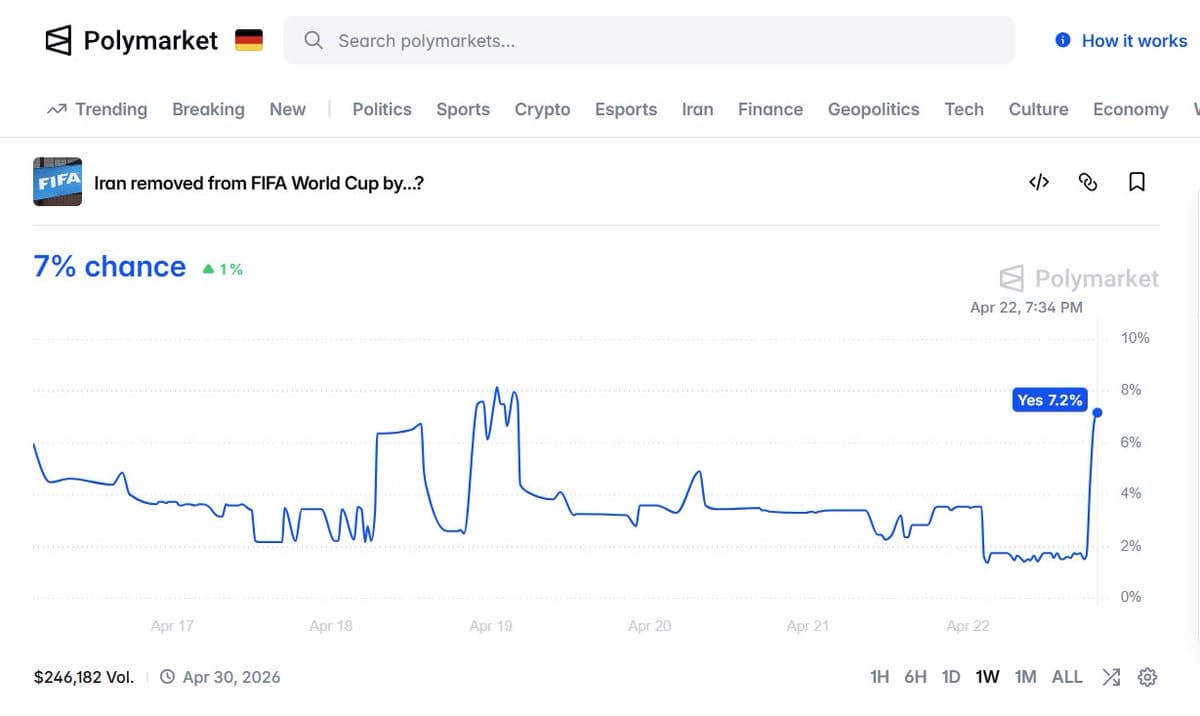
President Trump also postponed a planned trip to Beijing to focus on the Iranian front, underscoring how central this crisis has become to US foreign policy. In a separate and unusual move, Trump reportedly asked FIFA to disqualify Iran from the 2026 World Cup and replace it with Italy — prediction markets priced the odds of this happening before April 30 at around 7.2%, up from just 1%.
What prediction markets are saying
On Polymarket, the probability of a US-Iran diplomatic agreement before June 2026 surged following Iran's initial signals of willingness to negotiate. The market moved from the low-to-mid teens to an estimated 35–45% range during the peak of ceasefire optimism around April 17–18, before pulling back to approximately 25–30% after the Tosca seizure and renewed Hormuz tensions on April 20–22.
Related markets — including contracts on whether Iran will close the Strait of Hormuz again before July and whether oil will exceed $100 per barrel in Q2 2026 — have shown strong inverse correlation with the diplomatic probability. Geopolitical contracts on Kalshi similarly reflected elevated volatility, with bid-ask spreads widening during the April 20 reversal. Some market observers noted that parts of the de-escalation may have already been priced in before the ceasefire announcement, suggesting that further upside for peace contracts may be limited unless a substantive framework emerges.
Scenarios and probabilities
- Base scenario (50%): Negotiations resume but stall on the uranium enrichment timeline. A partial framework is announced before June — possibly a temporary Hormuz navigation guarantee in exchange for limited sanctions relief — but a comprehensive deal is pushed to Q3 or Q4 2026. Oil stabilizes in the $85–95 range. Prediction market contracts on a pre-June deal settle around 30–40%.
- Bull scenario (20%): Iran and the US reach a substantive interim agreement before June, including a compromise enrichment freeze (around 10 years) and full Hormuz reopening. Oil drops below $80, prediction market contracts on peace resolve near 100%, and risk assets rally broadly. LATAM currencies strengthen on lower energy import costs, and crypto markets benefit from renewed risk appetite.
- Bear scenario (30%): Negotiations collapse after further military incidents — additional vessel seizures, proxy attacks, or a direct strike on nuclear facilities. The Strait of Hormuz remains intermittently closed, oil spikes above $110, and global recession fears intensify. Prediction markets on conflict escalation surge past 70%. LATAM net oil importers face inflation pressure while the dollar strengthens.
Impact on prediction markets
This Iran-US dynamic is reshaping how traders should approach geopolitical prediction markets. The rapid oscillation between ceasefire and escalation — from Hormuz reopening on April 17, to the Tosca seizure on April 20, to renewed diplomatic language on April 22 — creates significant interpretation risk. Markets that appeared to be resolving toward peace can reverse within 48 hours on a single military action.
For crypto-native traders accustomed to volatile assets, the pattern is familiar but the drivers are fundamentally different. Geopolitical prediction markets are driven by a small number of decision-makers whose actions are difficult to model, unlike crypto markets where on-chain data provides some transparency. The key edge lies in understanding the negotiation structure: the uranium enrichment gap (20 years vs. 5 years) and the Hormuz control demand are the two variables that will determine resolution timing.
LATAM traders should pay particular attention to oil-linked contracts, as the region includes both net importers (most of Central America and the Caribbean) and net exporters (Venezuela, Brazil, Colombia, Ecuador) who are asymmetrically affected by the outcome. Agricultural commodity markets are also in play — the April 2026 US planting season is underway with soybean acreage increasing and corn acreage declining, and energy-driven input cost swings from the Iran crisis add further volatility to these markets.
Another key consideration: public statements from both sides have been contradictory. US officials have at times claimed Iran accepted all terms, while Iranian officials have flatly called those claims false. This information asymmetry means prediction market traders are pricing on incomplete and sometimes deliberately misleading signals.
Risks and what would invalidate this thesis
- Military escalation override: A major military incident — such as a strike on Iranian nuclear facilities or an attack on a US carrier group — would immediately invalidate any diplomatic probability pricing and likely trigger extreme moves in commodity and prediction markets.
- Domestic political capture: Both the Revolutionary Guard's five demands and Trump's increasingly aggressive posture (including the FIFA request and contradictory public claims) suggest hardliners on both sides could derail negotiations for domestic political purposes, independent of strategic logic.
- Third-party disruption: Israel, Saudi Arabia, or proxy groups could take actions that collapse the bilateral negotiation framework, even if both Iran and the US are genuinely pursuing a deal.
- Information asymmetry and manipulation: Much of the negotiation is happening through back channels. Contradictory public statements create fertile ground for mispricing in prediction markets. Traders risk being whipsawed by headline-driven moves that do not reflect the actual state of negotiations.
- Exhaustion of credibility: Repeated cycles of announced breakthroughs followed by reversals may erode market confidence in any future announcements, leading to muted price reactions even when genuine progress occurs.
FAQ
What are Iran's five demands from the Revolutionary Guard? The five formal demands include maintaining Iranian control of the Strait of Hormuz, a limited uranium enrichment freeze (5 years rather than the US-demanded 20), sanctions relief, a non-aggression guarantee, and recognition of Iran's regional security interests. These demands form the negotiation baseline but are widely seen as an opening position.
What is the current probability of a US-Iran deal before June 2026 on prediction markets? As of late April 2026, estimated probabilities on Polymarket for a diplomatic agreement before June sit in the 25–30% range, down from a peak of approximately 40–45% during the brief ceasefire window around April 17–18. These numbers shift rapidly with each development.
How does the Iran-US conflict affect LATAM traders specifically? The primary channels are oil prices and US dollar strength. Higher oil prices raise import costs for most Central American and Caribbean economies while benefiting South American exporters like Venezuela, Brazil, and Colombia. Dollar strength during geopolitical tension also pressures LATAM currencies and crypto-USD pairs frequently used by regional traders on platforms like Predik.
Sources
- Polymarket — Iran diplomatic agreement market
- Geopolitical analysis — Iran-US negotiation dynamics
- Reuters — Iran-US conflict developments
Track markets like this in real time on Predik.