Federal Judge Strikes Down Visa Suspension for 75 Countries: What Prediction Markets Now Price In
A federal judge in Manhattan struck down the Trump administration's immigrant visa suspension covering nationals of 75 countries, ruling the State Department policy was "contrary to law" and exceeded Secretary of State Marco Rubio's statutory authority. The August 21-22, 2026 decision unfreezes consular processing for Latin American families from Colombia, Uruguay and Cuba, and adds pressure to the visa pipeline ahead of the 2026 World Cup on US soil. Prediction markets on Polymarket and Kalshi repriced within hours across appeal, Supreme Court intervention and full-year deportation contracts — a reminder that in 2026, the judiciary has become the hardest variable to price in US immigration policy.
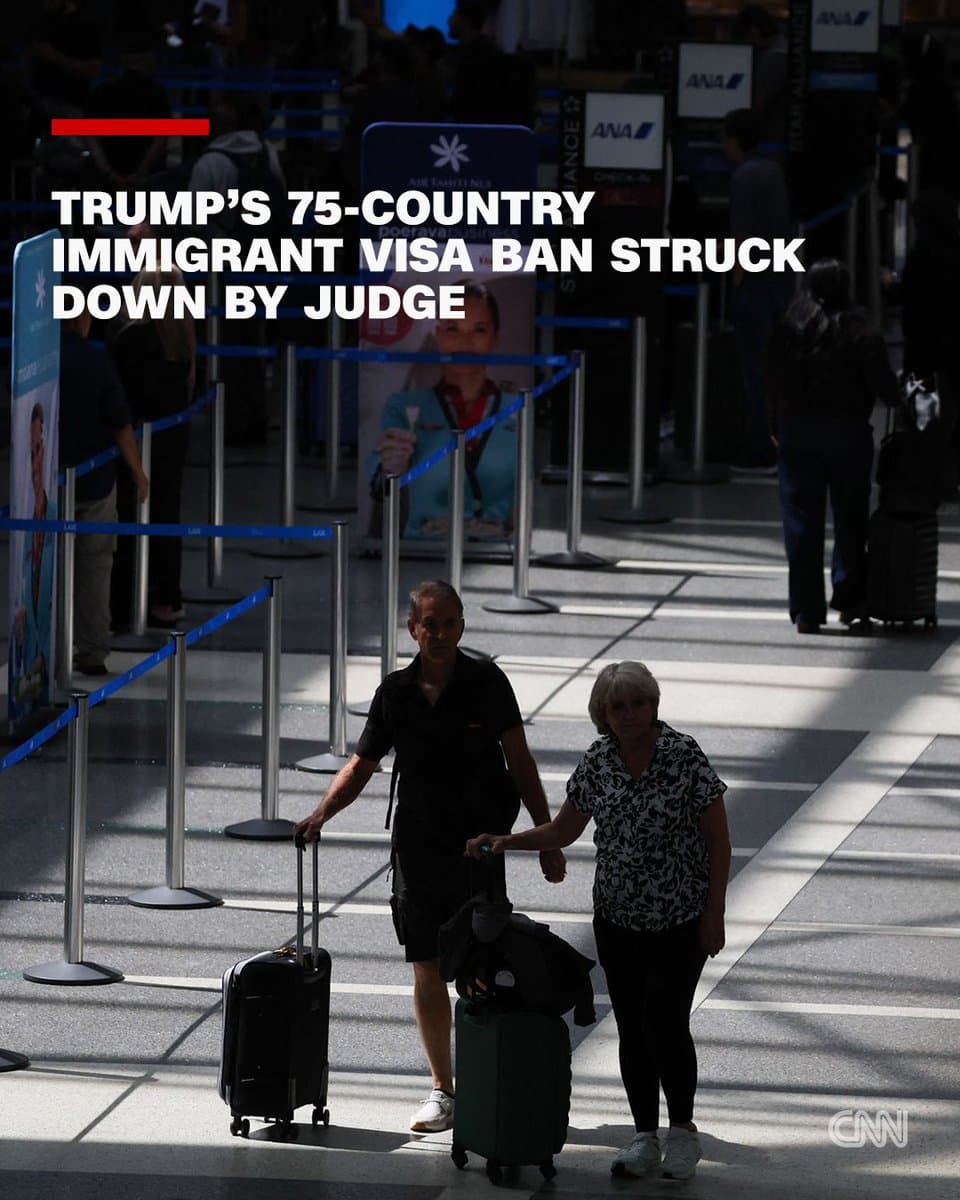
Federal Judge Strikes Down the Visa Suspension for 75 Countries: The Ruling and What Prediction Markets Are Pricing
A federal judge struck down the visa suspension for 75 countries, ruling that the State Department policy was "contrary to law" and beyond the legal authority of Secretary of State Marco Rubio. US District Judge Jeannette A. Vargas, sitting in the Southern District of New York, issued the 61-page decision on Friday, August 21, 2026, with coverage breaking worldwide through August 22-23.
For LATAM readers this is not an abstract legal story. The suspension had frozen immigrant visa processing — the green-card track — for nationals of more than 70 countries including Colombia, Uruguay and Cuba, stranding families mid-process at consulates. For traders, it is a live case study in how a single district-court docket can move probabilities on immigration contracts faster than any policy announcement.
What happened and why it matters
The facts, separated from interpretation:
The policy. In January 2026, the administration suspended the issuance of immigrant visas — the permanent-residence track — to nationals of 75 countries. The list spanned Latin America (Colombia, Uruguay, Cuba), Asia and the Middle East (Afghanistan, Iran), Africa (Somalia) and Russia. Unlike a travel ban on tourists, an immigrant visa suspension hits family reunification and diversity-lottery cases that had often been pending for years.
The ruling. Judge Jeannette A. Vargas of the US District Court for the Southern District of New York (Manhattan) held the policy "contrary to law." Two findings do the heavy lifting: first, that a visa cannot be denied to an applicant solely on the basis of nationality or country of origin; and second, that authority over individual immigrant visa determinations rests with consular officers, not with the Secretary of State issuing a categorical blanket directive. The opinion runs 61 pages.
The plaintiff. The challenge was brought by the Catholic Legal Immigration Network, a long-standing litigant in consular-processing cases, against Secretary Rubio and the State Department.
The World Cup overlay. The 2026 FIFA World Cup is hosted across the United States, Mexico and Canada, opening in June 2026 — meaning the tournament window and the consular backlog now overlap. Immigrant visas are a separate category from the B1/B2 and event-specific visitor visas most fans use, so the direct legal read-through is limited. The practical read-through is real: a State Department that must restart tens of thousands of frozen immigrant visa files while running a peak-load consular season faces a resourcing squeeze, and appointment wait times in high-volume LATAM posts are the metric to watch.
Regional context. Immigration friction is not moving in one direction across the hemisphere. Washington revoked the visa of a former Mexican president's son in mid-August 2026, and Colombia's new president Abelardo de la Espriella, inaugurated August 7, 2026, has moved toward closer counternarcotics cooperation with the US. Bilateral warmth and consular restriction are running on separate tracks.
What prediction markets are saying on the visa suspension for 75 countries
Immigration has been one of the most consistently traded political categories of 2026 on Polymarket and Kalshi. The figures below are estimated from the structure of comparable contracts and the news flow of August 21-23, 2026 — verify live prices before acting on any of them.
Administration appeals the ruling: estimated 90-95%. Near-consensus. This administration has appealed essentially every adverse immigration injunction, and the Second Circuit is the natural next stop.
Ruling stayed or narrowed on appeal before December 31, 2026: estimated 45-55% — the genuinely contested contract, and the one where a modest edge is available if you read the Second Circuit's stay posture correctly.
Supreme Court takes the case or grants emergency relief in 2026: estimated 25-35%. The Court has repeatedly granted the administration emergency relief on immigration, but the calendar is tight for a district decision issued in late August.
Full-year 2026 deportation and removal-count contracts: these repriced modestly downward after the ruling. That reaction is arguably overdone — the case concerns visa issuance abroad, not interior enforcement, and the two flows are only loosely coupled.
Scenarios and probabilities
- Base scenario (estimated 50%): The administration appeals within weeks. The Second Circuit grants a partial administrative stay or narrows the vacatur's scope while briefing proceeds. Consular processing restarts unevenly — some posts move, others wait for State Department guidance. No final resolution before year-end 2026.
- Bull scenario for applicants (estimated 30%): The ruling holds without a stay. The State Department issues processing guidance within 30-60 days, and immigrant visa interviews resume for the affected 75 nationalities during Q4 2026. Consular wait times in Bogotá, Montevideo and Havana become the visible confirmation metric.
- Bear scenario for applicants (estimated 20%): An emergency stay from the Second Circuit or the Supreme Court reinstates the suspension within weeks, leaving families in the same limbo as before while the merits litigate through 2027. Alternatively, the administration reissues a narrower nationality-neutral restriction built to survive the specific defects Vargas identified.
Impact on prediction markets
The tradable insight here is a structural one: judicial outcomes are the least efficiently priced variable in immigration markets. Policy announcements are telegraphed — an executive order is drafted, leaked, previewed. Court rulings drop without warning on a judge's schedule, which means the repricing is abrupt and the first movers are the handful of traders reading dockets rather than headlines.
Three interpretation risks worth naming. First, resolution language beats intuition — a contract on "visa suspension in effect on date X" resolves very differently from one on "policy struck down," because a stay pending appeal puts the policy back in effect without touching the underlying ruling. Read the rules, not the title. Second, headline conflation: coverage across August 22-23 blurred immigrant visas with travel bans and tourist visas. They are distinct legal instruments, and markets referencing "the travel ban" may not be exposed to this ruling at all. Third, thin-book distortion: legal-outcome markets often have shallow order books, so a post-news print can look like a 15-point conviction move when it was a single size order crossing a wide spread.
Risks and what would invalidate this thesis
- Fast appellate reversal. A Second Circuit administrative stay within days would restore the suspension and unwind most of the post-ruling repricing, punishing anyone who bought the "policy stays dead" side at the top.
- Reissued policy under different authority. The administration can redraft the restriction citing a different statutory hook or national-security rationale, achieving a similar practical result while mooting this specific litigation — a pattern already seen in the 2017-2018 travel ban sequence.
- Implementation gap. A vacated policy is not a processed visa. Even with the ruling intact, State Department guidance, staffing and interview capacity determine whether anyone actually gets an appointment. Markets pricing legal outcomes may badly misread on-the-ground throughput.
- Scope uncertainty. Whether the vacatur applies nationwide or only to the named plaintiffs materially changes who benefits, and reporting in the first 48 hours did not settle this cleanly.
- Data opacity. The State Department publishes visa issuance statistics with a multi-month lag, so contracts resolving on official figures may not settle until well after the news cycle ends.
FAQ
Which judge struck down the visa suspension for 75 countries? US District Judge Jeannette A. Vargas of the Southern District of New York, in a 61-page ruling issued Friday, August 21, 2026, holding the policy "contrary to law" and outside Secretary of State Marco Rubio's statutory authority.
Which Latin American countries were affected? Reporting identified Colombia, Uruguay and Cuba among the 75 nationalities covered. The full list also included Afghanistan, Iran, Russia and Somalia across other regions.
Does this mean immigrant visas resume immediately? Not automatically. The government is widely expected to appeal, and an appellate stay could pause the ruling's effect. Even without a stay, restarting consular processing requires State Department guidance and interview capacity — a matter of weeks to months, not days.
Does the ruling affect 2026 World Cup travel? Not directly. The case concerns immigrant (permanent-residence) visas, not the visitor visas most fans use. The indirect effect is consular workload: restarting frozen immigrant files during the tournament's peak visitor season could lengthen appointment waits at busy LATAM posts.
How do prediction markets treat court rulings? As high-variance, low-warning events. Unlike scheduled data releases or policy announcements, decisions arrive on a judge's timeline, producing sharp repricing — and, in thin books, moves that overstate genuine conviction.
Sources
- Polymarket — immigration and policy markets
- Kalshi — US immigration policy contracts
- SCOTUS Wire — federal court coverage
Track markets like this in real time on Predik.