Kalshi Valued at $11 Billion: Forbes 2026 Names Luana Lopes Lara Youngest Self-Made Female Billionaire
Forbes 2026 has crowned Luana Lopes Lara, co-founder of prediction market platform Kalshi, as the youngest self-made female billionaire in the world. With Kalshi now valued at $11 billion, the milestone signals a turning point for the prediction markets industry—and raises critical questions about competition, regulation, and what comes next for traders on Predik, Polymarket, and beyond.
Kalshi $11 Billion Valuation: Forbes 2026 Crowns Prediction Markets' First Female Billionaire
Forbes has included Luana Lopes Lara, co-founder of Kalshi, on its 2026 Billionaires List as the youngest self-made female billionaire in the world. The prediction market platform is now valued at $11 billion, marking the most definitive mainstream validation the prediction markets industry has ever received.
For LATAM-based traders active on platforms like Predik and Polymarket, this is more than a headline—it signals that institutional capital and regulatory legitimacy are reshaping the competitive landscape of prediction markets in real time. The key question: will the Kalshi-Polymarket rivalry continue to drive volume growth and liquidity for everyone, or will the market consolidate around a single dominant player?
What happened and why it matters
In March 2026, Forbes released its annual Billionaires List, placing Luana Lopes Lara among the world's wealthiest individuals. At 28 years old, the Brazilian-born entrepreneur became the youngest self-made female billionaire globally, driven entirely by the explosive growth of Kalshi, the U.S.-regulated prediction market she co-founded with Tarek Mansour.
Kalshi's $11 billion valuation reflects extraordinary growth. As of February 2026, the platform processed $10.4 billion in notional monthly volume—a 9.2% increase month-over-month—making it the single largest prediction market by traded volume. For context, total industry volume in February was $23.3 billion across all major platforms. Kalshi alone accounted for nearly 45% of that figure.
The platform now hosts over 991,000 open markets, processes approximately $300 million in daily volume, and launched a $1 billion March Madness bracket challenge that drew mainstream media coverage. Its integration with Robinhood has created what analysts describe as an unmatched pipeline to U.S. retail investors.
This listing comes in the same Forbes edition where Elon Musk leads at $839 billion, underscoring just how rapidly prediction markets have scaled relative to other asset classes.
What prediction markets are saying about Kalshi's $11 billion valuation
While there are no direct markets on Kalshi's valuation itself, adjacent prediction markets reveal strong sentiment around the industry's trajectory. Markets tracking U.S. prediction market regulation have shifted bullish, with estimated probabilities of full federal legalization of event contracts by 2027 sitting near 65% on platforms like Predik. Markets on whether Kalshi will IPO in 2026 or 2027 show estimated probabilities in the 30–40% range, reflecting both optimism and uncertainty around timing.
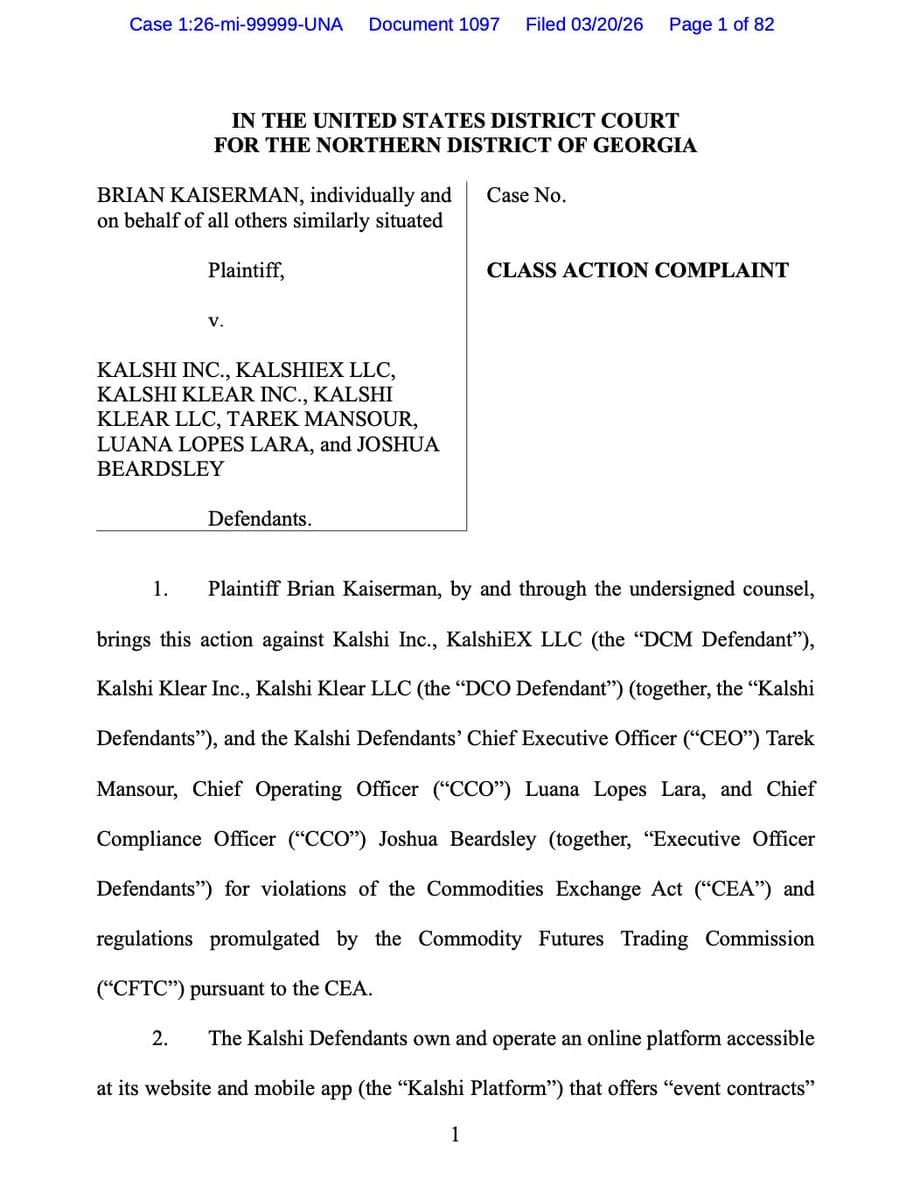
However, it is worth noting that a federal class action lawsuit was filed in March 2026 against Kalshi and its co-founders for allegedly offering sports-event contracts in violation of the Commodity Exchange Act (CEA) and CFTC Rule 40.11(a)(1). The suit invokes a private right of action under CEA § 25. This legal challenge introduces meaningful downside risk that prediction market traders should monitor closely.
Scenarios and probabilities
- Base scenario (55% estimated probability): Kalshi maintains its regulatory advantage and continues gaining U.S. market share. The legal challenge creates short-term uncertainty but is ultimately settled or narrowed. Industry-wide monthly volumes grow 15–25% through 2026. Polymarket and Predik retain relevance in crypto-native and LATAM segments, respectively, while Kalshi dominates the U.S. retail channel.
- Bull scenario (25% estimated probability): Kalshi resolves legal challenges quickly, completes an IPO at a valuation above $15 billion, and the Robinhood integration drives a wave of new retail participants. Total industry volumes surpass $40 billion monthly by late 2026. Competition raises all boats—Predik and Polymarket also see volume growth as mainstream awareness increases.
- Bear scenario (20% estimated probability): The class action lawsuit gains traction, leading to regulatory restrictions on sports-event contracts. The CFTC tightens oversight, slowing Kalshi's growth. Kalshi's valuation corrects to $5–7 billion. Market concentration fears materialize, with liquidity fragmenting across platforms and spreads widening for traders.
Impact on prediction markets
Kalshi's $11 billion valuation fundamentally changes the perception of prediction markets as an asset class. For traders on Predik and other platforms, there are several immediate implications.
First, the valuation attracts institutional capital to the space. As more funds allocate to prediction market infrastructure, liquidity across all platforms—including decentralized ones—tends to improve. February 2026 data already shows Polymarket growing 3.7% month-over-month to $7.9 billion in volume, suggesting that Kalshi's growth is not purely zero-sum.
Second, the regulatory divide is widening. Kalshi operates as a CFTC-regulated exchange with full KYC compliance, which commands a premium in institutional trust. Polymarket and crypto-native platforms offer different advantages: global access, anonymity, and on-chain settlement. This creates natural arbitrage opportunities—one trader recently identified a 30% arbitrage spread between Polymarket and Kalshi on a sports market, highlighting how regulatory fragmentation creates pricing inefficiencies that skilled traders can exploit.
Third, average activity per event on Kalshi remains relatively low at approximately $365, despite massive aggregate volume. This breadth-over-depth dynamic means that many individual markets remain thin, and traders who understand specific niches can find edge more easily than in deep, crowded markets.
Risks and what would invalidate this thesis
- Regulatory crackdown: The pending federal class action lawsuit against Kalshi could set a precedent restricting sports-event contracts, which represent a significant portion of recent volume growth. An adverse ruling could reduce Kalshi's valuation by 30–50% and chill the broader industry.
- Market concentration risk: If Kalshi captures too much market share through its Robinhood integration and regulatory moat, smaller platforms may lose liquidity. This would reduce competition and could lead to wider spreads and worse pricing for retail traders across the ecosystem.
- Valuation disconnect: An $11 billion valuation implies massive future revenue growth. If monthly volumes plateau or the path to profitability proves longer than expected, a valuation correction could trigger negative sentiment cascades across the prediction markets sector.
- Regulatory fragmentation in LATAM: While Kalshi's U.S. regulatory clarity is an advantage domestically, LATAM markets remain uncertain. Changes in local regulation—positive or negative—could significantly affect platforms like Predik that serve the region.
FAQ
Why is Kalshi valued at $11 billion in 2026? Kalshi's valuation reflects its dominant market position as a CFTC-regulated prediction market. The platform processes over $10 billion in monthly notional volume, hosts nearly 1 million open markets, and has integrated with Robinhood to access tens of millions of U.S. retail investors.
Who is Luana Lopes Lara and why is she on the Forbes 2026 list? Luana Lopes Lara is the Brazilian-born co-founder of Kalshi. At 28, she became the youngest self-made female billionaire on the Forbes 2026 Billionaires List, with her net worth driven by her equity stake in the $11 billion platform.
How does Kalshi compare to Polymarket in 2026? In February 2026, Kalshi led with $10.4 billion in monthly volume versus Polymarket's $7.9 billion. Kalshi's advantage lies in U.S. regulatory compliance and retail distribution through Robinhood. Polymarket offers global access and crypto-native settlement, attracting a different trader base. Both platforms grew month-over-month, suggesting the market is not yet zero-sum.
What does this mean for prediction market traders in Latin America? Kalshi's milestone legitimizes the entire prediction markets industry, likely attracting more capital and attention to the space globally. LATAM traders on platforms like Predik benefit from increased mainstream awareness and potentially deeper liquidity, while also facing the challenge of navigating a rapidly evolving competitive landscape between regulated and decentralized platforms.
Sources
Track markets like this in real time on Predik.