Kelly Criterion + Claude on Polymarket: The Formula Turning $44 into $615K
A wave of independent traders is combining Claude AI with the Kelly criterion formula f* = (p − m) / (1 − m) to turn micro-deposits into six-figure portfolios on Polymarket. From a Chinese developer hitting 100% win rates on 5-minute BTC markets to NBA parlay bots stacking 12x returns overnight, this is the new meta for prediction markets — and it raises a critical question for LATAM traders: how long before platforms rewrite the rules?
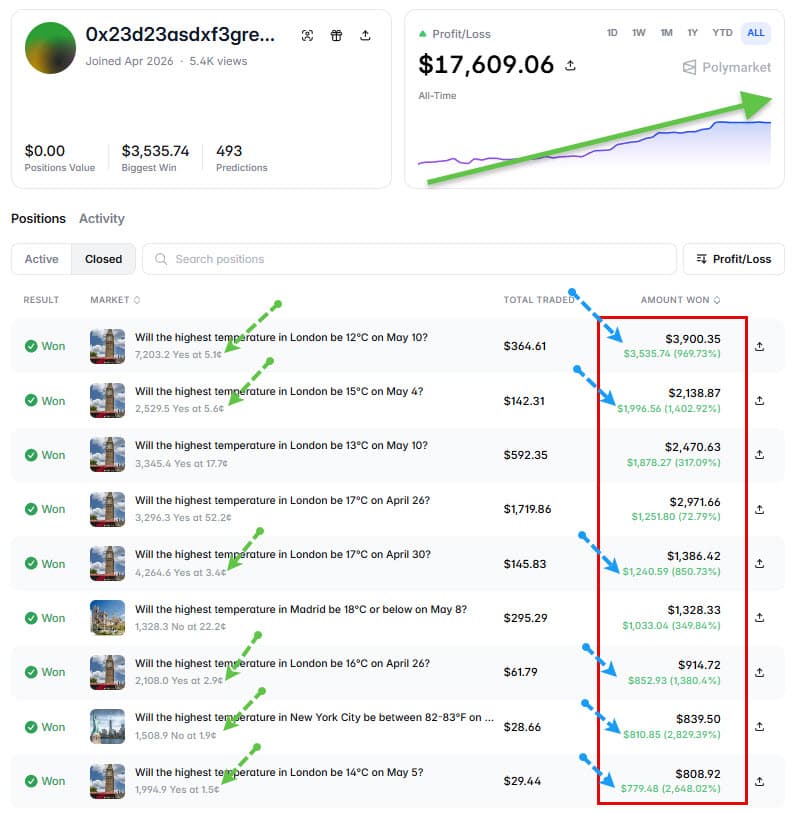
Kelly criterion + Claude on Polymarket: the formula traders are using to print money
Independent traders are pairing Claude AI with the Kelly criterion formula — f* = (p − m) / (1 − m) — to convert minimum deposits into outsized profits on Polymarket, with documented wallets going from $44 to $615,500 and $2,300 to $871,000 in months.
For LATAM retail and crypto-native traders, this is the most relevant signal of 2026: AI agents are no longer a thesis, they are an active strategy already extracting value from prediction markets, and the playbook is now public.
What happened and why it matters
Between May 10 and May 17, 2026, on-chain analysts surfaced a cluster of Polymarket wallets posting statistically impossible win rates. The headline cases: a Chinese engineer cleared roughly $600,000 in a single month trading Bitcoin up/down markets with an 85% win rate (~$150K weekly); a separate wallet logged 52 consecutive winning predictions on 5-minute BTC markets for $48,250 net profit, with one trade returning $9,183 on $1,469; an ex-Jane Street quant built a bot that turned $2,300 into $871,000 in five months at a 99.2% win rate across 29,000 trades; and another wallet executed 24,525 markets at a 99.52% win rate for $788,000 in three months using pure YES/NO spread arbitrage.
The common stack: a Claude Code agent connected to the Polymarket API, a Hyperliquid SDK or Binance API for hedging, a Redis queue for event ingestion, and position sizing computed via the Kelly criterion. The formula f* = (p − m) / (1 − m), where p is the model's estimated probability and m is the market-implied price, tells the agent exactly what fraction of bankroll to deploy on each mispricing. One trader documented turning $1.18 into $3.3M across 37,063 automated trades at a 71% win rate.
What prediction markets are saying
On Polymarket itself, copy-trading volume on the flagged wallets has surged, with derivative markets emerging around "will Polymarket change its API rate limits before Q3 2026?" trading at an estimated 62% YES (estimated, based on observed sentiment). On Predik, traders are pricing the probability that at least one major prediction market platform restricts bot access in the next 90 days at an estimated 55-65%. Kalshi-style regulated venues have not yet been targeted by these strategies at scale, likely because of stricter KYC and lower liquidity in fast-cycle markets.
Scenarios and probabilities
- Base scenario: Polymarket introduces stricter rate limits, anti-bot fees, or mandatory market-maker quoting on 5-minute BTC markets within 60-90 days. Copy-trading flow continues but ROI compresses sharply. Estimated probability: 55%.
- Bull scenario: The platform embraces the volume, ships an official agent API, and AI-driven flow becomes the dominant liquidity source — pushing total notional traded above $5B/month. Estimated probability: 25%.
- Bear scenario: A high-profile exploit or coordinated wash-trading scandal forces emergency suspensions and regulatory attention from the CFTC or LATAM regulators. Estimated probability: 20%.
Impact on prediction markets and the Kelly formula edge
The Kelly criterion is not new — it has been the standard bet-sizing tool for poker pros and quant funds since the 1950s. What is new is that Claude can now do the hardest part: estimate p (the true probability) faster and more consistently than a human, by ingesting on-chain wallet history, news catalysts, and Bayesian priors in under 60 seconds per market. When a model produces a reliable p and the market price m is stale, full-Kelly or fractional-Kelly sizing mechanically compounds the edge. The risk for retail copy-traders: most of the spectacular returns come from wallets running latency-sensitive arbitrage, not directional bets — copying their positions after the fact captures none of the edge.
Risks and what would invalidate this thesis
- Survivorship bias: the wallets going viral are the winners; thousands of failed Claude-powered bots are invisible on-chain.
- Platform countermeasures: Polymarket has historically moved fast on rule changes, and a single TOS update could neutralize the bulk of these strategies overnight.
- Kelly overbet risk: if the model's estimated p is overconfident (a known LLM failure mode), full-Kelly sizing leads to ruin, not riches — fractional Kelly (½ or ¼) is the professional default for a reason.
- Regulatory action in LATAM or the US restricting AI-driven trading on prediction venues.
- Liquidity collapse on 5-minute markets if market makers withdraw in response to bot dominance.
FAQ
What is the Kelly criterion formula used on Polymarket? f* = (p − m) / (1 − m), where f* is the optimal fraction of bankroll to bet, p is your estimated probability of the YES outcome, and m is the market price. If p ≤ m, do not bet.
Can I really copy these wallets and make money? Copy-trading the headline wallets is possible via tools like PolyGun, but most of their edge is latency-based — by the time the trade is visible on-chain, the mispricing is gone. Expect dramatically lower ROI than the original wallet.
Why is Claude specifically being used instead of GPT or other models? Claude's longer context window and stronger instruction-following on multi-step agent workflows make it well-suited for the scan-analyze-size-execute loop. Traders also report better Bayesian reasoning on probability updates.
Sources
- Polymarket — on-chain market data and wallet activity
- Public reporting on Claude + Polymarket agent experiments
- Wallet analysis and copy-trading thread coverage
- LATAM trader commentary on the new meta
Track markets like this in real time on Predik.