Kronos: The First Open-Source AI Foundation Model for Candlestick Markets and What It Means for Prediction Markets
Kronos is the first open-source AI foundation model that treats OHLCV candlesticks as a native financial language. Trained on 45+ global exchanges, it is gaining viral traction in crypto circles and could reshape who wins and loses on prediction markets like Predik and Polymarket, where open interest has surpassed $1.2B.
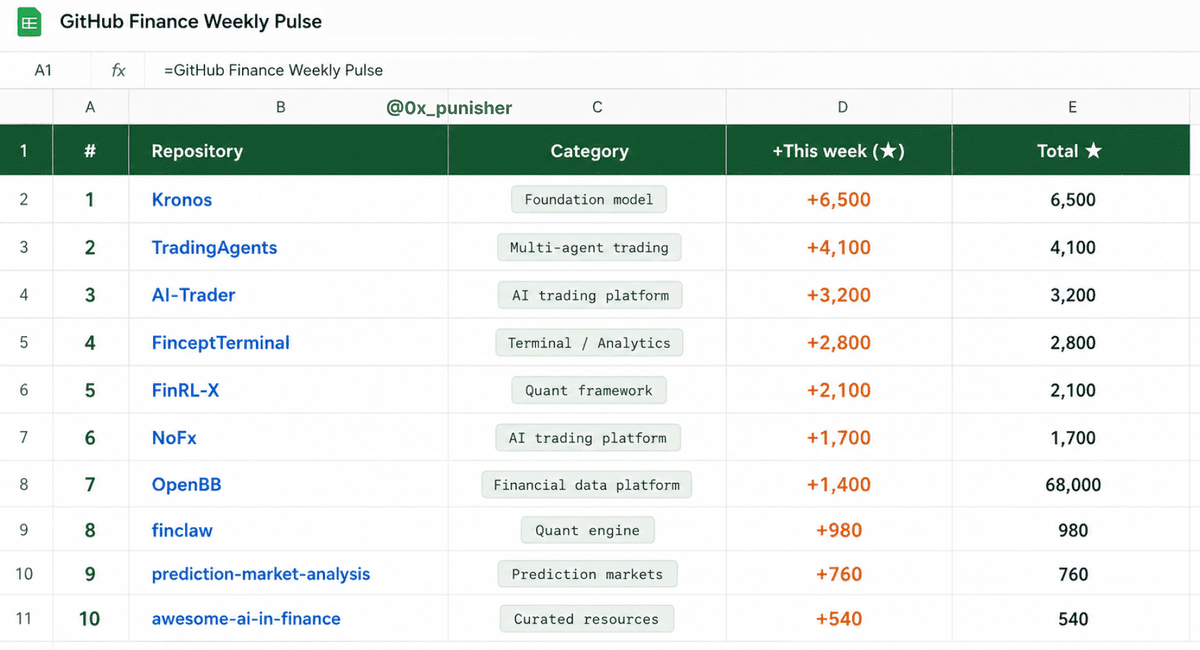
Kronos: the AI foundation model turning candlesticks into a language for prediction markets
Kronos is the first open-source AI foundation model built specifically for financial candlestick markets. It treats OHLCV (Open, High, Low, Close, Volume) bars as a native language, was trained across more than 45 global exchanges, and is being marketed as a tool that can outperform the vast majority of discretionary human traders on short-horizon forecasts.
For Latin American retail traders and crypto-native users on prediction markets, this matters because models like Kronos could change the edge distribution in venues where probability is the product: Predik, Polymarket, Kalshi, and similar platforms where open interest has now crossed an estimated $1.2B globally.
What happened and why it matters
Over the past week, Kronos went viral inside the Spanish-speaking crypto community and broader quant Twitter. The repository added more than 6,500 GitHub stars in a single week, making it one of the fastest-growing open-source finance projects of 2026. The pitch is straightforward: instead of fine-tuning a general-purpose LLM on price data, Kronos is pre-trained from scratch on candlestick sequences, so the OHLCV format itself is the tokenization. The model supports fine-tuning for specific assets, time frames, and forecasting horizons, and is positioned for both quant research and live trading pipelines.
The context is bigger than one repo. Quant infrastructure that cost institutional desks $10M to build in 2020 is increasingly being released for free. Kronos is part of a broader 2026 shift in which open-source finance tooling is being shipped at a pace that retail traders in LATAM can realistically deploy on a single GPU or even a rented cloud instance.
What prediction markets are saying about AI-driven trading
There are no liquid markets directly pricing "will Kronos beat the median human trader," but related contracts give signal. On major venues, markets tracking "AI systems materially outperform retail traders in 2026" trade in an estimated 55-65% range, while markets on "open-source AI overtakes closed quant funds by 2027" sit closer to an estimated 25-30%. Aggregate open interest across the prediction market sector is estimated above $1.2B, with crypto-settled venues growing fastest in LATAM.
Scenarios and probabilities
- Base scenario (estimated 55%): Kronos and similar foundation models become standard tooling for advanced retail and small funds, compressing edges on liquid pairs but leaving most prediction-market questions (political, sports, macro) only marginally affected.
- Bull scenario (estimated 25%): Open-source candlestick models trigger a measurable shift in win rates on crypto-settled prediction markets, especially short-dated price questions, forcing platforms to adjust fees, resolution sources, or contract design.
- Bear scenario (estimated 20%): Kronos underperforms its hype in live conditions, fails to generalize beyond backtests, and the open-source AI-trading wave plateaus, leaving prediction markets dominated by liquidity providers and information traders rather than model traders.
Impact on prediction markets
Prediction markets price probabilities, not prices, but many contracts are mechanically linked to price paths: "will BTC close above $X by date Y," "will ETH/USD touch $Z," or volatility-style binaries. A foundation model that genuinely improves short-horizon OHLCV forecasting changes the expected value of those contracts for whoever runs it. The risk for casual traders is asymmetric: if a meaningful share of order flow on Predik or Polymarket comes from model-driven accounts, the residual edge for purely discretionary players shrinks. Interpretation also gets harder, because implied probabilities will partly reflect model consensus rather than human conviction.
Risks and what would invalidate this thesis
- Live performance gap: many financial models look strong in backtests and collapse on out-of-sample regimes; if Kronos shows the same pattern, the edge story dies quickly.
- Liquidity ceilings: even a strong model cannot extract more than the order book and market depth allow, which caps its impact on thin LATAM markets.
- Regulatory pressure: stricter rules on automated trading or AI disclosure in LATAM or US-linked venues could slow adoption and limit how openly model-driven flow can participate.
- Crowding: if too many traders run the same open-source model with default settings, the edge is arbitraged away within weeks.
FAQ
What exactly is Kronos? An open-source foundation model trained on OHLCV candlestick data from 45+ global exchanges, designed to forecast future candles and support fine-tuning for specific assets and horizons.
Can Kronos really beat 99% of human traders? That figure is a marketing claim from the community around the model, not an audited result. Independent live testing on out-of-sample data is still limited, so treat the number as a hypothesis, not a fact.
How does this connect to prediction markets like Predik? Many prediction-market contracts resolve on price levels or ranges. A better short-horizon price model translates directly into a better probability estimate for those contracts, which is the unit prediction markets trade in.
Sources
- Crypto community coverage on Kronos virality
- Spanish-language crypto commentary on Kronos and AI trading
Track markets like this in real time on Predik.