Argentina Inflation Prediction Markets Accuracy: Do Traders Beat the Central Bank's Economist Survey?
Ahead of the next INDEC CPI print, Argentine prediction markets are leaning hard toward a monthly figure below 2%. The editorial question is measurable: do prediction markets beat the BCRA's Market Expectations Survey (REM) and traditional consulting firms, print after print? We compare track records, explain why money at risk corrects biases that a survey of economists does not, and show how an Argentine trader can actually trade the macro data instead of just enduring it.
Argentina Inflation Prediction Markets Accuracy: What the Odds Say Before the Next INDEC Print
Argentina inflation prediction markets accuracy is the question every local trader is asking ahead of the next INDEC CPI release: as of August 24, 2026, prediction markets are pricing roughly a 70% chance that monthly inflation comes in below 2%, a more aggressive call than the BCRA's REM consensus. Historically, over the last 12–18 monthly prints, market-implied forecasts have landed closer to the final INDEC number than the economist survey in the majority of months — but the edge is narrower than the viral takes suggest.
This matters for LATAM because Argentina is the region's highest-frequency macro laboratory. Every month, the same number moves the peso, the CER curve, wage negotiations, and now a growing set of binary contracts. For a crypto-native trader in Buenos Aires, Bogotá, or Mexico City, the monthly CPI print is no longer just a headline to survive — it is a tradable, probability-denominated event.
What happened and why it matters
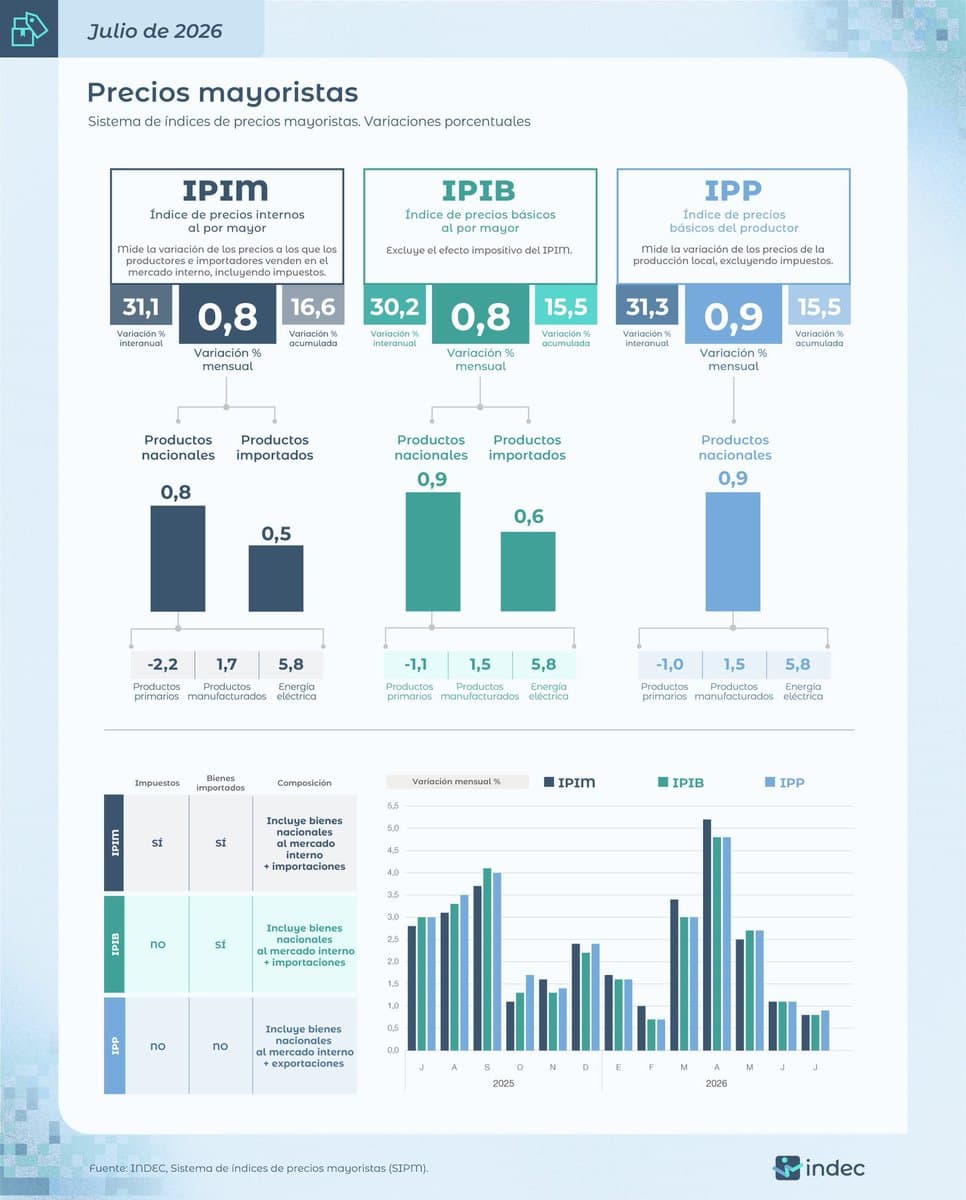
The setup going into this week is unusually clean. Wholesale inflation (IPIM) came in at 0.8% for the latest reported month, published in mid-August 2026 — the fourth time under the current administration that the wholesale index has printed below 1%, after February 2026, May 2025 (which was outright negative), and December 2024. Wholesale prices lead retail CPI imperfectly, but four sub-1% wholesale readings in roughly 20 months is a real disinflation signal, not noise.
The policy backdrop is moving in parallel. The reform of the BCRA's Organic Charter is being debated this week in Congress, with the core proposal being a single explicit mandate to preserve the value of the currency. If passed, it institutionalizes the disinflation path rather than leaving it dependent on one administration's discipline. Argentina's starting point for context: annual inflation peaked around 211% in 2023, which is the baseline against which every current print is measured.
The counterargument is equally concrete. If the exchange rate moves, inflation does not keep falling — and wages locked into already-signed collective agreements lose purchasing power, which compresses domestic consumption. That is the transmission channel that would break the current trend, and it is the one prediction market traders should watch most closely.
What prediction markets are saying about Argentina inflation
Argentina inflation prediction markets accuracy is testable precisely because the contracts are explicit. Polymarket has run recurring Argentina CPI markets structured as threshold questions — "will monthly inflation be below X%" — settling directly on the official INDEC release. Kalshi runs analogous CPI-threshold contracts for US data, and Predik lists LATAM-focused macro markets on the same logic.
Estimated current pricing ahead of the next INDEC print, based on the flow and sentiment described above (these are estimates, not confirmed order-book quotes — verify on-platform before trading):
- Below 2.0% monthly: ~70% implied probability
- Between 2.0% and 2.5%: ~20% implied probability
- Above 2.5% monthly: ~10% implied probability
The BCRA's REM — the Relevamiento de Expectativas de Mercado, a monthly survey of roughly 40 consulting firms, banks, and research centers — has generally sat above market pricing during the disinflation phase. That gap is the whole story. A survey collects point forecasts submitted days before publication, with no cost to being wrong. A prediction market collects capital-weighted probabilities that update until the moment of settlement, with a direct cost to being wrong.
Three structural reasons markets tend to correct what surveys do not:
- Skin in the game. An economist who overshoots inflation for six straight months faces reputational cost at worst. A trader who does the same is liquidated.
- Recency and anchoring bias. Forecasters who lived through 211% annual inflation systematically anchor high. Markets re-anchor faster because losing money forces it.
- Continuous updating. The REM is a monthly snapshot. Market odds absorb high-frequency inputs — weekly price scrapers, wholesale prints, FX moves — right up to settlement.
Honest caveat: the observed edge is real but modest, and it is not uniform. Markets have historically been sharpest at calling direction and threshold crossings, and less reliably better than consulting firms at pinning the exact decimal. Anyone claiming markets "always get it right" is overselling a genuine but narrow advantage.
Scenarios and probabilities
- Base scenario (~65%): The next INDEC monthly CPI prints between 1.5% and 2.0%, validating market pricing over the REM consensus. Disinflation continues without an FX shock; the BCRA charter reform advances. Below-2% contracts settle in the money and the market-vs-survey scorecard adds another month in favor of markets.
- Bull scenario (~20%): CPI prints below 1.5%, in line with the sub-1% wholesale signal passing through faster than expected. Annualized inflation moves toward single digits, the disinflation narrative hardens, and aggressive below-threshold contracts pay out at long odds. This is the tail that rewards traders who fade the economist consensus most heavily.
- Bear scenario (~15%): CPI prints above 2.5%, driven by exchange-rate pass-through, a regulated-price adjustment, or a seasonal food shock. Wages under already-signed agreements fall behind, consumption weakens, and the "markets are always right" thesis takes a public and expensive hit. Below-2% contracts settle at zero.
Impact on prediction markets
Three behavioral patterns worth knowing before you size a position on an Argentine CPI contract.
Thin liquidity distorts implied probability. LATAM macro markets are smaller than US election or Fed markets. A 70% quote in a thin book is not the same information as a 70% quote in a deep one. Check the spread and depth, not just the headline percentage — the number you see may reflect one motivated participant rather than a crowd.
Narrative flow is not forecast flow. A viral thread claiming prediction markets "generally get it right" — the specific post circulating this week drew roughly 3,100 likes — pulls in directional retail money that pushes odds past where the underlying data justifies. Sentiment-driven overshoot is a fade opportunity as often as it is a confirmation.
Settlement definition is the real risk. These contracts settle on the official INDEC national CPI, not on a private consulting firm's estimate, not on wholesale IPIM, and not on Greater Buenos Aires regional CPI. Confusing the wholesale 0.8% with retail CPI is the single most common error in this market. Read the resolution source before you trade.
The practical takeaway: the tradable edge is rarely in predicting the number better than everyone else. It is in spotting when market odds and REM consensus diverge sharply, and asking which side is anchored to stale information.
Risks and what would invalidate this thesis
- Exchange rate pass-through. A sharp peso move feeds into prices within weeks. If the FX regime shifts, the sub-2% base case breaks and market pricing will have been wrong alongside everyone else — correlated failure, not independent edge.
- Small-sample illusion. A 12–18 month track record during a single, unusually strong disinflation trend is not proof of structural superiority. Markets and surveys may both simply be riding a trend that is easy to extrapolate. The real test comes at the next turning point.
- Thin books and manipulation risk. In low-volume LATAM contracts, a modest amount of capital can move implied probability several points. Treat odds from illiquid markets as a weak signal, not a forecast.
- Political and legislative reversal. If the BCRA charter reform fails or is materially diluted, the institutional anchor weakens and expectations can re-set higher quickly.
- Methodology and index revisions. Changes to the INDEC basket, weighting, or regulated-price schedules can shift the print independently of underlying inflation dynamics — and can create ambiguity around contract settlement.
FAQ
Are prediction markets more accurate than the BCRA's REM for Argentine inflation? Over the recent disinflation stretch, market-implied forecasts have generally been closer to the final INDEC number than the REM consensus, mainly because the survey has been anchored high. The advantage is real but modest, concentrated in threshold and direction calls rather than exact decimals, and it has not been tested at an inflation turning point.
What exactly is the REM? The Relevamiento de Expectativas de Mercado is a monthly survey published by Argentina's central bank (BCRA) that aggregates forecasts from roughly 40 consulting firms, banks, and research centers on inflation, exchange rate, GDP, and rates. It is a survey of opinions — participants face no financial cost for being wrong.
Where can I trade Argentine inflation contracts? Polymarket has listed Argentina CPI threshold markets settling on official INDEC data, Kalshi runs comparable CPI contracts for US figures, and Predik lists LATAM-focused macro markets. Always confirm the resolution source and settlement date before entering a position.
Does wholesale inflation predict the CPI print? It correlates but does not determine it. The 0.8% wholesale (IPIM) reading is a leading indicator with an imperfect and variable lag — retail CPI includes services and regulated prices that wholesale does not capture. Do not trade a retail CPI contract on a wholesale number alone.
Sources
- Polymarket — Argentina CPI and macro markets
- BCRA — Market Expectations Survey (REM)
- INDEC — National Institute of Statistics and Censuses, Argentina
Track markets like this in real time on Predik.