MOVE Index Hits 8-Month High as US Bond Crisis Reshapes Prediction Markets
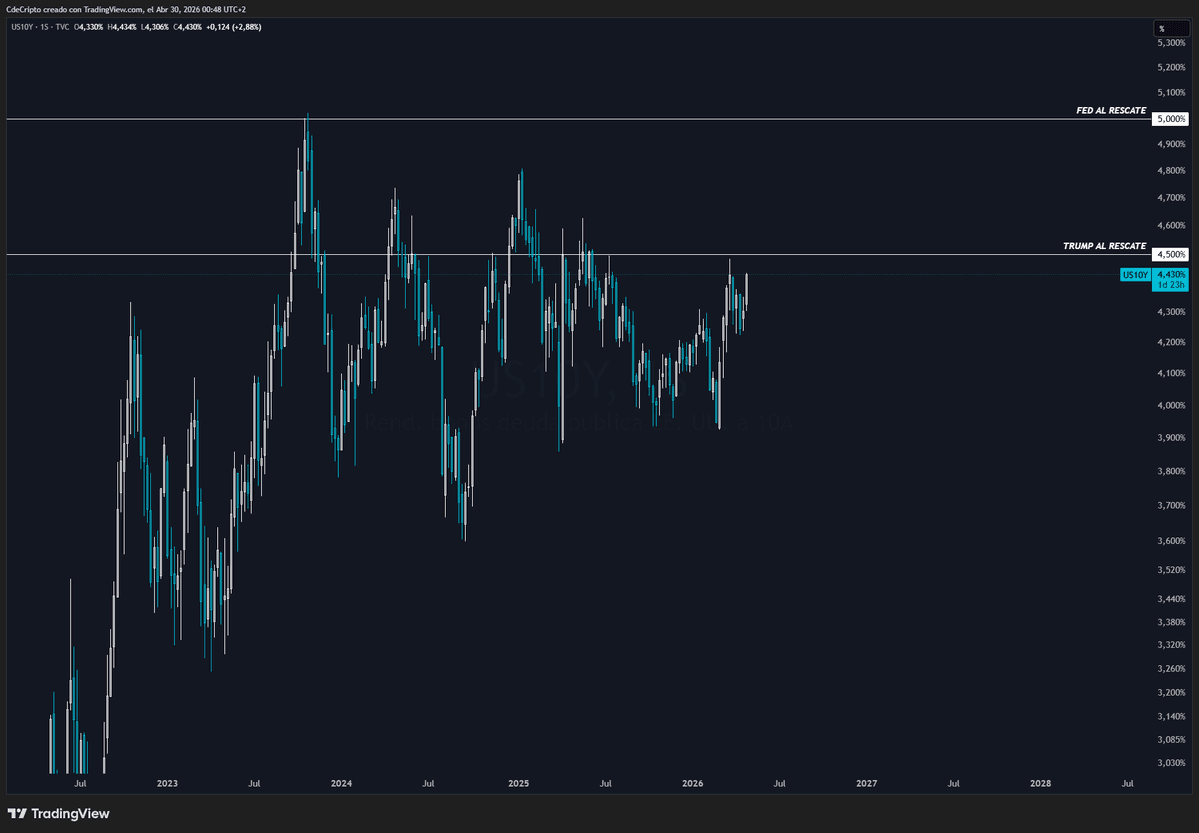
The 10-year US Treasury yield has surged to 4.46%, its highest level in eight months, while the MOVE Index — often called the VIX for bonds — has spiked to levels not seen since April 2025. With Trump publicly voicing concern over the debt market turmoil, prediction markets are repricing recession odds, Fed rate cut timelines, and the Bitcoin-as-safe-haven thesis. Here is what the data says and how LATAM traders can position around it.
MOVE Index Surges to 8-Month High: What the US Bond Crisis Means for Prediction Markets
The 10-year US Treasury yield has climbed to 4.46% — its highest reading in eight months — while the MOVE Index, widely considered the "VIX for bonds," has hit levels not seen since April 2025. This twin spike signals a deep fracture in fixed-income confidence that is now directly repricing prediction markets on US recession, Fed rate cuts, and Bitcoin's role as an alternative store of value.
For LATAM retail and crypto-native traders, this matters because US bond volatility sets the tone for global risk appetite, dollar liquidity, and the probability curves on platforms like Polymarket, Kalshi, and Predik. When the world's benchmark "risk-free" asset wobbles, everything downstream — from emerging-market currencies to crypto — recalibrates.
What happened and why it matters
In the first days of May 2026, the yield on the US 10-year Treasury note pushed to 4.46%, a level that historically has triggered direct government intervention. The MOVE Index (Merrill Lynch Option Volatility Estimate), which measures implied volatility across the US Treasury curve, simultaneously reached an 8-month peak, reflecting surging uncertainty among institutional bond traders.
Several forces are converging. Geopolitical stress from the ongoing US-Iran standoff has pushed oil to $118 per barrel, fueling inflation expectations. Gulf states have accelerated sales of US sovereign debt. China continues to offload US Treasuries while accumulating gold — a pattern that undermines the structural demand base that has kept US borrowing costs low for decades. The petrodollar framework, the backbone of US economic hegemony since the 1970s, is showing visible cracks as energy payments increasingly shift to yuan.
Meanwhile, US equities remain near all-time highs, creating a rare and historically unstable divergence: rising bond yields alongside a rallying stock market. Analysts note this disconnect tends to resolve violently — either stocks correct downward or yields retreat through policy intervention. Former President Trump has publicly expressed alarm about the bond sell-off, and market participants recall that previous yield spikes in this range during his tenure prompted direct pro-market actions.
What prediction markets are saying
On Polymarket, the probability of a US recession beginning before Q4 2026 has climbed to an estimated 38–42%, up from roughly 28% in early April. Fed rate cut contracts for the June and July 2026 FOMC meetings now price in approximately 55% odds of at least one 25-basis-point cut — a sharp repricing from 35% just three weeks ago. Markets appear to be betting that the bond volatility will eventually force the Fed's hand, even as inflation remains sticky above target.
Bitcoin-related prediction markets tell a parallel story. The probability that BTC surpasses $120,000 by August 2026 has firmed to around 30%, with traders citing the breakdown of confidence in sovereign bonds as a structural catalyst for "digital gold" narratives. On Predik, emerging-market currency contracts tied to the dollar are seeing elevated volume as LATAM traders hedge against spillover effects from US fixed-income turmoil.
In a notable regulatory development, the US Senate unanimously banned sitting senators from trading on prediction markets like Polymarket and Kalshi — a move that paradoxically legitimizes the industry by treating it as a financially significant venue. Separately, Polymarket has formally requested CFTC approval to launch its primary exchange onshore in the United States, a step that could dramatically expand liquidity and market depth if approved.
Scenarios and probabilities
- Base scenario (50% estimated probability): Bond yields stabilize in the 4.30–4.50% range through May as the Fed maintains hawkish rhetoric but signals readiness to act. The MOVE Index gradually retreats. Prediction markets price recession odds at 35–40%, and Bitcoin consolidates between $95,000 and $110,000. LATAM currencies experience moderate pressure but no crisis-level moves.
- Bull scenario (20% estimated probability): A diplomatic breakthrough in US-Iran tensions pushes oil below $100, easing inflation fears. The Fed delivers a surprise dovish pivot or the Treasury announces buybacks. Yields drop below 4.20%, the MOVE Index normalizes, and risk assets rally hard. Recession odds on Polymarket fall below 25%. Bitcoin breaks $120,000 on renewed liquidity optimism.
- Bear scenario (30% estimated probability): China accelerates Treasury liquidation, Gulf states follow suit, and oil pushes above $130. The 10-year yield breaches 4.70%, triggering margin calls and forced selling across leveraged fixed-income positions. The MOVE Index spikes past 150. Prediction markets reprice US recession probability above 55%. Bitcoin initially drops on a broad risk-off move before recovering as the sovereign-debt-crisis narrative strengthens the digital-gold thesis.
Impact on prediction markets
The MOVE Index is not just a volatility gauge — it is a leading indicator for how prediction markets reprice tail risks. When bond volatility spikes, the implied uncertainty around Fed policy, government solvency, and macro outcomes widens. This creates both opportunity and danger for traders on platforms like Predik and Polymarket.
Specifically, elevated MOVE readings tend to increase the premium on "extreme outcome" contracts. Recession bets become more expensive to enter, rate-cut contracts see wider bid-ask spreads, and crypto-linked markets experience higher implied volatility. For LATAM traders, the key transmission mechanism is the dollar: rising US yields typically strengthen the greenback, pressuring local currencies and making dollar-denominated prediction contracts more expensive in real terms.
The divergence between US stocks at all-time highs and bonds flashing distress signals is a classic setup for a volatility event. Prediction market participants should watch whether this gap closes from the equity side (stocks sell off) or the bond side (yields retreat) — the direction of convergence will determine which contracts pay out.
Risks and what would invalidate this thesis
- Coordinated central bank intervention: If the Fed, Treasury, and allied central banks announce emergency bond-buying programs or swap lines, the MOVE Index could collapse rapidly, invalidating bearish prediction market positions.
- Geopolitical de-escalation: A sudden resolution to the US-Iran conflict or a trade détente with China could remove the fundamental drivers of bond selling, causing a sharp yield reversal that wrong-foots traders positioned for continued turmoil.
- Inflation surprise to the downside: If upcoming CPI data prints significantly below expectations, the Fed gets room to cut preemptively, and the entire bond-crisis narrative unwinds — taking recession market probabilities down with it.
- Prediction market liquidity risk: Regulatory uncertainty around Polymarket's CFTC application and the new Senate trading ban could temporarily reduce liquidity, making contract prices less reliable as probability signals.
FAQ
What is the MOVE Index and why does it matter for prediction markets? The MOVE Index measures implied volatility in US Treasury options — essentially, how much uncertainty exists around future bond prices. When it spikes, it signals institutional stress in fixed income, which cascades into prediction markets by widening the probability distributions on macro outcomes like recession, rate changes, and currency moves.
How does the 10-year Treasury yield at 4.46% affect crypto markets? Higher Treasury yields make "risk-free" government bonds more attractive relative to speculative assets like crypto. However, when yields rise due to a loss of confidence in sovereign debt — as opposed to healthy economic growth — Bitcoin can benefit from its "digital gold" narrative as investors seek alternatives to government-backed instruments.
Should LATAM traders be worried about spillover effects? Yes. Rising US yields and a stronger dollar typically tighten financial conditions in emerging markets, pressuring local currencies and increasing the cost of dollar-denominated debt. LATAM traders should monitor the DXY index and local FX markets alongside prediction contract prices for correlated moves.
Sources
- Polymarket — Prediction Market Data
- CryptoRover on X — Market Commentary
- FRED — 10-Year Treasury Constant Maturity Rate
- ICE — MOVE Index Overview
Track markets like this in real time on Predik.