Prediction Markets Open Interest Hits All-Time High Above $1.2 Billion — What LATAM Traders Need to Know
Aggregate open interest across major prediction markets surpassed $1.2 billion in the last week of March 2026, setting a new all-time high. Kalshi leads with $497 million, followed by Polymarket at $457.5 million, as geopolitical tensions, crypto volatility, and the approaching 2026 FIFA World Cup drive unprecedented volumes. For Latin American traders, the surge means deeper liquidity and tighter spreads — but also new competition from AI bots and institutional players reshaping the market.
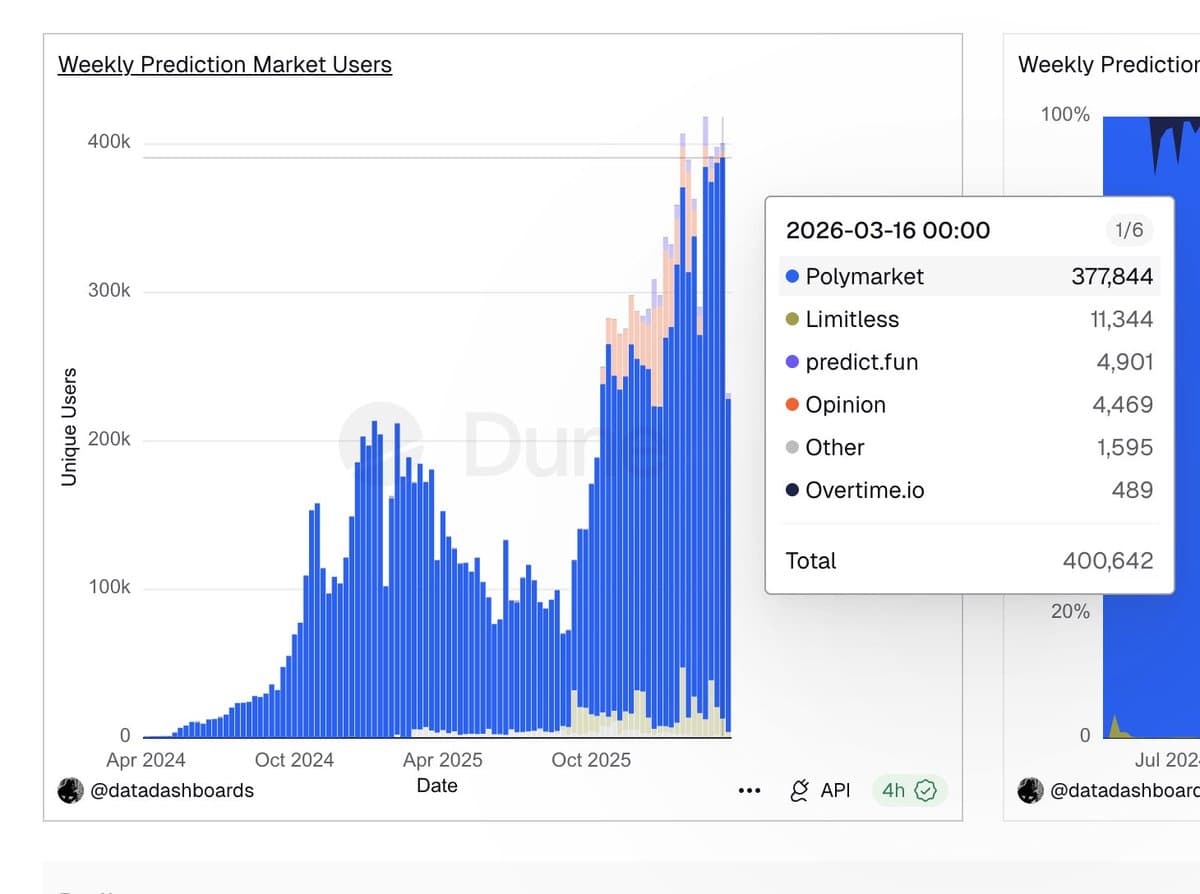
Prediction Markets Open Interest Reaches All-Time High in March 2026
Aggregate open interest across the world's largest prediction markets has crossed $1.2 billion for the first time, with weekly notional volume hitting $6.41 billion during the week ending March 25, 2026. This all-time high eclipses even the frenzy around the 2024 U.S. presidential election and marks a structural shift in how global participants — including a growing wave of LATAM retail traders — are pricing real-world events.
For traders in Latin America, this milestone matters beyond the headline number. Higher open interest translates directly into deeper order books, tighter bid-ask spreads, and more reliable price signals on the outcomes you care about. But the same growth is attracting automated trading bots and institutional capital that are fundamentally changing the dynamics of these markets.
What happened and why it matters
During the week of March 20–25, 2026, prediction market platforms reported record-breaking figures. Kalshi led all platforms with $3.40 billion in weekly notional volume and $497 million in open interest. Polymarket followed with $2.54 billion in weekly volume, $457.5 million in open interest (up 10.7% week-over-week), and a total value locked of $434.7 million. Polymarket's cumulative historical volume reached $49.13 billion, with over 2.38 million registered traders and 344 million trades executed since inception — the latter growing 19.6% in a single reporting period.
Smaller platforms contributed meaningfully as well: Crypto.com processed $158.7 million, OpinionLabs reached $128.5 million, and Limitless handled $98.5 million in weekly volume. Combined with Predict.fun ($60.3 million), Overtime ($4 million), and others, the ecosystem's total weekly volume exceeded $6.4 billion — a figure that would have been unthinkable just eighteen months ago.
Three catalysts are driving this surge. First, escalating geopolitical tensions between Iran and the United States have generated massive trading interest in conflict-related outcome markets. Second, renewed crypto volatility — with Bitcoin 5-minute markets alone producing individual traders $20,000 in weekly profits through automated strategies — has attracted speculative capital. Third, the proximity of the FIFA World Cup 2026, set to kick off in June across North American venues, is already creating sports prediction volume months before the tournament begins.
What prediction markets are saying about their own growth
Polymarket's open interest has now surpassed its peak during the 2024 U.S. election cycle, a milestone confirmed by multiple independent data trackers in the third week of March 2026. At the time of the election, Polymarket was essentially a single-event platform in terms of liquidity concentration. The fact that current open interest exceeds that level — spread across geopolitics, crypto, sports, and entertainment markets — signals genuine diversification in market participation.
Kalshi, the U.S.-regulated prediction exchange, has matched this trajectory with over $400 million in open interest of its own. Both platforms are simultaneously tightening insider trading controls amid Senate scrutiny, suggesting that regulatory maturity is keeping pace with growth rather than lagging behind it.
On the DeFi side, Hyperliquid's HIP-3 perpetual prediction protocol saw open interest jump 25% in a single week to $1.74 billion, driven by 24/7 trading in commodities like oil, silver, and gold — assets that traditional prediction markets do not cover.
Scenarios and probabilities
- Base scenario (55% estimated probability): Aggregate prediction market open interest stabilizes between $1.0B and $1.5B through Q2 2026, with steady growth driven by World Cup markets and ongoing geopolitical events. Liquidity improves for LATAM-relevant markets but remains concentrated in U.S.-centric outcomes.
- Bull scenario (25% estimated probability): Open interest breaks $2B by mid-2026 as World Cup betting volumes compound with a major geopolitical resolution market (e.g., Iran deal or ceasefire). Institutional market makers enter aggressively, compressing spreads to sub-1% on high-volume markets. LATAM-specific markets on Predik and competitors see 3–5x volume growth.
- Bear scenario (20% estimated probability): Regulatory crackdown — particularly from the U.S. Senate — forces Kalshi or Polymarket to restrict market creation. A flash crash or manipulation event in a high-profile market erodes retail confidence. Open interest drops below $800M and takes two or more quarters to recover.
Impact on prediction markets and open interest dynamics
The all-time high in open interest is reshaping how traders should approach prediction markets in three specific ways.
First, deeper liquidity means that mid-size positions ($5,000–$50,000) can now be entered and exited on major markets without significant slippage — a material improvement over 2024 conditions where anything above $10,000 moved prices noticeably.
Second, the rise of AI-powered trading bots is creating a new competitive layer. Automated systems that analyze spot ETF inflows, CME open interest, and the DXY index in real time are already generating consistent returns on Polymarket's short-duration crypto markets. One documented strategy produced $20,000 in profit in a single week on 5-minute Bitcoin markets without any manual intervention. For retail traders who rely on gut instinct or delayed news, competing against these systems on pure price prediction is increasingly difficult.
Third, the gap between Kalshi (regulated, U.S.-only KYC) and Polymarket (crypto-native, global access) creates distinct opportunities for LATAM traders. Polymarket's permissionless structure provides access, while Kalshi's regulated framework offers legal clarity. Traders should understand which platform matches their risk profile and jurisdictional constraints.
Risks and what would invalidate this thesis
- Regulatory intervention: Both Kalshi and Polymarket are under increased Senate scrutiny over insider trading. A forced shutdown or restriction of specific market types could cut open interest by 30–40% overnight.
- Smart contract or platform failure: With $434.7 million in TVL on Polymarket alone, a security exploit or oracle manipulation would cause cascading liquidations and a severe confidence crisis.
- AI bot dominance: If automated strategies extract enough edge to make manual trading consistently unprofitable, retail participation could plateau or decline — reducing the diversity of opinion that makes prediction markets valuable.
- Liquidity concentration risk: Despite the headline $1.2B figure, open interest is concentrated in a handful of high-profile markets. Long-tail markets (including many LATAM-relevant outcomes) may still suffer from thin order books and wide spreads.
FAQ
What does all-time high open interest mean for prediction markets? Open interest measures the total value of unsettled positions across all active markets. The $1.2 billion ATH means more capital than ever is actively committed to outcome predictions, providing deeper liquidity and more accurate probability signals.
Which platforms have the highest open interest in March 2026? Kalshi leads with $497 million in open interest, followed by Polymarket at $457.5 million. On the DeFi side, Hyperliquid's HIP-3 reached $1.74 billion, though it covers perpetual contracts rather than pure prediction markets.
How does this affect LATAM traders specifically? Higher aggregate open interest means better execution quality (tighter spreads, less slippage) on globally traded markets. However, LATAM-specific markets remain thinner, and traders should watch for the expansion of regional outcomes on platforms like Predik to capture local edges.
Are AI bots a threat to retail prediction market traders? Automated strategies are already profitable on short-duration markets, particularly crypto price predictions. Retail traders can maintain an edge on longer-duration, information-intensive markets (politics, regulation, cultural events) where local knowledge matters more than execution speed.
Sources
- Polymarket — Official Platform
- Kalshi — Official Platform
- PolyData — Polymarket Analytics (stats as of March 24, 2026)
Track markets like this in real time on Predik.