OpenClaw: The Autonomous AI Agent Making Thousands Overnight on Polymarket Spreads
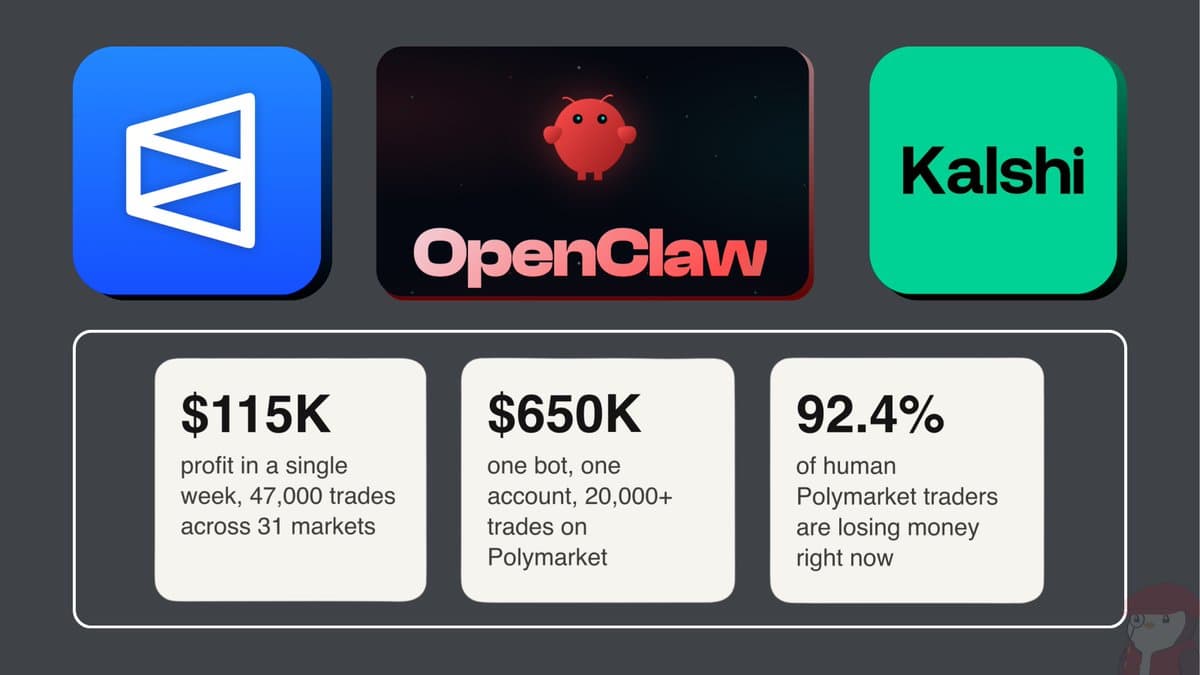
OpenClaw, an autonomous AI trading agent, went viral this week as users reported overnight profits from $6,700 to $50,000 by exploiting NOAA weather spreads on Polymarket with roughly 94% accuracy. One account alone logged over 20,000 trades and $650,000 in profits. But is this the democratization of quant trading — or the beginning of the end for retail traders clicking manually?
OpenClaw AI Agent: Autonomous Trading on Polymarket Explained
OpenClaw is an autonomous AI agent that trades prediction market spreads on Polymarket, and this week it became the most talked-about tool in crypto. Users report overnight profits ranging from $6,700 to $50,000 by exploiting pricing inefficiencies in NOAA weather contracts — buying at 11¢ and selling at 44¢ while they sleep, with an estimated accuracy rate of roughly 94%.
For LATAM retail traders and crypto-native speculators, OpenClaw represents a pivotal moment: AI-powered autonomous trading, once reserved for hedge funds with seven-figure budgets, is now accessible to anyone with a $20/month Claude subscription. But the implications cut both ways — and prediction market participants need to understand what is happening before the edge disappears.
What happened and why it matters
Over the past two weeks (early-to-mid April 2026), OpenClaw-powered bots began dominating specific segments of Polymarket, particularly weather-related contracts tied to NOAA (National Oceanic and Atmospheric Administration) data feeds. The strategy is straightforward in concept: the AI agent monitors real-time weather data, identifies mispriced prediction contracts, and executes spread trades automatically — often across 50 or more markets simultaneously.
The numbers are striking. One widely cited account accumulated over 20,000 trades on Polymarket with an estimated $650,000 in total profits. A 21-year-old student from Shanghai Jiao Tong University reportedly built an automated trading bot using Claude Code in just two days — the system monitors price discrepancies across 50+ Polymarket markets while syncing with Binance for short-term crypto price analysis. Meanwhile, a separate autonomous trading system called WaveRider posted an 82.2% win rate across 366 out-of-sample trades with only 0.4% maximum drawdown over 11 days, using seven layers of risk management that reject 87% of incoming signals.
The cost barrier has collapsed. Running these AI agents previously required thousands of dollars in API tokens. Now, a $20/month Claude subscription provides comparable capability. As one trader summarized the progression: OpenClaw, then Hermes Agent, then Claude Dispatch — each iteration cheaper and faster. The competitive moat that early adopters enjoyed lasted months, not years.
What prediction markets are saying
There are no direct Polymarket contracts asking "Will AI bots dominate prediction markets by Q3 2026?" — but the signal is embedded in market behavior. Spreads in weather markets and other data-verifiable categories have been tightening rapidly as bot participation increases, suggesting the easy arbitrage windows are already narrowing.
On Predik and similar LATAM-focused platforms, the conversation has shifted from whether to use AI tools to which ones. Crypto influencers in the Spanish-speaking community are already listing OpenClaw alongside prediction markets as essential tools for 2026. Estimated probability that autonomous AI agents will account for more than 30% of Polymarket volume by end of Q3 2026: approximately 55-65%, based on the current adoption trajectory.
Scenarios and probabilities
- Base scenario (55%): AI trading agents like OpenClaw become standard tools for sophisticated retail traders within 3-6 months. Spreads compress in data-verifiable markets (weather, sports scores, economic indicators), reducing per-trade profits but increasing overall market efficiency. Retail traders who adapt coexist with bots; those who don't gradually exit these markets.
- Bull scenario (25%): OpenClaw and similar agents democratize quantitative trading at scale. New prediction market categories emerge specifically because AI agents create enough liquidity to make them viable. Platforms like Predik see a surge in LATAM participation as the barrier to sophisticated trading drops to near-zero. Average retail trader profits increase due to better tooling.
- Bear scenario (20%): A small number of well-funded operators run optimized AI agent farms that extract most available alpha, effectively turning prediction markets into a bot-vs-bot arena. Retail participation drops. Regulatory scrutiny increases — particularly if losses mount for unsophisticated users who deploy agents without understanding the risks. A major security incident (wallet drain, data leak) from a poorly configured agent triggers a backlash.
Impact on prediction markets
The immediate effect is spread compression. Markets where outcomes are tied to verifiable data feeds (weather, sports, economic releases) are being arbitraged more efficiently than ever. For manual traders, this means the easy money — buying obvious mispricings and waiting — is drying up in these categories.
However, markets driven by subjective judgment, political outcomes, or complex geopolitical scenarios remain largely unaffected. AI agents excel at processing structured data feeds but struggle with nuanced interpretation. A Polymarket contract on whether a specific policy will pass Congress is far harder for a bot to price than a weather outcome with a clear NOAA data feed.
For LATAM traders specifically, there is both opportunity and risk. The opportunity: tools that previously required fluent English and deep technical knowledge are becoming accessible through natural-language interfaces. The risk: deploying an autonomous agent with access to your trading wallet without proper security configuration is, as one security commentator put it, like handing your house keys to a stranger.
There is also a credibility issue. The viral story of a programmer who supposedly earned $868,000 because he "accidentally" left bots running has been debunked — the actual account ("gabagool22") was trading Polymarket prediction contracts, not Bitcoin directly, and the narrative was clickbait built on a real but misrepresented data point. Traders should verify claims before allocating capital based on social media hype.
OpenClaw autonomous trading: risks and what would invalidate this thesis
- Security exposure: Giving an autonomous AI agent access to your wallet and exchange accounts creates attack surface. Misconfigured agents could leak API keys, execute unintended trades, or be exploited by malicious actors. The technology moves faster than most users' security hygiene.
- Spread collapse eliminates profits: As more bots compete on the same data-verifiable markets, the arbitrage window shrinks to near-zero. Early adopters have already seen the best returns — latecomers may find that the $50,000-overnight stories are no longer replicable.
- Regulatory intervention: Prediction markets already operate in a legal gray zone in many LATAM jurisdictions. A wave of bot-driven trading could attract regulatory attention, particularly if retail losses become a political issue. Any platform-level restrictions on automated trading would directly impact this thesis.
- Overfitting and drawdown risk: An 82% win rate in 366 out-of-sample trades is impressive but not conclusive. Market regimes change, data feeds shift, and strategies that worked in April 2026 may fail in June. The 0.4% max drawdown figure, while excellent, reflects a very short testing window (11 days).
- Hype cycle deflation: Much of the current enthusiasm is driven by viral social media posts with survivorship bias — we see the $50,000 winners, not the users who lost money or broke even. If the narrative shifts, adoption could stall.
FAQ
What is OpenClaw and how does it trade on Polymarket? OpenClaw is an autonomous AI agent that connects to prediction markets like Polymarket and executes trades automatically based on data analysis. It monitors real-time data feeds (such as NOAA weather data), identifies contracts that are mispriced relative to the actual probability, and buys or sells to capture the spread — often across 50 or more markets simultaneously.
How much does it cost to run an AI trading agent like OpenClaw? The cost has dropped dramatically. Early users spent thousands of dollars on API tokens. As of April 2026, a $20/month Claude subscription can power comparable autonomous trading setups. Hardware requirements are minimal — the compute-intensive work happens on cloud APIs, not on your local machine.
Can retail traders in LATAM realistically compete with AI trading bots? Yes, but the strategy needs to evolve. AI bots dominate in markets tied to structured, verifiable data feeds (weather, scores, economic numbers). Retail traders retain an edge in markets requiring subjective judgment — political outcomes, cultural events, regulatory decisions. The smartest approach for LATAM traders may be to use AI tools themselves for data-heavy markets while applying human judgment where bots fall short.
Sources
- Polymarket — Prediction Market Platform
- OpenClaw trading discussion — X (formerly Twitter)
- AI agent trading analysis — X (formerly Twitter)
- LATAM crypto trading tools coverage — X (formerly Twitter)
Track markets like this in real time on Predik.