Pichetto vs Kicillof: How Argentina's Shifting Alliances Create Prediction Market Opportunities Ahead of 2026 Elections
A viral video exposes Miguel Ángel Pichetto's contradictions on economic policy, criticizing Kicillof's protectionism while now aligning with Cristina Kirchner's camp. With polls showing Milei at 40-60% and Kicillof at 17-28% for 2027, Argentina's volatile coalition dynamics offer unique opportunities for prediction market traders tracking LATAM political risk.
Pichetto vs Kicillof: Argentina's Election Prediction Markets Flash Opportunity as Alliances Shift
A viral video has surfaced showing Argentine politician Miguel Ángel Pichetto sharply criticizing Axel Kicillof for wanting to "return to currency controls and import restrictions" — statements made when Pichetto was running as Mauricio Macri's vice-presidential candidate. Now, Pichetto is reportedly seeking to align with Cristina Kirchner's coalition, embracing the same protectionist economic agenda he once attacked. This contradiction is reshaping prediction market odds for Argentina's 2026 legislative elections.
For LATAM-focused prediction market traders, Argentina's fluid political alliances represent some of the most volatile and potentially profitable markets in the region. Understanding the dynamics between Peronist factions, the opposition realignment, and economic policy contradictions is critical for pricing electoral outcomes correctly ahead of the October 2026 midterms.
What happened and why it matters
The video clip, widely circulated on social media in the week of March 16–22, 2026, shows Pichetto — who ran as Macri's running mate in the 2019 presidential election — explicitly condemning the economic model associated with Kicillof's tenure as Economy Minister (2013–2015). During that period, Kicillof implemented price controls, currency restrictions (the "cepo"), and import barriers that drew sharp criticism from the center-right coalition Juntos por el Cambio.
Fast forward to 2026: Pichetto is now repositioning himself within the broader Peronist orbit, reportedly exploring a joint candidacy or coalition alignment with Cristina Fernández de Kirchner for the legislative elections. The irony is unmistakable — the same protectionist policies he railed against are now part of the platform he would theoretically champion. As one Argentine political commentator noted, "Argentina is a country where everyone has an opinion on economics, nobody trusts official data (with good reason), and misinformation has no consequences." This makes prediction markets particularly valuable for cutting through the noise.
The Pichetto flip-flop is not just political theater. It signals a broader consolidation attempt within Peronism to present a unified front against President Javier Milei's libertarian coalition ahead of the 2026 midterms, where control of Congress is at stake.
What prediction markets are saying about Argentina elections
On Polymarket, Argentine electoral markets remain among the most actively traded in LATAM political categories. While specific 2026 legislative race contracts are still developing, the broader sentiment can be inferred from 2027 presidential polling and early prediction market pricing:
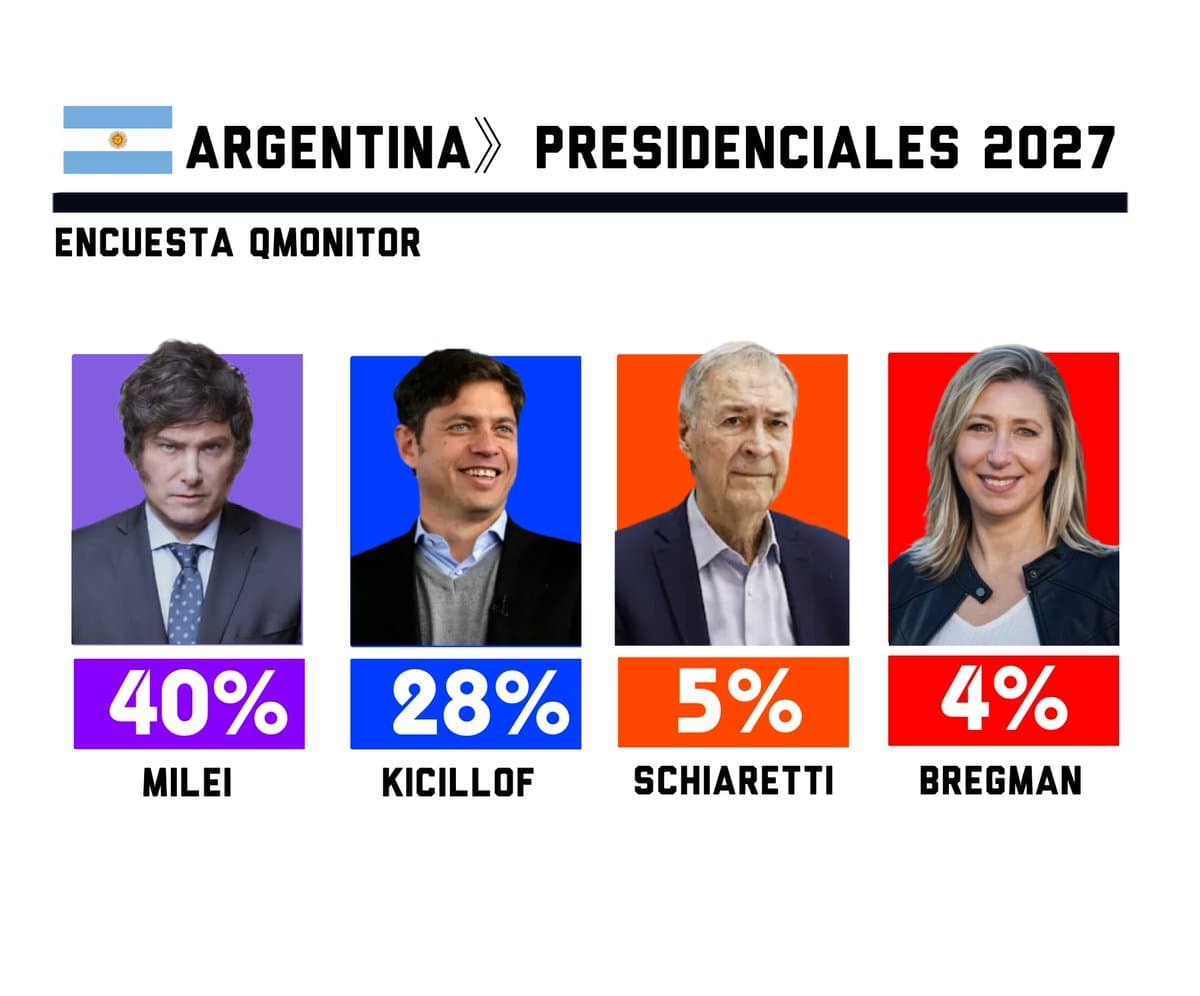
- Recent polls (QMonitor/Perfil, March 2026) show Milei leading at 40% in 2027 presidential vote intention, with Kicillof at 28%, Schiaretti at 5%, and Bregman at 4%.
- A separate survey showed an even wider gap: Milei at 60% vs Kicillof at 17%, though this appears to reflect a more favorable sample for the ruling party.
- Prediction market implied probabilities for a Peronist coalition winning a Senate majority in 2026 are estimated at 30-35%, while Milei's La Libertad Avanza maintaining or expanding its congressional bloc is priced at approximately 50-55% (estimated based on polling aggregation).
The Pichetto-Cristina alliance rumors have not yet significantly moved odds, but traders should watch for contract repricing if a formal coalition announcement materializes.
Scenarios and probabilities
- Base scenario (50% estimated probability): Pichetto's repositioning fails to generate meaningful electoral traction. The Peronist coalition enters the 2026 midterms fragmented, with Kicillof leading the Buenos Aires province ticket but lacking national coordination. Milei's bloc gains seats. Prediction market odds for Peronist majority remain below 35%.
- Bull scenario (20% estimated probability): Pichetto successfully bridges the moderate Peronist and Kirchnerist wings, forming a broad opposition coalition. Economic headwinds — inflation resurgence or currency pressure — erode Milei's support. Prediction markets reprice Peronist coalition odds above 45%, creating profitable long positions for early entrants.
- Bear scenario (30% estimated probability): The Pichetto video and similar contradictions become effective opposition research for Milei's coalition, further discrediting the Peronist brand. Kicillof's association with the "cepo economy" becomes a drag on the ticket. Prediction markets move Peronist odds below 25%, and Milei consolidation contracts spike.
Impact on prediction markets
Argentina's political prediction markets are uniquely volatile for several reasons that traders must account for. First, the Peronist movement's internal dynamics are notoriously fluid — alliances that seem impossible one month become official the next. Pichetto going from Macri's VP candidate to Cristina's potential ally in under seven years illustrates this perfectly. This means implied probabilities can shift 10-15 points on a single coalition announcement.
Second, the gap between the two major polls (Milei at 40% vs 60%) reveals significant methodological disagreement, which creates arbitrage-like opportunities for traders who can correctly model the likely electorate. The QMonitor survey showing 40-28 is generally considered more methodologically rigorous, suggesting markets pricing in the 60% figure may be overvaluing Milei's legislative prospects.
Third, Argentina's 12% "undecided" voter block is unusually large for this stage of the cycle, and these voters historically break toward Peronist candidates in midterm elections, a pattern that prediction markets often underprice until late in the campaign cycle.
Risks and what would invalidate this thesis
- Macro shock: A significant positive economic event — such as a successful IMF deal renegotiation or sustained peso stability — could solidify Milei's position beyond current polling and make Peronist coalition dynamics irrelevant to market pricing.
- Cristina legal factor: Cristina Kirchner's legal situation remains a wildcard. A conviction or disqualification could collapse the Kirchnerist wing entirely, making Pichetto's repositioning moot and forcing a complete remodel of Peronist coalition probabilities.
- U.S. intervention narrative: The Trump-Milei relationship has been cited as a factor in Argentine politics, with some observers noting U.S. financial support tied to Milei's economic program. A shift in U.S. policy could destabilize assumptions baked into current prediction market pricing.
- Provincial fragmentation: Argentina's midterm elections are heavily influenced by provincial dynamics. A strong Schiaretti candidacy in Córdoba or unexpected Peronist losses in Buenos Aires province could make national coalition narratives misleading for market positioning.
FAQ
When are Argentina's 2026 legislative elections? Argentina's midterm elections are scheduled for October 2026, when voters will renew half the Chamber of Deputies (127 seats) and one-third of the Senate (24 seats).
Why does Pichetto's alliance shift matter for prediction markets? Pichetto represents the moderate Peronist faction. His alignment with Kirchnerism signals a potential unified opposition front, which would significantly change the probability distribution for congressional race outcomes currently priced in prediction markets.
Can I trade Argentina election markets on Polymarket or Predik? Polymarket has historically listed Argentine political markets, particularly around presidential elections. Predik tracks political prediction markets across LATAM, including Argentine electoral dynamics. Specific contract availability varies by platform and timing relative to election dates.
Sources
- Polymarket — Political Prediction Markets
- El Duck Post — Original Video Source
- Perfil — QMonitor Poll Data (March 2026)
Track markets like this in real time on Predik.