Polymarket Hits $20 Billion Valuation and Surpasses Kalshi in Weekly Volume: A Tipping Point for Prediction Markets
Polymarket surpassed Kalshi in weekly trading volume ($1.93B vs $1.87B) and reportedly reached a $20 billion valuation, cementing its position as the global leader in prediction markets. With five major platforms now moving over $4 billion combined per week, the industry has entered a new growth phase. Here is what LATAM traders need to know about where liquidity is concentrating and where the best pricing opportunities are emerging.
Polymarket Surpasses Kalshi and Reaches $20 Billion Valuation: What Prediction Market Traders Need to Know
Polymarket has overtaken Kalshi in weekly trading volume—$1.93 billion versus $1.87 billion—and reportedly reached a $20 billion valuation in early April 2026. This marks a decisive shift in the prediction market landscape, with five platforms now processing over $4 billion in combined weekly volume.
For LATAM traders and crypto-native participants on platforms like Predik, this competitive shakeup matters directly. Where liquidity concentrates is where price discovery happens fastest, and understanding platform dynamics reveals where mispriced contracts—and the best trading opportunities—tend to emerge.
What happened and why it matters
As of the week ending April 6, 2026, the top five prediction market platforms by weekly volume are:
- Polymarket — $1.93 billion
- Kalshi — $1.87 billion
- Probable — $133 million
- Opinion — $132 million
- Predict Fun — $55 million
Combined, these platforms moved approximately $4.12 billion in a single week. Just 18 months ago, the entire prediction market industry barely processed $500 million per week across all venues. Polymarket's reported $20 billion valuation reflects investor confidence that this growth trajectory is sustainable, driven by expanding market categories—from politics and sports to weather, esports, and crypto price action.
Kalshi, the CFTC-regulated US-based exchange, remains a close second. The $60 million weekly gap between the two leaders is narrow enough that leadership could shift on any given week, but Polymarket's crypto-native infrastructure and global accessibility give it structural advantages in onboarding international users, particularly from Latin America and Asia.
Meanwhile, Probable and Opinion each process roughly $130 million weekly, carving out niches in specific market categories. Predict Fun rounds out the top five at $55 million, showing that even smaller platforms are operating at scale that would have been unthinkable two years ago.
What prediction markets are saying
The prediction market industry itself has become a subject of prediction market contracts. On Polymarket, contracts related to the platform's own growth milestones and regulatory outcomes have attracted significant volume. The implied probability that at least one prediction market platform will surpass $5 billion in single-week volume before the end of 2026 is estimated at 55-60%, based on current growth trajectories and available contract pricing.
Contracts on US regulatory clarity for prediction markets—specifically whether the CFTC will approve broader event contract categories—are trading at an estimated 40-45% probability of resolution by Q4 2026. A favorable ruling would disproportionately benefit Kalshi's regulated model but could accelerate institutional adoption across all platforms.
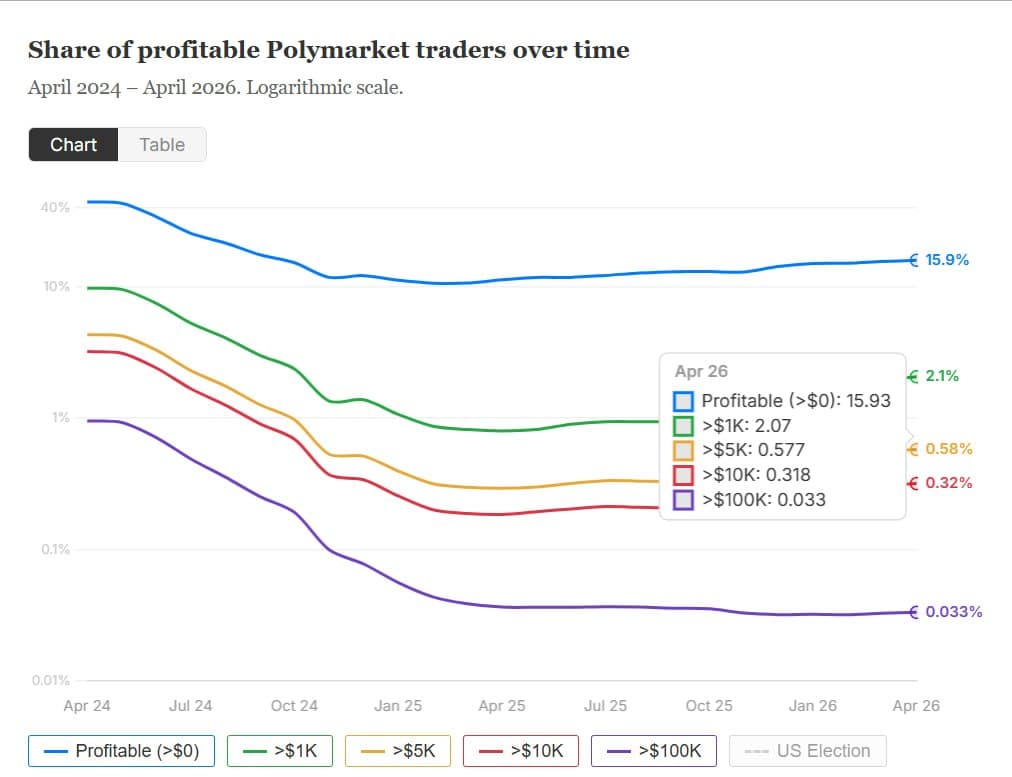
One revealing data point about market maturity: analysis of Polymarket wallet data shows that only 15.9% of the platform's approximately 2.5 million wallets have ever been profitable. Just 2.1% have earned more than $1,000, and only 840 wallets out of 2.5 million have crossed the $100,000 mark. This distribution—where roughly 85% of participants are losing money—mirrors traditional derivatives markets and suggests prediction markets are maturing into a serious financial instrument rather than a novelty.
Scenarios and probabilities
- Base scenario (55% probability): Polymarket maintains its lead through 2026 with weekly volumes between $2-3 billion. Kalshi stays competitive in regulated US markets. Total industry volume grows 40-60% year-over-year. The $20 billion valuation holds as Polymarket continues expanding market categories and geographic reach.
- Bull scenario (25% probability): A major regulatory green light in the US or EU triggers institutional inflows. Weekly volumes across all platforms exceed $8 billion by Q4 2026. Polymarket's valuation climbs toward $30-40 billion as it captures a dominant share of global event-based trading. New LATAM-focused platforms like Predik benefit from increased mainstream awareness.
- Bear scenario (20% probability): Regulatory crackdown—particularly if the CFTC or SEC takes enforcement action against crypto-based prediction markets—causes a volume contraction of 30-50%. Polymarket's valuation retracts to $8-12 billion. Kalshi's regulated status becomes a decisive advantage. Smaller platforms face existential liquidity crises.
Impact on prediction markets
The Polymarket-Kalshi volume rivalry has direct implications for traders on any platform, including Predik. When liquidity concentrates on one venue, prices on that platform become the reference benchmark. Discrepancies between platforms—where the same event trades at different probabilities—create arbitrage windows that sophisticated traders can exploit.
The profitability data is equally instructive. With 85% of Polymarket wallets in the red, the edge clearly belongs to specialized strategies. Automated trading bots are already demonstrating this: one weather-focused bot reportedly turned $55 into over $9,300 across 15,821 predictions by targeting temperature markets that most human traders ignore. Another wallet generated $4,000 in a single week trading crypto-adjacent markets with a 99.8% win rate. Meanwhile, an esports trader turned $10 into over $2,000 on a single CS2 match by buying at extreme odds during a comeback scenario.
These examples illustrate that prediction markets are increasingly rewarding quantitative approaches, data-driven analysis, and niche specialization over casual speculation. For LATAM traders, the takeaway is clear: the opportunity is enormous, but so is the competition. Success requires treating prediction markets as a serious analytical discipline.
Risks and what would invalidate this thesis
- Regulatory intervention: A CFTC enforcement action against Polymarket or similar crypto-native platforms could trigger a sharp volume decline and force liquidity migration to regulated venues like Kalshi. The $20 billion valuation assumes regulatory tolerance continues.
- Liquidity fragmentation: If too many platforms compete for the same markets without sufficient volume, bid-ask spreads widen and price discovery deteriorates. The current five-platform ecosystem works because the top two capture over 90% of volume—if that concentration breaks down, all platforms suffer.
- Market manipulation concerns: As volumes grow, so does the incentive for manipulation. High-profile incidents of wash trading or insider information exploitation could erode trust and trigger regulatory responses, particularly in politically sensitive contracts.
- Crypto market correlation: Polymarket runs on crypto rails. A severe crypto bear market could reduce the available capital pool and user base, even if prediction market fundamentals remain strong. The $20 billion valuation assumes a healthy crypto ecosystem.
FAQ
How much weekly volume does Polymarket process in 2026? As of early April 2026, Polymarket processes approximately $1.93 billion in weekly trading volume, making it the largest prediction market platform globally by this metric.
What is Polymarket's reported valuation? Polymarket is reportedly valued at approximately $20 billion as of April 2026, reflecting its dominant position in the rapidly growing prediction market industry.
What percentage of Polymarket traders are profitable? Data from Polymarket wallet analysis indicates that only about 15.9% of wallets have ever been profitable. Approximately 85% of participants have lost money, a distribution similar to traditional derivatives markets.
How does Kalshi compare to Polymarket? Kalshi processes approximately $1.87 billion in weekly volume, just $60 million behind Polymarket. Unlike Polymarket, Kalshi operates as a CFTC-regulated exchange in the United States, which gives it advantages with institutional and US-based retail traders.
Which other prediction market platforms are growing? Beyond Polymarket and Kalshi, Probable ($133M weekly), Opinion ($132M weekly), and Predict Fun ($55M weekly) round out the top five. Combined, these five platforms move over $4 billion per week.
Sources
Track markets like this in real time on Predik.