Wall Street's Trillion-Dollar Rally in Q2 2026: Floor or Bull Trap?
Wall Street kicked off Q2 2026 by adding $1 trillion in market cap in a single session, reversing a brutal Q1 dominated by tariff panic, the Strait of Hormuz crisis and a crypto crash. Prediction markets are split on whether this is a confirmed bottom or a bull trap before more turbulence — and the answer matters directly for LATAM capital flows, FX and commodity exporters.
Wall Street's Trillion-Dollar Rally in Q2 2026: Is This the Bottom or a Bull Trap?
Wall Street's trillion-dollar rally in Q2 2026 wiped out most of Q1's tariff-driven losses in a matter of weeks, but prediction markets still price US recession odds well above historical averages. The base case on Polymarket and Kalshi treats the rebound as a relief rally inside a fragile regime, not a confirmed floor.
For LATAM retail and crypto-native traders, this is not an abstract Wall Street story. A sustained Q2 rebound historically drags emerging-market equities, compresses sovereign risk spreads and supports commodity-linked currencies. A failed rally does the opposite — fast.
What happened and why it matters
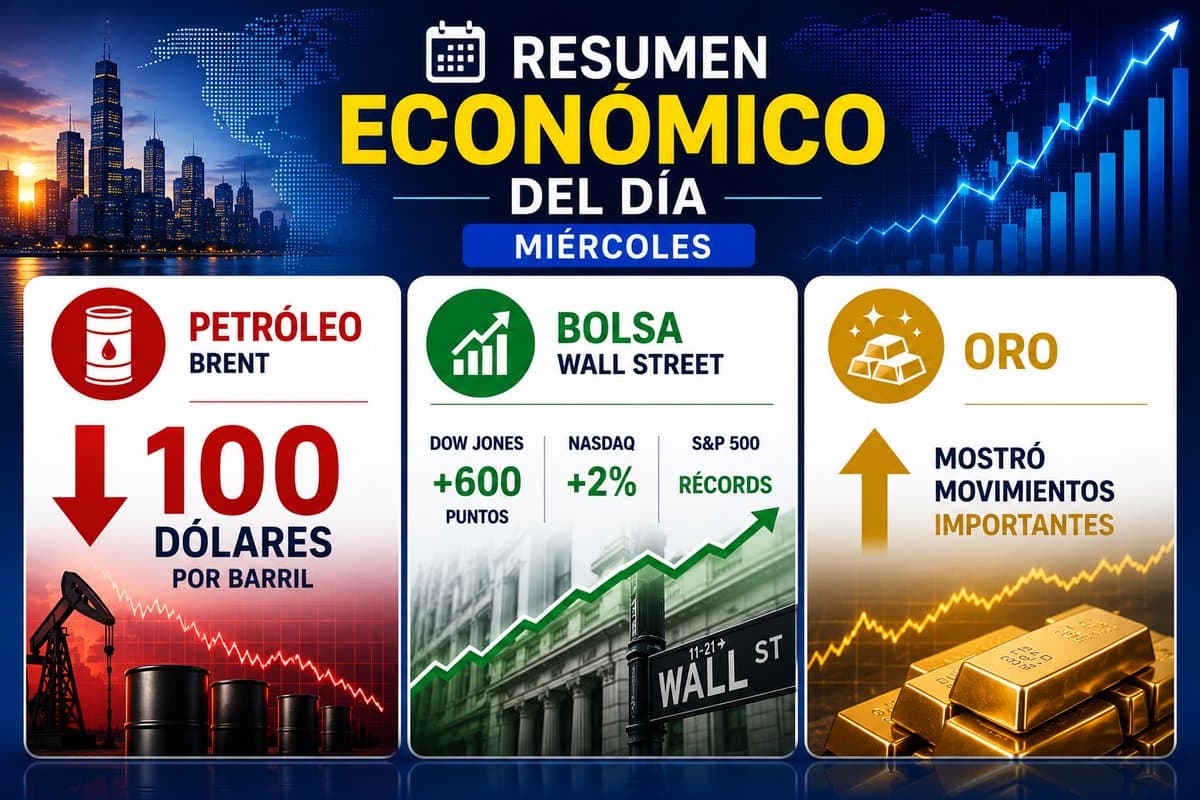
US equities opened Q2 2026 with one of the largest single-day market-cap expansions on record, adding roughly $1 trillion in valuation across the S&P 500 in one session. The Nasdaq printed fresh highs in early May, with semiconductors leading: the SMH ETF advanced more than 3% on May 5, growth names followed, and by May 6 the Dow closed up around 600 points with the Nasdaq up roughly 2%. Brent crude hovered near $100 per barrel as Middle East diplomacy showed tentative progress.
The backdrop matters: Q1 2026 was defined by the Trump tariff shock in April, the Strait of Hormuz crisis pushing oil higher, and a parallel crypto drawdown. The Q2 reversal is sharp enough that the "trillion-dollar club" of US mega-caps has visibly expanded again, and Bitcoin spot ETFs pulled in roughly $1.97 billion in April 2026 — the strongest month of the year, led by BlackRock's IBIT.
What prediction markets are saying on the Q2 2026 Wall Street rally
On Polymarket and Kalshi, contracts tied to a US recession in 2026 are still pricing meaningful tail risk — roughly 30–40% implied probability (estimated), down from the 50%+ readings seen at the April tariff lows but well above the ~15% base rate of a typical year. Markets on the S&P 500 closing Q2 above its Q1 high are trading around 55–60% (estimated), consistent with a "rally believed, but not trusted" regime. Contracts on further Fed rate cuts in 2026 have re-tightened as growth data stabilizes.
Scenarios and probabilities for Q2 2026
- Base scenario (≈55%): The rally extends but choppily. The S&P 500 ends Q2 modestly above Q1 levels, recession odds drift down toward 25–30%, and LATAM ADRs and sovereign bonds continue grinding higher as risk premia compress.
- Bull scenario (≈25%): Tariff de-escalation is confirmed, Middle East tensions cool further, and the Fed signals cuts. Wall Street prints new all-time highs, Bitcoin spot ETF inflows accelerate past $3 billion/month, and LATAM equities and currencies see a strong inflow cycle.
- Bear scenario (≈20%): The rally proves to be a bull trap. A second tariff escalation, an oil shock above $110, or a credit-event surprise drives the S&P back toward Q1 lows, recession odds re-spike above 45%, and LATAM risk assets give back most of the May gains.
Impact on prediction markets and LATAM
Prediction market prices on US macro outcomes have become a real-time barometer for LATAM traders. When recession contracts compress, Argentine ADRs, Brazilian equities and Mexican peso volatility tend to follow within days. The May rebound is already visible locally: Argentine country risk has perforated the 500 basis-point level for the first time in months, ADRs of names like YPF have outperformed the local Merval significantly in dollar terms in 2026, and dollar-denominated sovereign bonds across the region have rebounded alongside the global risk-on tone.
The interpretation risk is straightforward: a single trillion-dollar session is a price event, not a regime change. Position sizing should reflect that prediction market implied probabilities still embed substantial downside tail risk.
Risks and what would invalidate this thesis
- A renewed tariff escalation in late Q2 2026, especially targeting China or the EU, that resets equity multiples lower.
- Oil sustaining above $105–110 per barrel on Middle East flare-ups, squeezing margins and reviving stagflation pricing.
- A US credit or labor-market deterioration that pushes Polymarket/Kalshi recession odds back above 45% and triggers a fresh LATAM outflow cycle.
FAQ
How much did Wall Street add in market cap at the start of Q2 2026? Roughly $1 trillion in a single session, with the Nasdaq printing fresh highs and semiconductors leading via a 3%+ move in the SMH ETF.
What do prediction markets say about a US recession in 2026? Implied probabilities on Polymarket and Kalshi sit around 30–40% (estimated) — elevated versus history, but down from the April tariff-shock peak.
Why does this matter for LATAM traders? A sustained Wall Street rebound compresses country risk and lifts ADRs and sovereign bonds. Argentina's country risk has already perforated 500 basis points, and YPF ADRs are up over 22% year-to-date in 2026 while the local Merval is down in dollar terms.
Sources
Track markets like this in real time on Predik.