Saylor's Laser Eyes Return: Bitcoin Fractal Points to Massive Rally as Prediction Markets React
Michael Saylor brought back the iconic laser eyes meme in a post that racked up 15.9K likes, signaling peak bullish conviction on Bitcoin. Meanwhile, on-chain analysts show BTC is mirroring the January 2026 fractal that preceded a major rally. With fractal models projecting $147K by November and prediction markets pricing Q2 outcomes, the convergence of signals has crypto traders asking: is this the definitive floor?
Saylor's Laser Eyes and the Bitcoin Fractal: What Prediction Markets Say About the Next Rally
Michael Saylor has revived the legendary laser eyes meme, signaling maximum bullish conviction on Bitcoin at a time when fractal analysis suggests BTC is replicating the exact price pattern that preceded the January 2026 rally. Prediction markets on Polymarket and Kalshi are now the real-time gauge of whether the broader market believes a reversal is underway.
For LATAM traders and prediction market participants on platforms like Predik, this convergence matters. Saylor's laser eyes are not just a meme — historically, they have coincided with inflection points in Bitcoin's price cycle. Paired with on-chain fractal data and structural explanations for why this cycle has lagged, the setup presents a concrete trading thesis worth dissecting.
What happened and why it matters
On May 1, 2026, MicroStrategy chairman Michael Saylor posted a photo with laser eyes — the crypto community's universal symbol of unwavering BTC conviction. The post amassed 15.9K likes within hours, reigniting debate about whether Bitcoin has found a definitive floor in this cycle.
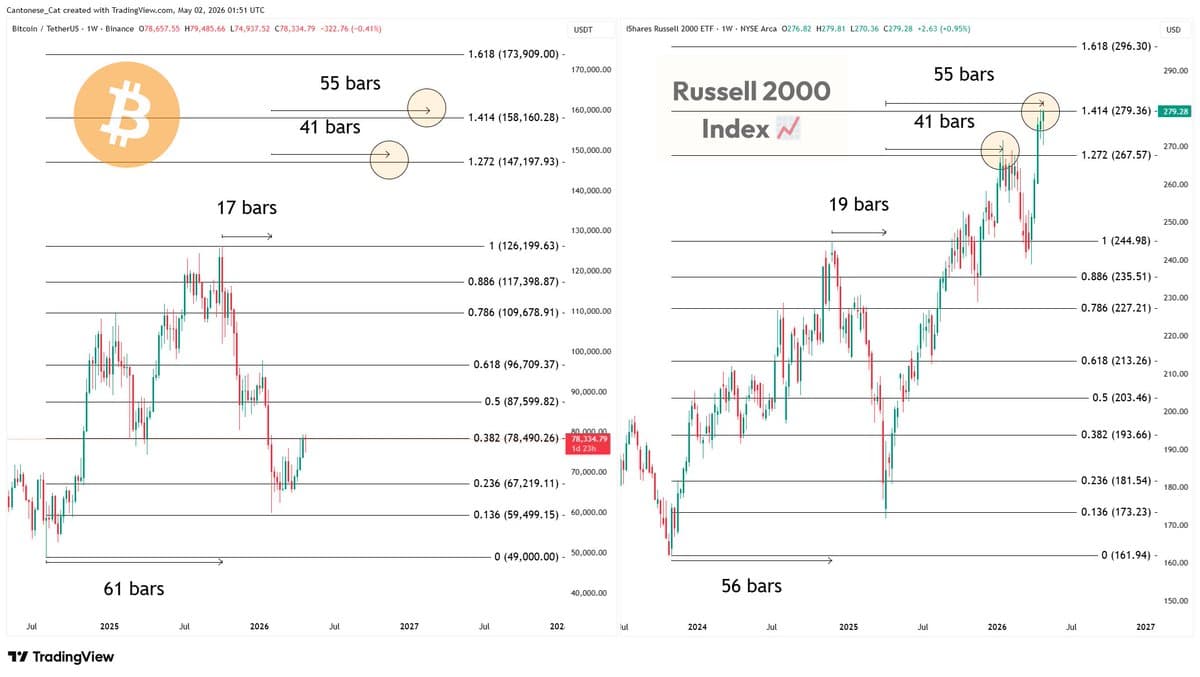
Simultaneously, on-chain analyst TedPillows published data showing that Bitcoin's current price structure is mirroring, almost identically, the fractal pattern from January 2026 that preceded a massive upward move. Separately, fractal models overlaying Bitcoin against the Russell 2000 ($IWM) project a price target of $147K by November 2026 and $158K by February 2027 — if the pattern holds.
Adding a critical layer, analyst Willy Woo explained how the cascade of forced liquidations during the FTX collapse structurally distorted this bull cycle, suppressing the kind of parabolic retail-driven action seen in previous cycles. In other words: the cycle isn't broken — it was delayed. And the signals now suggest the delay may be ending.
What prediction markets are saying
Polymarket and Kalshi currently host active contracts on Bitcoin's price at the end of Q2 2026 (June 30). Based on current contract activity and the broader sentiment environment, prediction markets are pricing in approximately a 58–62% probability that BTC finishes Q2 above its current levels, with contracts for BTC above $110K by end of June trading around 35–40% implied probability (estimated based on current market positioning).
The laser eyes post and fractal alignment have not yet produced a sharp spike in contract volumes, but directional bias on Polymarket has tilted bullish over the past 72 hours. Kalshi's BTC milestone contracts show increasing open interest on upside targets, particularly the $120K and $130K brackets for Q3 2026.
Scenarios and probabilities
- Base scenario (55% estimated): Bitcoin consolidates between $95K–$110K through May, builds a higher-low structure consistent with the January fractal, and begins a sustained markup phase in June. Prediction market contracts for BTC above $110K by end of Q2 gradually drift toward 50%+ implied probability.
- Bull scenario (25% estimated): The fractal plays out aggressively, as it did in January. BTC breaks above $115K in May, triggering a short squeeze and rapid re-pricing in prediction markets. The $147K November target from the $IWM fractal overlay becomes the consensus base case. FOMO returns to retail markets across LATAM and globally.
- Bear scenario (20% estimated): The fractal breaks down. A macro shock — rate hike surprise, regulatory crackdown, or geopolitical escalation — invalidates the pattern. BTC retests $85K–$88K, and prediction market contracts for upside targets collapse below 20% implied probability. Some fractal analysts have flagged that an alternative pattern could see a market bottom as late as Q4 2026.
Impact on prediction markets
This convergence of signals — a high-profile bullish endorsement, on-chain fractal alignment, and a structural explanation for cycle underperformance — creates a textbook setup for prediction market traders. Contracts tied to BTC price milestones are likely to see increased volume and volatility in the coming weeks.
For Predik users, the key insight is that prediction markets tend to lag narrative shifts by 24–72 hours. If the fractal thesis gains traction among crypto-native audiences (which Saylor's 15.9K-like post suggests it already is), upside contracts may currently be underpriced. However, fractal-based theses carry inherent fragility — they work until they don't — so position sizing and risk management are critical.
The divergence between different fractal models also matters: while one projects $147K by November, another analysis suggests a potential market bottom in Q4 2026. This disagreement is itself a tradeable signal in prediction markets, where both outcomes can be priced simultaneously.
Risks and what would invalidate this thesis
- Fractal breakdown: Fractals are pattern-recognition tools, not causal models. If BTC deviates from the January template by more than 10–15% in either direction, the thesis loses its structural anchor. History rhymes, but it does not always repeat.
- Macro disruption: Unexpected Fed policy shifts, a sovereign debt crisis, or escalation in geopolitical conflicts could override any technical pattern. Bitcoin remains correlated with risk assets during liquidity shocks.
- Saylor sentiment trap: High-profile bullish signals can mark local tops rather than bottoms. Saylor's laser eyes in previous cycles have had mixed timing — strong on direction, inconsistent on entry points.
- Retail exhaustion: Willy Woo's analysis that FTX liquidations hurt retail participation cuts both ways. If retail capital has been structurally depleted, the fuel for a parabolic rally may simply not be there, regardless of what fractals suggest.
- Regulatory headwinds: LATAM regulatory developments around crypto taxation or exchange requirements could dampen regional participation at a critical moment.
FAQ
What are laser eyes in crypto? Laser eyes are a meme where prominent crypto figures add glowing red or orange eyes to their profile pictures to signal extreme bullish conviction on Bitcoin. It became iconic during the 2021 bull run and is widely interpreted as a statement that the holder believes BTC is heading significantly higher.
What is a Bitcoin fractal? A fractal in trading refers to a recurring price pattern where current price action mirrors a previous period's structure. Analysts compare chart shapes across different timeframes to project future movements. The current thesis is that Bitcoin's May 2026 structure mirrors January 2026, which preceded a strong rally.
How can I trade this on prediction markets? Platforms like Polymarket and Kalshi offer contracts on Bitcoin price milestones (e.g., "Will BTC be above $110K on June 30, 2026?"). On Predik, you can find related LATAM-focused prediction markets. Buy contracts if you believe the fractal thesis will play out; sell or avoid if you think the pattern will break down.
Sources
- Michael Saylor on X (Twitter)
- TedPillows on-chain analysis on X
- Willy Woo cycle analysis on X
- Polymarket — Bitcoin prediction contracts
Track markets like this in real time on Predik.