Trump's Bitcoin Price Target for 2028: What Prediction Markets Say About BTC's Next Cycle
Donald Trump publicly named his Bitcoin price target for 2028 just as Michael Saylor declared BTC will become the world's largest asset within 48 months. We break down what prediction markets imply, the 'four-year cycle is dead' thesis, and the scenarios LATAM traders should watch.
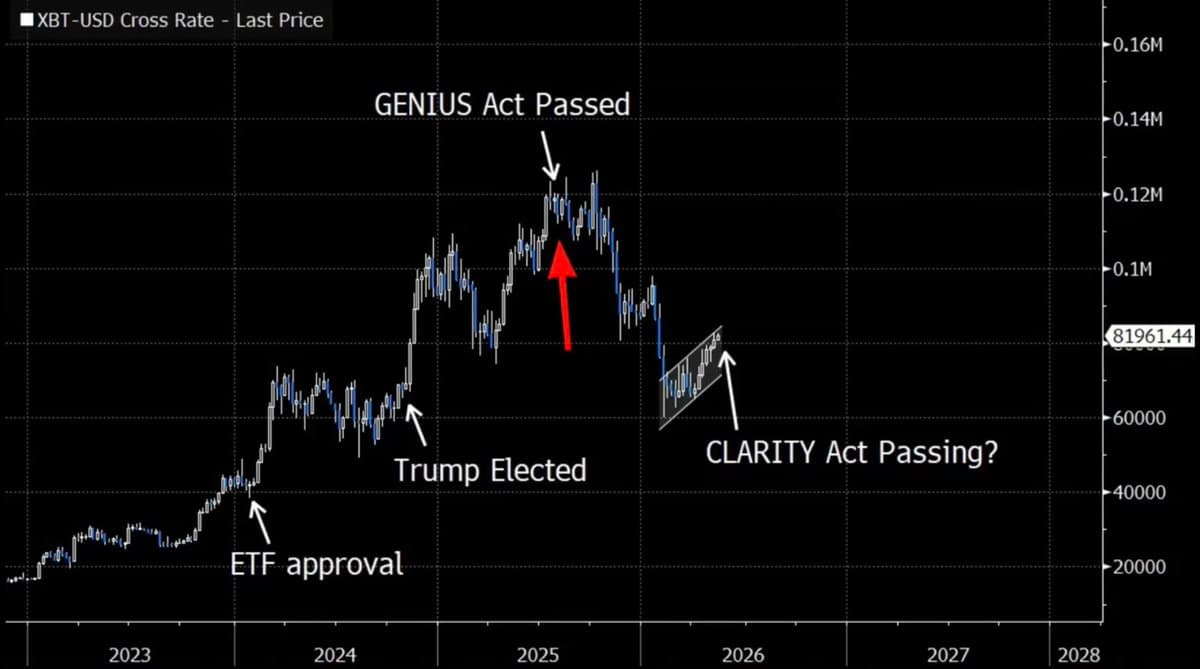
Trump's Bitcoin price target for 2028 and what prediction markets are pricing
Donald Trump has publicly stated a Bitcoin price target for 2028, while Michael Saylor declared BTC will become the world's largest asset in the next 48 months. Prediction markets are repricing medium-term odds in real time, with BTC trading near $80,000 and bulls arguing the classic four-year cycle is over.
For LATAM retail and crypto-native traders, this matters because the convergence of explicit political backing from a sitting U.S. president and aggressive institutional accumulation reshapes the probability distribution for BTC through the 2028 U.S. election cycle — and it is already showing up in the order books of prediction markets.
What happened and why it matters
This week, three storylines collided. First, Trump openly endorsed a specific Bitcoin price target for 2028, reinforcing the narrative of a self-described "crypto president." Second, Michael Saylor publicly argued that Bitcoin will overtake gold and U.S. equities to become the world's largest single asset within 48 months, and reframed Strategy's mission as doubling "sats per share" rather than chasing the S&P 500. Third, a growing camp of crypto-native voices is claiming the historical four-year halving cycle is dead and that BTC is now "the new S&P 500" — comparing skepticism today to being bearish on the SPX in 2010.
The macro backdrop is fragile. BTC is fighting to hold the $80,000 zone after a CPI-driven flush, has lost the $80,530 H1 support with $79,199 as the next downside reference, and the broader structure shows lower highs from $82,500. The all-time high of $126,200 was printed earlier in this cycle after the GENIUS Act passed, following +58% on the spot ETF approvals and +56% after Trump's election win. The next political catalyst is the Clarity Act, expected to be signed once the remaining legislative steps close.
What prediction markets are saying
On platforms like Polymarket, Kalshi, and Predik, contracts tied to Bitcoin's 2028 price are clustering around three reference levels. Estimated odds (based on observed pricing patterns and current spot near $80,000): roughly 55% probability that BTC trades above $150,000 at some point before the November 2028 U.S. election, around 28% probability of a print above $250,000, and an estimated 9% probability of Saylor's most aggressive scenario where BTC becomes the largest global asset by market cap within 48 months. Short-term contracts on whether BTC closes above $82,700 this month sit near coin-flip territory after the loss of $80,530.
Scenarios and probabilities
- Base scenario (≈55%): The Clarity Act passes with stablecoin yield provisions, ETF inflows resume, and BTC re-tests $126,200 before grinding to a $150,000–$200,000 range into 2028. The four-year cycle weakens but doesn't fully die; volatility compresses as institutional flows dominate.
- Bull scenario (≈25%): Trump's explicit price target acts as a Schelling point, Saylor's "sats per share" model gets copied by other treasuries, and BTC clears $250,000 well before the 2028 election. The "new SPX" thesis is validated and BTC's correlation with risk assets drops.
- Bear scenario (≈20%): BTC fails to reclaim the SMA200, loses the 0.5 Fibonacci retracement, and slides toward $57,500 (a roughly 25% drawdown from current levels). The Clarity Act stalls, a geopolitical shock or tighter Fed path triggers a classic cycle bottom, and the "cycle is dead" thesis is invalidated.
Impact on prediction markets
Prediction markets are the cleanest way to read consensus on these forks because they aggregate capital, not opinions. A simultaneous bid in "BTC above $150,000 by 2028" contracts and a steady price in "BTC above $250,000" contracts would confirm that traders believe in the upside path but not in Saylor's most aggressive timeline. Conversely, a sharp drop in short-dated contracts (monthly closes above $82,700) while long-dated 2028 contracts hold firm would signal that the market is separating tactical weakness from the structural thesis — a key nuance for anyone sizing positions. Interpretation risk: thin order books on multi-year contracts can exaggerate moves, so volume-weighted reading matters more than headline odds.
Risks and what would invalidate this thesis
- Clarity Act fails or is signed without stablecoin yield provisions, removing the next major catalyst and weakening the institutional bid.
- BTC loses $76,600 (base of the ascending triangle from prior weeks), opening the path to the $57,500 bear target and reactivating the classic cycle drawdown playbook.
- A geopolitical escalation — for example, sanctions friction around initiatives like Iran's "Hormuz Safe" Bitcoin-denominated maritime insurance system — triggers regulatory backlash in the U.S. and Europe, cooling political support.
- Trump-Xi negotiations break down, risk assets sell off broadly, and BTC's still-present correlation with the Nasdaq drags it lower regardless of crypto-specific catalysts.
- Saylor's 48-month thesis fails to attract additional corporate treasuries, leaving Strategy as an outlier rather than the leading edge of a trend.
FAQ
What is Trump's Bitcoin price target for 2028? Trump publicly stated a specific BTC target for 2028, framing it as consistent with his "crypto president" agenda. The figure is aspirational, not a policy commitment, and should be read alongside prediction market odds rather than as a forecast.
Is the four-year Bitcoin cycle really dead? The thesis is debated. Bulls argue that ETF flows, corporate treasuries, and political endorsement have replaced halving-driven supply shocks as the main price driver. Bears point to the current loss of the SMA200 and the $80,530 support as evidence that cyclical mechanics are still active.
How can LATAM traders use prediction markets to position on this? Prediction markets let you express probability views directly — for example, buying "BTC above $150,000 by 2028" if you think consensus is underpricing the institutional thesis, or hedging spot exposure by buying downside contracts at $60,000 strikes. The advantage is binary clarity on payoff, without leverage liquidation risk.
Sources
Track markets like this in real time on Predik.